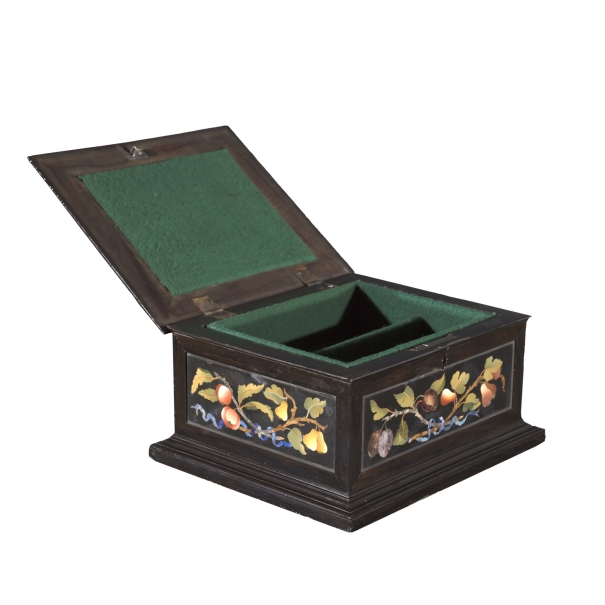
Semiprecious-stone box
1650 - 1700. Ebony wood, Hardstone.Not on display
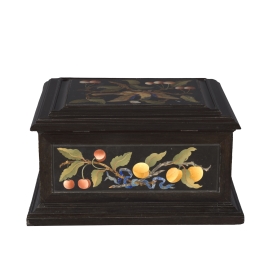
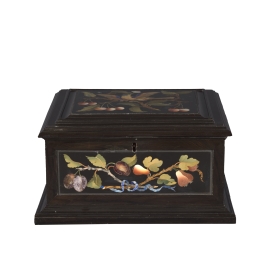
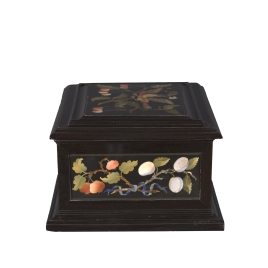
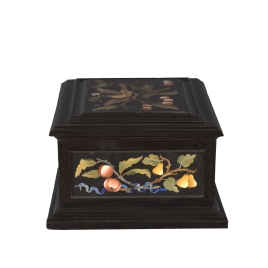
Florentine Mosaic is a technique in which semiprecious stones are cut and assembled so that their different colors and grains form a pictorial composition. This term reflects the fact that the technique emerged in 16th-century Florence with a degree of perfection that has since been equaled, but never surpassed. Its origins undoubtedly lie in classic mosaic—Roman opus sectile—as the technique is essentially the same, except that the artist cuts and carves the stones to the desired shape, taking advantage of their natural color variations. This new stone-inlay technique was intimately linked to the Medici family. The stones employed for their hardness and colors—mainly different types of quartz, chalcedony, jade, agate, porphyry, onyx, lapis-lazuli, malachite, petrified wood and mother-of-pearl—are chosen and arranged in order to bring out their natural qualities, with careful carving and perfect polishing. This piece is a rectangular ebony box with a flat top and smooth moldings on the base and top. Each of the four sides and the top bear decorative semiprecious-stone plaques on which two brightly colored branches with cherries and peaches tied with an artistic bow stand out against a black background. The top has a cherry branch at the center of which a bird with spread wings perches, turning its head to catch a butterfly. Both the branches, the form of the bow, the technical peculiarities and the subject of a bird with a butterfly appear frequently in all sorts of variations in Florentine works. The most outstanding and important examples are the plaques and furniture that adorn the Florentiner Zimmer at Schloss Favorite, a castle in Baden-Baden, south of Karlsruhe, built at the behest of the Margravine Sibylla Augusta (1675-1733) (Text from De Ceballos-Escalera, I.; Braña de Diego, M.: Catálogo del Legado Fernández Durán. Artes Decorativas, 1974, p. 102).