Solomon
Ca. 1525. Oil on panel.Not on display
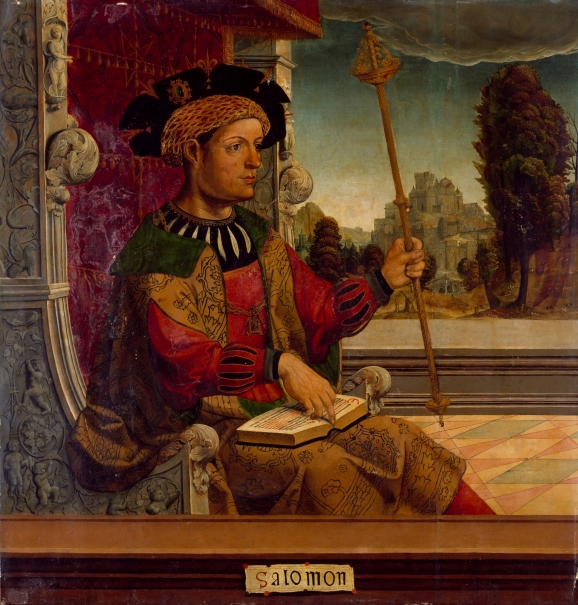
This painter is one of the most outstanding and unique representatives of the First Renaissance in Palencia. Even though there is no record of any document that confirms it, he might have been somehow connected to John of Flanders (doc. 1496–1519) during his time working in Palencia (1509–19) judging from how he portrayed landscapes and the models he used for his figures, which were strongly dependent on those by John of Flanders. He also was influenced by Pedro Berruguete (c.1445/1450–1503), but only in some specific compositional schemes, such as the depiction of a prophet seated on a predella before a parapet, which is the case in this painting. Besides the influence of John of Flanders and of Berruguete to a lesser extent, the Master of Becerril was also receptive to the influence of Italian art, to which he would have had indirect access through engravings. Evidence of this can be found in the Renaissance architecture he liked to include in his paintings, in which he usually added sculptures or reliefs with a symbolic meaning.
Due to his strong dependence on John of Flanders, in 1947 Post even considered that they could have been father and son. Conversely, in 1937, Angulo made an unfounded assertion that he may have been identified with Juan González Becerril, Pedro Berruguete’s son-in-law, documented in 1498 in Toledo, where he continued to work. Neither can he be associated with García Ruiz, documented in Palencia in 1533, ‘who came from Paredes de Nava’, as Joaquín Yarza inferred in 1987, although this is more likely to be accurate. Since the identity of the painter from Palenca has yet to be correctly ascertained, he was given a conventional name. Master of Becerril was the option chosen from one of his most remarkable and renowned works: The High Altarpiece of the church of San Pelayo de Becerril de Campos in Palencia, no longer installed in situ. The body of the altarpiece and two panels of the predella with the figures of Saint Catherine and Saint Agatha were acquired by the cathedral of Málaga, where the work is currently located in the chapel of the Sacred Heart, to the side of the Epistle.
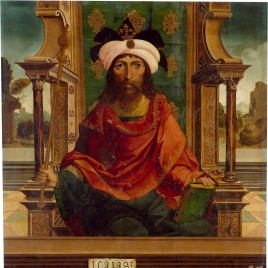
When they were in the Adanero Collection in 1937, Diego Angulo Íñiguez brought to light these four panels of prophets that belong to an altarpiece predella and whose original destination is unknown. They are major pieces among the painter’s production, since he achieves his greatest successes in those works where only one figure is portrayed, as is the case in this painting. So much so that, when Angulo mentioned the Master of Becerril in 1937 and in subsequent essays, he even asserted that ‘if he would have known how to maintain his own level when it comes to painting individual characters, his position within our Renaissance painting would have been significantly higher’.
The four prophets in the Prado (Solomon, Isaiah, Ezequiel and David) are solid evidence of the artist’s interest in Renaissance architecture, visible in the rich thrones where the prophets are seated. Solomon’s and David’s thrones are foreshortened, as they are each placed at the end of the predella, whereas the others’ are depicted frontally. Proof of the artist’s appreciation of landscape is in this painting (as in many others): he set the figures before a landscape background – which back then was called the los lejos in contemporary documents – as opposed to Berruguete’s layouts that almost persistently rendered gilded brocade backgrounds. These conventions were consistent with the preferences of the period in which each artist developed his work: Berruguete until 1503, and the Master of Becerril between 1520 and 1535. The Master of Becerril’s human models that were used to represent the four prophets, particularly David, his mode of transcribing the landscape in these four panels demonstrate the profound debt he had incurred with John of Flanders. Several elements recall the work of the Flemish artist: the derelict buildings, the shapes of the rocks that evoke Mantegna’s style, the scattered gemstones that allude to paradise, and motifs including the wax seal with which the phylactery with the prophets’ names is attached, as John of Flanders did with Christ’s ‘INRI’ in The Crucifixion, in the main altarpiece in the cathedral of Palencia, located in the Museo del Prado since 2005.
Museo Nacional del Prado, Memoria de actividades 2009, Madrid, Museo Nacional del Prado, 2009, p.22-23