formularioRDF
The itinerary <em>TITULORECORRIDO</em> has been successfully created. Now you can add in works from the Collection browser
<em>TITULOOBRA</em> added to <em>TITULORECORRIDO</em> itinerary

Close Continuar a ficha de la obra Continuar a ficha de la obra
02-06-2026
Willem Claesz Heda

Haarlem, 1594 - Haarlem, 1680

See author's file

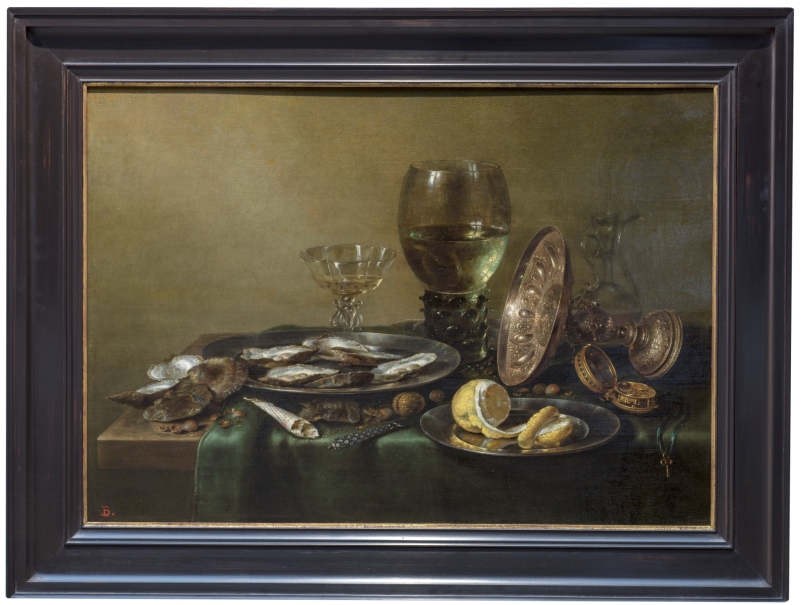
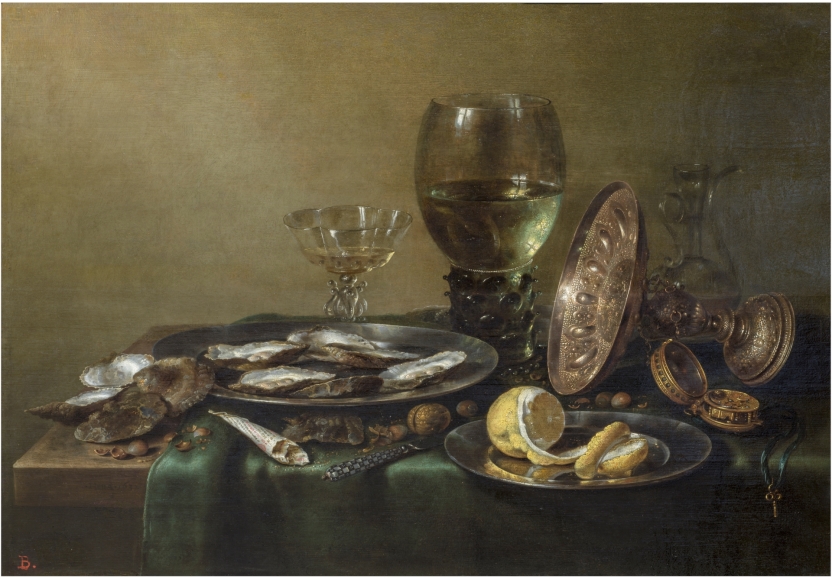
Still Life with a silver "tazza", a roemer and oysters

1632. Oil on baltic oak planks.
Room 076

The painting belongs to the type of still life designated by Vroom as monochrome banketjes, pieces first executed by Heda towards the end of the 1620s that became very popular in the Netherlands and abroad, as illustrated by the fact that there were two in the inventory of Rubens´s property. There are sufficient grounds to interpret these compositions as moralising, religious or allegorical works. In addition, they also presented an opportunity for the painter to demonstrate his skill with perspective and his mastery in portraying the reflection of light on different kinds of surfaces, textures and shapes.

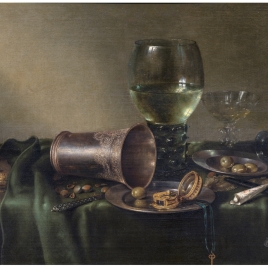
Still Life with a silver tazza, a roemer and oysters combines all the compositional and stylistic devices typical of these banketjes which, despite their apparent spontaneity, are carefully meditated and highly balanced arrangements. Lined up in two diagonal axes parallel to the background, the objects and food habitual in this kind of representation are depicted on a table placed in the plane closest to the viewer and against a neutral wall. In this case -as with the Prado´s other two Heda still lifes (P2754 and P2755)- the table is only covered with a green cloth, rather than the white napkin or tablecloth frequently found in most of the painter`s works of this genre. The light both illuminates and shapes the objects and the food. It enters, top left, through a window that is outside the painting, but which is reflected in the Roemer glass containing white wine. The objects reveal a range of textures and share the same rounded shapes, linked to one another in a rhythmic combination of contrasting curves over which the light softly glides, glistening or gleaming according to the surface on which it is reflected.

The yellow of the lemon and the pearly white of the oysters are the only concession to local colour, and serve as counterpoint to the monotone range of greenish and grey-brown shades that prevail in this kind of still life.

In addition to the Roemer glass -the main feature of all these monochrome table-top still lifes- the other objects depicted here only appear in the works that have been identified and accepted as Heda´s until the mid-1630s, after which they seem to disappear. The Façon-de-Venise glass is the same as the one represented in Still Life with a silver beaker and a clock (P02755), dated 1633. The knife, too, appears in the latter and in Still Life with beer-pitcher and orange (P02754), dated 1633. Finally, the clock, which is also present in these two works, features as well in two earlier still lifes, dated 1629 (The Hague, Mauritshuis) and 1631 (Dresden, Gemäldegalerie Alte Meister). Where the food is concerned, this and another still life, also dated 1632, seem to be the first to include oysters.

Posada Kubissa, Teresa, Pintura holandesa en el Museo Nacional del Prado. Catálogo razonado, Madrid, Museo Nacional del Prado, 2009, p.65-67
Multimedia

Technical data

Imagen del carrusel
Imagen del carrusel
Inventory number
P002756
Author
Willem Claesz Heda
Title
Still Life with a silver "tazza", a roemer and oysters
Date
1632
Technique
Oil
Support
Baltic oak planks
Dimension
Width: 73 cm; Height: 52 cm
Provenance
Bequest of Pedro Fernández Durán y Bernaldo de Quirós, 1931
Entry date
1931

Bibliography +

Vroom, Nicolaas Rudolph Alexander, Des Schilders Van Het Monochrome Banketje, Kosmos, Amsterdam, 1945, pp. 55-87.

Sánchez Cantón, Francisco Javier, Museo del Prado. Catálogo de las pinturas, Museo del Prado, Madrid, 1972.

Valdivieso, Enrique, Pintura Holandesa del siglo XVII en españa, Universidad, Valladolid, 1973.

Vroom, N.R.A., A Modest Message As Intimated by the Painters of the Monochr, II, Interbook International B.V., Schiedam, 1980, pp. 67.

Bergstrom, Ingvar, Dutch Still-Life Painting in the Seventeenth Century, Hacker Art Books, New York, 1983, pp. 123-134.

Museo Nacional del Prado, Catálogo de las pinturas, Museo del Prado, Madrid, 1985, pp. 327.

Museo Nacional del Prado, Museo del Prado: inventario general de pinturas. Nuevas Adquisiciones. Museo Iconográfico. Tapices, III, Museo del Prado, Espasa Calpe, Madrid, 1996.

El bodegón, Galaxia GutenbergCírculo de Lectores, Barcelona, 2000, pp. lám.20.

Dominguez-Fuentes, Sophie, Les collections de l'Infant Don Luis Antonio Jaime de Borbón..., [s.n.], 2002, pp. nº45.

López Fanjul, M. Pérez Preciado, J. J., Los números y marcas de colección en los cuadros del Museo del Prado, Boletín del Museo del Prado, XXIII, 2005, pp. 84-110.

Posada Kubissa, Teresa, Pintura holandesa en el Museo Nacional del Prado. Catálogo razonado, Museo Nacional del Prado, Madrid, 2009, pp. 65-67.

Other inventories +

Cuadros escogidos por José de Madrazo de la colección de Boadilla del Monte, 1822. Núm. s. nº.
Sala 7.a [n.o] 1 tres bodegones de Heda en tabla, alto 2 p.s y 5 d.s anchos 3 p.s y medio 1800

Inv. Nuevas Adquisiciones (iniciado en 1856). Núm. 1586.
Autor, Heda / 1586. Asunto, Bodegón / lienzo, 52 x 73 cm. /Nº de Catalogo, 2756 / Legado de Fernandez Durán, en 1930...

Inscriptions +

HEDA · 1632 [sobre el canto de la mesa]
Signed and dated. Front, lower left corner

B. [en referencia al Palacio de Boadilla, colección condes de Chinchón]
Inscribed in red color. Front, lower left corner

N 2756
Inscribed with chalk. Frame, back, upper bar

Exhibitions +

Dutch Painters at the Prado
Madrid
03.12.2009 - 11.04.2010

Location +

Room 076 (On Display)

Expuesto

Displayed objects +

Domestic items: ¿Aceitera de vidrio?

Decorative object and tableware: Copa a la veneciana, muy similar a la que aparece en la obra P02755.
Siglo XVII

Decorative object and tableware: Cuchillo. Aparece también en sus otras obras del Museo (P02754 y P02755).
Siglo XVII

Decorative object and tableware: Taza de plata del siglo XVII.

Watch, Pocket: El reloj se repite en otra obra suyas del Museo (P02755) y figura en dos pinturas anteriores fechadas en 1629 (La Haya, Mauritshuis) y en 1631 (Dresde, Gemäldegalerie Alte Meister).
Siglo XVII

Update date: 02-06-2026 | Registry created on 28-04-2015

Visor 360

Drag with the cursor to rotate the piece

Other works by Willem Claesz Heda

Print on demand

Print artworks available in our catalogue in high quality and your preferred size and finish.

Image archive

Request artworks available in our catalogue in digital format.

Up