- Inventory number
-
P006388
- Author
-
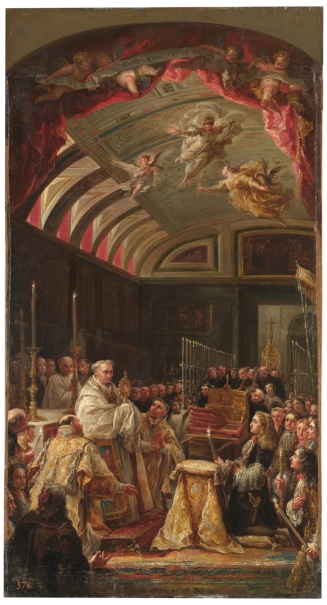
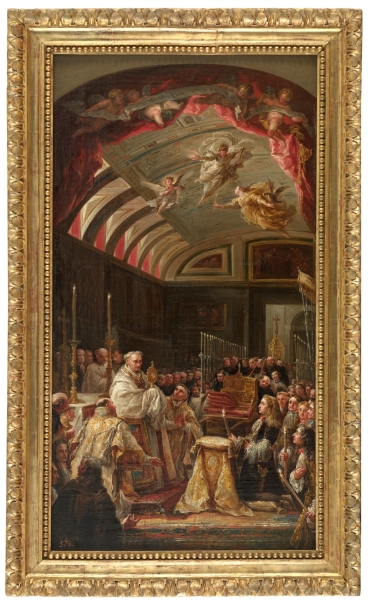
Vicente López Portaña (Copy after: Claudio Coello)
- Title
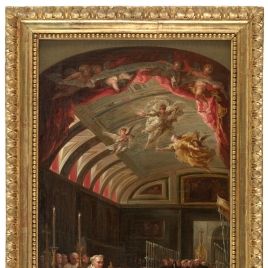
- The Adoration of the Sacred Form
- Date
- Ca. 1792
- Technique
- Oil
- Support
- Canvas mounted on panel
- Dimension
-
Height: 70.5 cm;
Width: 38 cm
- Provenance
- Royal Collection; Museo de Arte Moderno, 1896-1971
- Entry date
- 1971
Bibliography +
Museo Nacional del Prado, Museo del Prado: inventario general de pinturas (I) La Colección Real, Museo del Prado, Espasa Calpe, Madrid, 1990, pp. nº576.
Museo Nacional del Prado, Maestros de la pintura valenciana del siglo XIX en el Museo, Museo Nacional del Prado, Autoridad Portuaria, Madrid, 1997.
Díez García, José Luis, Vicente López (1772-1850) II. Catálogo razonado, Fundación de Apoyo a la Historia del Arte Hispánico, Madrid, 1999, pp. 71-72, nº305.
Orihuela, Mercedes y Cenalmor, Elena, El "Prado disperso". Obras depositadas en Almería y Jaén. Jaén. Museo, Boletín del Museo del Prado, 23, 2005, pp. 127.
Mena Marqués, M.; Albarrán, V., La belleza encerrada: de Fra Angelico a Fortuny, folleto, Museo Nacional del Prado, Madrid, 2013, pp. 50 n.220.
Maurer, Gudrun, Goya: lo bello y lo recóndito, La belleza encerrada: de Fra Angelico a Fortuny, Museo Nacional del Prado, Madrid, 2013, pp. 378.
Mena Marqués, M.; Albarrán, V., Azúa, F. de, La belleza cautiva. Pequeños tesoros del Museo del Prado = La bellesa captiva. Petits tresors del Museo del Prado, Museo del Prado - Obra Social "La Caixa", Barcelona, 2014, pp. 173.
Díez, José Luis (dir.), Pintura del Siglo XIX en el Museo del Prado: catálogo general, Museo Nacional del Prado, Madrid, 2015, pp. 328.
Other inventories +
Catálogo Museo del Prado, 1819.
Núm. 112 (Salón tercero).
Catálogo Museo del Prado, 1821.
Núm. 259.
Catálogo Museo del Prado, 1828.
Núm. 302.
Catálogo Museo del Prado, 1854-1858.
Núm. 576.
Inv. Real Museo, 1857.
Núm. 576.
Lopez (don Vicente.) / 576. La Santa Forma. / Copia del cuadro de Claudio Coello que / está en el altar de este nombre, existente en / la sacristía del monasterio de san Lo- / renzo del Escorial. (Lienzo sobre tabla.) / Alto 2 pies, 6 pulg; ancho 1 pie, 4 pulg [Nota al margen derecho en rojo] Pasó al Museo / de Arte moderno
Catálogo Museo del Prado, 1872-1907.
Núm. 773.
Actas del envío de cuadros del Prado al Museo de Arte Moderno.
Núm. 576.
Catálogo Museo de Arte Moderno, 1899.
Núm. 208.
SECCIÓN DE PINTURA EN SUS DIVERSAS CLASES, DIBUJOS Y GRABADOS EN LAMINAS. / LÓPEZ Y PORTAÑA (D. Vicente) [...] 208.- Adoración de la Santa Forma (copia). / Alto 0'70 metros. Ancho 0'36 metros.
Inv. General del Museo de Arte Moderno, 1899-1902.
Núm. 18.
Registros-Inventarios Museo Nacional de Arte Moderno, 1900-1936.
Núm. 25-L y 36-L.
Catálogo Museo de Arte Moderno, 1900.
Núm. 633.
SECCIÓN DE PINTURA EN SUS DIVERSAS CLASES, DIBUJOS Y GRABADOS EN LÁMINAS. / COPIAS. / López (D. Vicente). [...] 633.- La adoración de la Santa Forma. (En depósito.) / Alto 0'70 metros. Ancho 0'36 metros.
Inscriptions +
25
Inscribed with blue pencil.
Back, central area
576.
Inscribed in red color.
Front, lower left corner
Displayed objects +
Organ, positive:
En el centro de la escena aparece un órgano realejo de plata. Varios autores lo identifican con el que Felipe II príncipe, había recibido en 1551 como regalo de su tío, el emperador de Alemania, y que donó a los monjes de El Escorial en 1567, durante los años de la fundación del Monasterio. La existencia de este órgano está documentada por los inventarios sucesivos, a partir del de Felipe II (1602). Desapareció tras la guerra de la Independencia (1808-1814). Sobre la identificación del órgano representado por Claudio Coello con el órgano de plata donado por Felipe II, véase Bordas, C, 2000: 250-56. Checa, F, 1992: 88-97 y 475. Noone, M, 1998, y Sierra, José, 1996: 147-224. El que se representa en la obra es un órgano portativo (realejo en castellano de la época) de pequeñas dimensiones y potencia sonora discreta (Proyecto Iconografía Musical, U.C.M.).
Su uso se hizo fundamental en los ritos religiosos y en particular en la iglesia católica de España y sus colonias desde el Renacimiento.
Music, Illegible:
Uno de los monjes del coro, en primera fila justo detrás del organista, sujeta una partitura en las manos que no se distingue apenas. En el original de Claudio Coello la partitura parece un folio apaisado plegado por la mitad, o un librete de pocas hojas. Lo sujeta el primer cantor, que marca el compás con la mano derecha levantada (Proyecto Iconografía Musical, U.C.M.).
Lighting accesories:
Farol del tipo utilizado en actos litúrgicos
Update date: 02-06-2026 | Registry created on 28-04-2015