The Annuncation
Ca. 1565. Oil on panel.Not on display
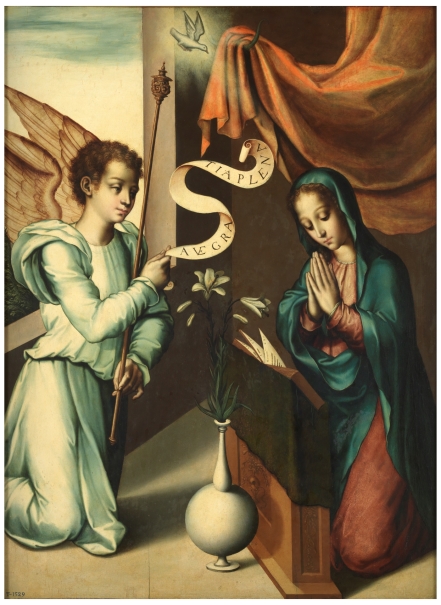
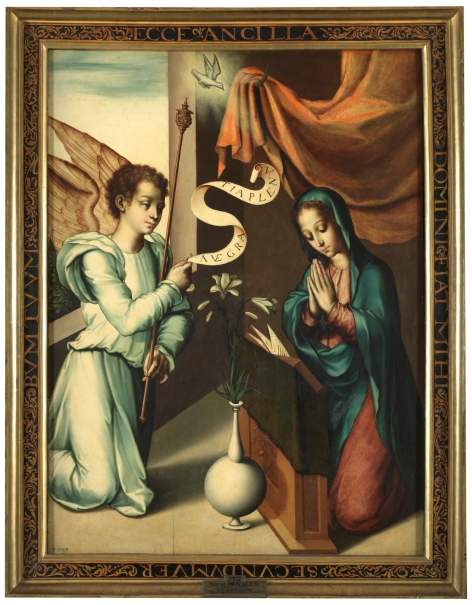
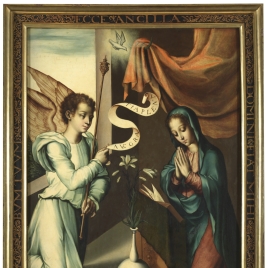
In a single sequence, the painting shows the Archangel Gabriel’s greeting to Mary, his announce ment to her that she has been designated as the mother of the son of God, and her acceptance of the divine will (Luke, 1, 26-38). St Gabriel appears on the viewer’s left, kneeling before the Virgin. He is covered in a white tunic constructed with a rich array of solidly drawn folds interspersed with a succession of clean bluish shadows. The outspread wings, golden in colour, stand out between the garment and the light sky in the background. In his left hand, the archangel, as a celestial emissary, holds a golden sceptre with a long shaft ending in a Renaissance-style fleuron. With his right hand, raised higher, he unfurls a scroll with the text: AVE GRATIA PLENA (And the angel came in unto her, and said: Hail, thou that art highly favoured, the Lord is with thee:... thou shalt conceive in thy womb, and bring forth a son, and shalt call his name Jesus). On the other side, framed by drapery in orange tones forming a kind of canopy, Mary shows her submission by inclining her head and joining her hands in prayer. On the prie-dieu before which she kneels there lies a book. She has just interrupted her reading to reply: Behold the handmaid of the Lord; be it unto me according to thy word. In front of the prie-dieu, close to the viewer, is a vase with a bunch of white lilies symbolising Mary’s virginity. At the top, the Holy Spirit, a small dove surrounded by golden light, is ready to descend to deposit the miraculous seed in the womb of the young maiden.
Nothing is known of the original provenance of this panel, which was donated to the Museo del Prado in 1930 by Xavier Laffitte y Charlesteguy. The son of the banker León A. Laffitte, a Frenchman born in Bayonne who settled in Madrid with his wife, María Laura Charlesteguy, and their seven children, Xavier died in Madrid in May 1930, and shortly afterwards the Prado received his bequest of seventeen paintings formerly owned by his father. Among them were two by Morales, the Fifth Sorrow or Pietà (P2513) and this Annunciation.
It is not an easy task to situate the Prado panel appropriately in terms of chronology and provenance. A date no earlier than 1560-65 is indicated by dendrochronological analysis of the support, made up of four vertical oak boards, and by verification that the red lake on the Virgin’s mantle was achieved with a mixture of kermes and cochineal pigment. That is the decade from which the Annunciations of Arroyo de la Luz and Plasencia are assumed to date, as well as the lost altarpiece of Alconchel (Badajoz), of 1565-66, with which we have related the panel at the Museo de Salamanca and the two from the Colección Arango (P8211 y P8212), with a style rather later than the one appreciable on this Annunciation at the Prado.
Otherwise, the sequence of the five compositions known to date allows us to explore the variety of registers maintained by Morales’s workshop in the course of more than twenty years, during two decades that were fundamental for his career. The five panels start from a basic composition which, as Pérez Sánchez observed with regard to the Arroyo painting, derives from a work by Titian (c. 1489-1576) disseminated through a print of 1537 by Gian Giacomo Caraglio (c. 1500/5-1565). That composition was transformed or adapted in the different versions, especially the position and gesture of the Virgin. The archangel Gabriel in the meantime repeats the Venetian painter’s formula (standing, with one leg forward, pointing upwards with his right index finger) in the Badajoz and Arroyo versions, although Titian’s lilies are replaced by the messenger’s sceptre. This feature is also included by Morales in the Prado, Plasencia and Elvas versions, where St Gabriel appears kneeling in accordance with mediaeval courtly custom.
The space in which the scene takes place in the different Annunciations also displays certain variations whose probable explanation lies not so much in an evolution as in the intervention of different workshop assistants. In the Prado Annunciation, Mary’s room is constructed by means of a forced representation on three planes, where the open space that frames St Gabriel is juxtaposed with the drapery that encloses and defines the interior space where Mary is located. A formal counterpoint to this juxtaposition of planes is visible in the vase of lilies, designed with a markedly spherical bowl of immaculate white which was perhaps intended to emphasise the significance of the subject of the work. The vase is repeated on the other four versions, although in no case is it so prominent and expressive as here. The execution of the figures, cleanly drawn and rendered with limpid colouring full of subtle transparencies, meanwhile obliges us to consider this version as a practically autograph work that may have been conceived as an isolated painting, perhaps comissioned by a private client, rather than as part of an altarpiece (Text drawn from Ruiz, L.: The Divine Morales, Museo Nacional del Prado, 2015, pp. 66-68).