formularioRDF
The itinerary <em>TITULORECORRIDO</em> has been successfully created. Now you can add in works from the Collection browser
<em>TITULOOBRA</em> added to <em>TITULORECORRIDO</em> itinerary

Close Continuar a ficha de la obra Continuar a ficha de la obra
02-06-2026
Annibale Carracci

Bologna (Italy), 1560 - Rome (Italy), 1609

See author's file

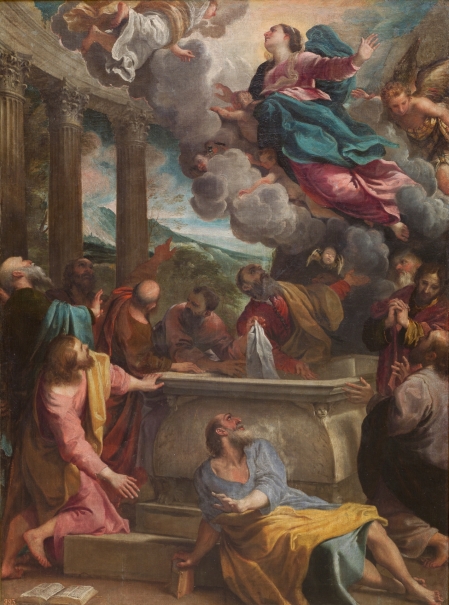
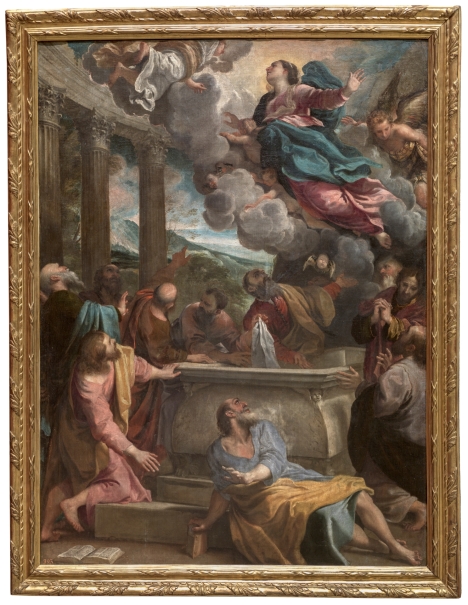
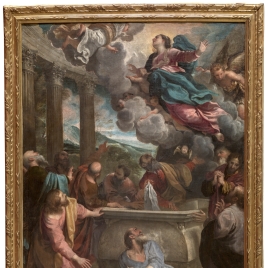
The Assumption of the Virgin

1588 - 1590. Oil on canvas.
Room 004

Annibale Carracci’s Assumption of the Virgin now in the Museo del Prado is first mentioned in the so-called “Memoria de Velázquez”, a list of the paintings in the possession of King Philip IV that were sent at his behest to the monastery of San Lorenzo de El Escorial in 1656. Here, Annibale’s picture, which is said to be in the sacristy, is described as a gift to the king brought from Italy by Manuel de Fonseca y Zúñiga, 6th Count of Monterrey (1588–1653). In 1657, the historian monk Francisco de los Santos describes it in the same place: “It is a painting of great renown, by Annibale Carracci, very similar to those by Tintoretto in the blotches and colours; as well as in the composition of the story”. In 1668, the writer and diplomat Lorenzo Magalotti reports that Cosimo III de’ Medici, Grand Duke of Tuscany, saw the painting in the sacristy of El Escorial. The painting remained there until it was put on deposit at the Academy of Fine Arts of San Fernando, Madrid, in 1813; it was given to the Prado in 1839.

Nothing is known about who might have commissioned the painting, or when. Given its relatively small size, it was likely to be destined for a private chapel. More certain is its unrelatedness to another Assumption of the Virgin by Annibale in Dresden’s Gemäldegalerie which is dated 1587, and for which it was erroneously believed to be preparatory. Made for the Confraternity of San Rocco in Reggio Emilia, the Dresden work is profoundly infused with reminiscences of Correggio (c. 1489–1534). Quite differently, the Prado Assumption reflects Annibale’s fascination with Venetian painting, in particular Titian (c. 1488–1576) and Jacopo Tintoretto (1519–1594) – the latter’s 1554–55 Assumption of the Virgin in Santa Maria Assunta in Venice must have impressed Annibale – although Paolo Veronese (1528–1588) could also qualify as a source of inspiration. Another Assumption of the Virgin by Annibale, executed in 1592 for the Bonasoni chapel in San Francesco, Bologna, is also indebted to Venice, whose influence nevertheless appears entirely metabolised here, as opposed to the Prado painting, where Annibale seems to be experimenting with the “blotches” and “colours” – as acutely suggested by Santos – characteristic of the Venetian pictorial tradition. On a preliminary basis, it can generally be assumed that the Prado Assumption was executed between 1587 and 1592. To be more specific, the painting was almost certainly made in 1588–90: that is, between Annibale’s Madonna of Saint Matthew, dated 1588 – where Correggio’s imprint is still discernible – and the Virgin and Child in Glory with Saints Louis, Alexius, John the Baptist, Catherine, Francis and Clare, known as the Madonna of San Ludovico, which is usually dated after Annibale’s sojourn in Venice in 1588, and was probably executed in 1589–90.

As a disciple and collaborator of Annibale, Guido Reni considered both Correggio and Venetian painters such as Titian, Tintoretto, and Veronese canonical models to learn from and improve upon. In Guido’s eyes, however, Annibale’s engagement with these two pictorial traditions (the “Venetian” and the “Lombard”, to which Correggio belonged) was at times too exclusive. In praising the “broader” vision of painting of Ludovico Carracci (1555–1619), Guido pointed out that he, “unlike his cousins [Annibale and Agostino], had not been so attached to the Lombard and the Venetian schools that it could not be seen that he had studied the Roman school as well, and that the other two had been taken up with a manner that was similar to Titian and Correggio, whereas Ludovico, despite having also studied the manners of Andrea del Sarto, Tibaldi, Primaticcio, and having a liking for all the other masters, had then formed a new manner that was distinctive and truly his own.” Whether or not Guido might have thought this was the case, the notion that Annibale and Agostino did not manage to create a fuller synthesis of styles by going beyond Titian and Correggio is as unfair as it is inaccurate. It is nonetheless true that Ludovico was more open to various styles, and in some cases bolder in fusing them together.

Pericolo, Lorenzo, 'Ludovico Carracci. The Assumption of the Virgin'. In: Guido Reni, Madrid, Museo Nacional del Prado, 2023, p.159-160 nº 6
Multimedia

Technical data

Imagen del carrusel
Imagen del carrusel

Related artworks

Inventory number
P000075
Author
Annibale Carracci
Title
The Assumption of the Virgin
Date
1588 - 1590
Technique
Oil
Support
Canvas
Dimension
Width: 97 cm; Height: 130 cm
Provenance
Royal Collection (sacristía de El Escorial, 1657; Real Monasterio de San Lorenzo, El Escorial, Madrid, sala del Capítulo Prioral, 1839).
Entry date
1839

Bibliography +

Santos, Francisco de (Jer.), Descripcion breve del Monasterio de San Lorenzo el Real del Escorial, Imprenta Real, Madrid, 1657, pp. fl 46r.

Ponz, Antonio, Viage de España: en que se da noticia de las cosas mas apreciables, y dignas de saberse, que hay en ella, Atlas, Madrid, 1794; ed. facs. 1972, pp. 80.

Cruzada Villaamil, Gregorio., Anales de la vida y de las obras de Diego de Silva Velázquez, Libreria de Miguel Guijarro, Madrid, 1885, pp. 210.

Justi, Carl, Diego Velázquez und Sein Jahrhundert, I, Verlag Friedrich Cohen, Bonn, 1922, pp. 225.

Voss, Hermann, Die Malerei des Barock in Rom, Propylaen Verlag, Berlín, 1924, pp. 488, lám. 153.

Pérez Sánchez, Alfonso E., Pintura italiana del S. XVII en España, Universidad Fundación Valdecilla, Madrid, 1965, pp. 99.

Milicua, José, Pintura italiana del s. XVII en el Casón del Buen Retiro, Goya. Revista de Arte, 97, 1970, pp. 7.

Pérez Sánchez, Alfonso E., Pintura italiana del siglo XVII: exposición conmemorativa de, Ministerio de Educación y Ciencia, Dirección Gener, 1970, pp. 134.

Posner, Donald, Annibale Carracci: a study in the reform of italian painting, II, Phaidon, 1971, pp. 19 nº 39.

De Andrés, Gregorio, Relación anónima del siglo XVII sobre los cuadros del Escorial, Archivo Español de Arte, 44, 1971, pp. 58.

Sánchez Cantón, Francisco Javier, Museo del Prado. Catálogo de las pinturas, Museo del Prado, Madrid, 1972, pp. 124.

Cooney, Patrick J., L'opera completa di Annibale Carracci, Rizzoli, Milán, 1976, pp. 95.

Turner, Nicholas, Italian Baroque Drawings, British Museum, Londres, 1980, pp. 94-95, nº 38.

Burke, Marcus B., Private Collections of Italian Art in Seventeenth Century Spain, University Microfilm International, Nueva York, 1984, pp. 62, lám. 9.

Museo Nacional del Prado, Catálogo de las pinturas, Museo del Prado, Madrid, 1985, pp. 127.

Vicens, Maria Teresa, Iconografia Assumpcionista, Direcció General de Cultura, Valencia, 1986, pp. 89.

Posner, D, 'Annibale Carracci. Assumption of the Virgin', The age of Correggio and the Carracci. Emilian painting of the sixteenth and seventeenth centuries, National Gallery of Art, Washington, 1986, pp. 275-278 nº90.

Brown, Jonathan, Velázquez: pintor y cortesano, Alianza Editorial, Madrid, 1986, pp. 236, lám. 284.

Pepper. D. Stephen, The aftermath of the Correggio/Carracci exhibitions. A new early chronology for the Carracci, Apollo, 125/6, 1987, pp. 409.

Museo Nacional del Prado, Museo del Prado. Inventario general de pinturas (I) La Colección Real, Museo del Prado, Espasa Calpe, Madrid, 1990, pp. 885.

Allgemeines Künstlerlexikon : die bildenden Künstler aller Z, VI, Saur, 1992.

Brogi, A, 'Annibale Carracci. Assunzione della Vergine', En: Annibale Carracci, Electa, 2006, pp. 210.

Robertson, Clare, The invention of Annibale Carracci, Silvana, Milán, 2008, pp. 12-14.

Riello, José, 'Annibale Carracci. The Assumption of the Virgin', Italian masterpieces from Spain's royal court, Museo del Prado, National Gallery of Victoria Thames & Hudson, 2014, pp. 98.

Pericolo, Lorenzo, 'Ludovico Carracci. The Assumption of the Virgin', In: Guido Reni, Museo Nacional del Prado, Madrid, 2023, pp. 159-160 nº 6.

Pericolo, Lorenzo, 'Annibale Carracci. La Asunción de la Virgen', En: Guido Reni, Museo Nacional del Prado, Madrid, 2023, pp. 159-160 nº 6.

Other inventories +

Catálogo Museo del Prado, 1854-1858. Núm. 883.

Inv. Real Museo, 1857. Núm. 883.
Caracci (Anibal) / 883. La asuncion de nuestra señora. (E.) / Alto 4 pies, 7 pulg, 8 lin; ancho 3 pies, 5 pulg, 6 lin.

Catálogo Museo del Prado, 1872-1907. Núm. 90.

Exhibitions +

Paolo Veronese (1528-1588)
Madrid
27.05.2025 - 21.09.2025

Guido Reni
Madrid
28.03.2023 - 09.07.2023

Italian Masterpieces from Spain's Royal Court. Museo Nacional del Prado
Melbourne
16.05.2014 - 31.08.2014

Annibale Carracci
Roma
23.01.2007 - 06.05.2007

Annibale Carracci
Bolonia
22.09.2006 - 07.01.2007

The Age of Correggio and the Carracci
Nueva York NY
19.03.1987 - 24.05.1987

The Age of Correggio and the Carracci
Washington DC
18.12.1986 - 15.02.1987

The Age of Correggio and the Carracci
Bolonia
10.09.1986 - 10.11.1986

Location +

Room 004 (On Display)

Expuesto
Update date: 02-06-2026 | Registry created on 02-12-2015

Visor 360

Drag with the cursor to rotate the piece

Other works by Annibale Carracci

Print on demand

Print artworks available in our catalogue in high quality and your preferred size and finish.

Image archive

Request artworks available in our catalogue in digital format.

Up