The Christ Child Asleep on the Cross
Ca. 1660. Oil on canvas.Not on display
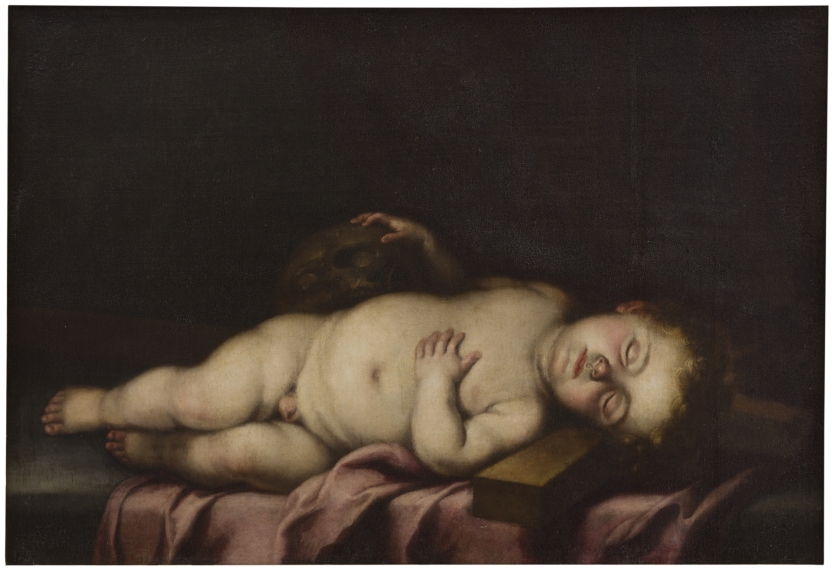
Bartolomé Esteban Murillo created a series of images of the infancy of Jesus which, over time, became established in Spain’s cultural consciousness through the diffusion of countless reproductions, right up to the present day. Good examples include the Infant Christ and Saint John the Baptist with a Shell and the Holy Family with a Little Bird, paintings which share a number of formal features that succeed in arousing devotion through endearing tenderness. In these everyday scenes, the common gestures of the holy figures elicit the empathy of the faithful. But Murillo also made use of children as a means of creating visual metaphors that prompted the viewer to reflect on theological matters. Such is the purpose of his depictions of the Christ Child Asleep on the Cross, in some cases surrounded by the attributes of his martyrdom, together with a skull that prefigures his Passion and death.
This iconography can be traced back to the early sixteenth century, and specifically to an engraving by Giacomo Francia (c. 1447–1517), in which the image of the infant Jesus asleep on the cross is accompanied by a verse from the Song of Songs (5:2), ‘I sleep, but my heart waketh’, perhaps alluding to the contemplative soul, which remains watchful even though the body may sleep. Interpreted in Marian terms, however, this verse might refer to the protective role assumed by Mary, aware of her son’s destiny from the moment of his birth. Though not based on a biblical event –indeed, the composition was probably inspired by a Hellenistic sculpture representing the allegory of Sleep – this subject not only survived Church censorship following the Council of Trent, aimed at seeking authenticity in the visual arts, but also enjoyed widespread popularity as a theme for pious meditation. Guido Reni’s various reworkings of the theme were highly successful, to judge by the numerous versions attributed to him, the engravings made of his compositions, and the influence they exerted on other painters.
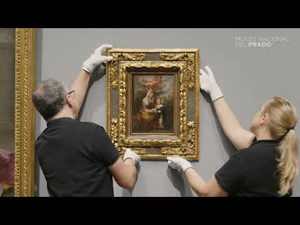
Murillo was among the artists thus inspired, as is evident in this Prado canvas showing Jesus asleep on a cross, laying on the purple drapery beneath him, his right hand resting on a skull. In Seville, Murillo would have seen not only prints of Reni’s work, but at least one painted copy that was on show in the archbishop’s palace when Domingo Pimentel was the primate of Seville, around 1650, when this picture was painted. At that time, moreover, the painter Alonso de Zamora y Toro had at his home in Seville an original painting on this theme by Reni.
By contrast, Benito Navarrete Prieto suggests that Murillo may have been inspired by the figure in an engraving by Francesco Vanni (1563–1610) of the Virgin adoring the Sleeping Christ Child, while Alfonso E. Pérez Sánchez had earlier discerned echoes of the Christ Child Asleep on the Cross by Bartolomeo Cavarozzi (c. 1587–1625) when he compared Murillo’s canvas with a painting in the Museo del Prado attributed at the time to Cavarozzi but now thought to be the work of Orazio Gentileschi (1563–1639).
The authorship of this canvas has also sparked some debate. In the early twentieth century it was listed in the Museum’s catalogues as a copy, a view rejected by a number of Murillo specialists, including August L. Mayer. Later, Juan Antonio Gaya Nuño dismissed it as an unquestionable copy, but Diego Angulo Íñiguez hailed it as one of Murillo’s finest originals on this subject, an attribution that has not since been challenged. Interestingly, a further Sleeping Christ Child by Murillo – once owned and exhibited at the palace of Boadilla del Monte by another member of the royal family, Luis Antonio Jaime de Borbón y Farnesio – was auctioned in 2018.
Japón, Rafael, 'Bartolomé Esteban Murillo. Niño Jesús dormido sobre la Cruz'. En: Guido Reni, Madrid, Museo Nacional del Prado, 2023, p.338-339 nº 70