The Emperor Charles V at Yuste
1877. Oil on canvas.On display elsewhere
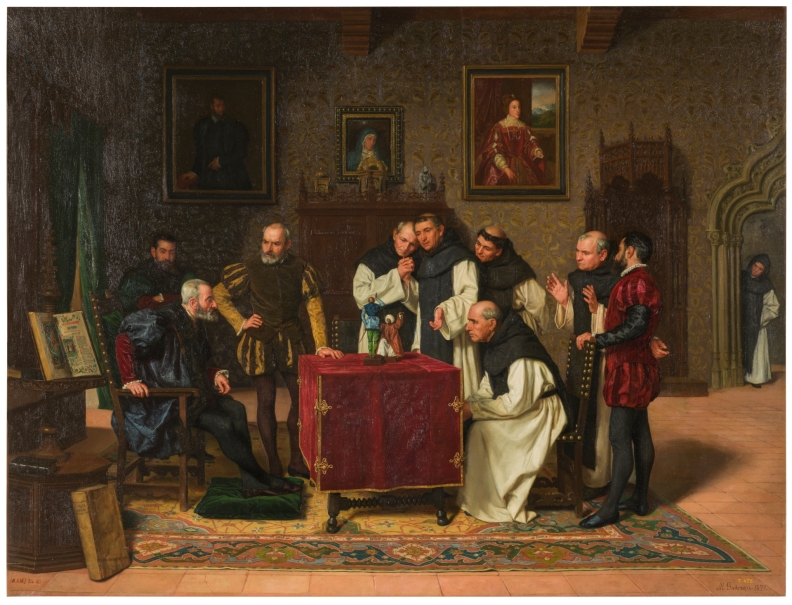
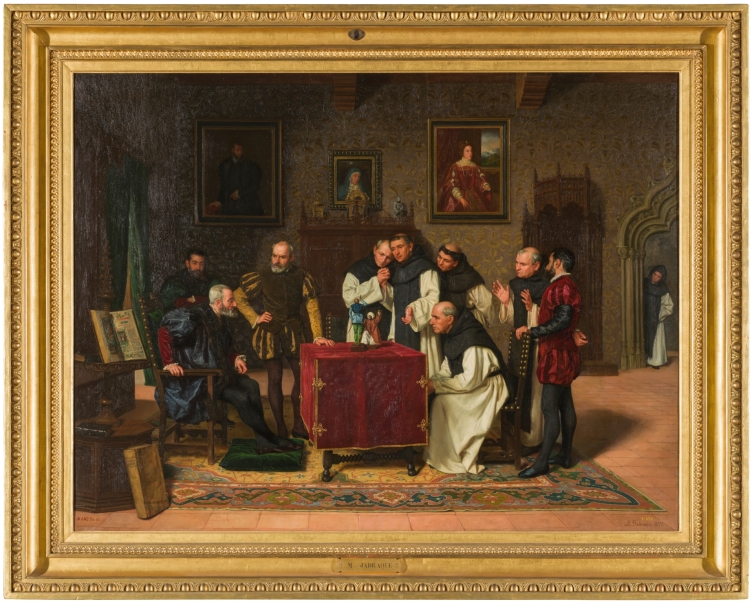
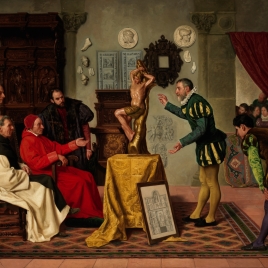
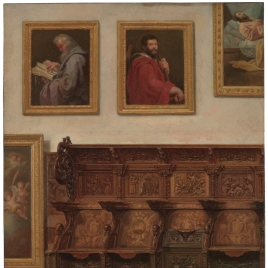
Charles V (Ghent, 1500–Yuste, 1558), King of Spain (1516–1556) and Emperor of Germany (1520–1558), appears indoors, seated on the left, looking in profile towards the opposite side. He is observing the automata placed on the table, made by the engineer and inventor Juanelo Turriano (Crémona, Italy, 1501–Toledo, 1585), who is standing next to him. On the right, the monks of the monastery observe the figures with admiration. Three paintings hang on the wall in the background: Titian´s portrait of the Empress Isabella of Portugal (P00415), a portrait of the Emperor and a portrait of the Our Lady of Dolours.
There are several 19th century paintings that evoke the emperor´s stay at the monastery of Yuste. They were produced both in Spain and abroad, although none are known to refer to his relationship with Turriano. The subject is taken from the History of the Reign of the Emperor Charles V, written by William Robertson in 1769. This work states that Charles V ‘[...] had encouraged Turriano, one of the most ingenious mechanics of his century, to accompany him in his solitude. He worked with him in constructing models of the most useful machines [...] He composed figures that imitated human movements with the great admiration of the monks. Since they saw effects beyond their comprehension, they sometimes suspected that Charles and Turriano were dealing with invisible powers.’
The painting was awarded a second-class medal at the National Exhibition of Fine Arts in 1878, where it was recognised as one of the best works presented that year. It is outstanding for its meticulous execution, in which even the smallest details are depicted with the utmost care. The painting was very favourably received by the critics. (In: The time of Charles V and Philip II in 19th century history painting, Madrid: State Society for the Commemoration of the Centenaries of Philip II and Charles V, 1999, p. 284 and painting of the 19th century in the Museo del Prado: General Catalogue, Madrid: Museo Nacional del Prado, 2015, p. 300.)