formularioRDF
The itinerary <em>TITULORECORRIDO</em> has been successfully created. Now you can add in works from the Collection browser
<em>TITULOOBRA</em> added to <em>TITULORECORRIDO</em> itinerary

Close Continuar a ficha de la obra Continuar a ficha de la obra
02-06-2026
Louis-Michel van Loo

Toulon (France), 1707 - Paris (France), 1771

See author's file

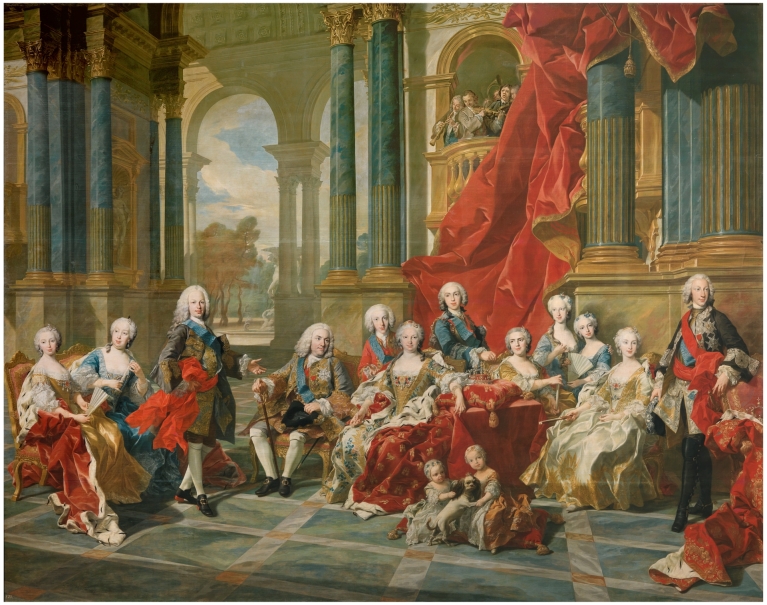
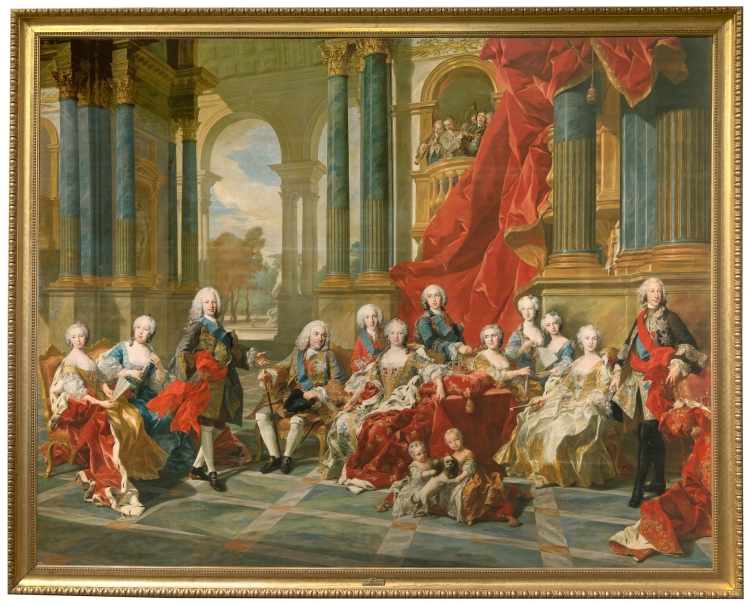
The Family of Philip V

1743. Oil on canvas.
Room 039

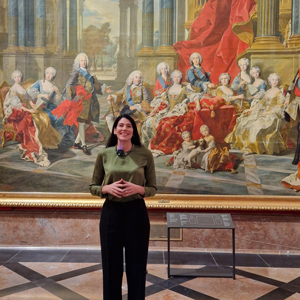
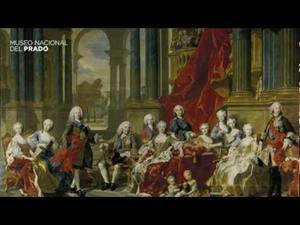
The King is depicted with his second wife, Isabella Farnese, at the centre of the composition. He appears surrounded by his descendants, soon-to-be Kings Ferdinand VI –son of the King’s first marriage– and Charles III, both with their respective wives, and all the other members of the royal family alive at that date. This portrait, at once intimate family and dynastic gathering, betrays curious and contrasting attitudes among the sitters: first of all, the exhaustion of Philip V against the dominant and authoritarian grandiosity of his second wife, Isabella Farnese. Secondly, the presence of the Prince of Asturias, soon-to-be King Ferdinand VI, whose presence, intended as elegant, ends as merely gauche. Thirdly, the somewhat oblivious confidence of Charles III, who at the time was King of Naples, the gentleness of his wife, and the grace of the girls in the foreground. Fourthly, the frieze of the faces of the Spanish princes who were destined to play a crucial role in the troubled years to follow. And so on through the depiction of a set of different characters. The tone is courtly and refined, without compromising the psychological depth and despite the heavy compositional scheme, with a monumental and solemn atmosphere. Nevertheless, this painting is a product of the drama of the historical moment in which it was executed, seeking to represent the majesty of royal persons through their own attributes, the sense of glorious dynastic continuity, and the splendour that surrounds their power, expressed in the enveloping sumptuousness.

The artist imagined a palace room that opens onto a garden in the Roman Baroque style. The Queen, who appears in the centre of the room, ‘was also the Queen of the Court and of the Government’ (Sánchez Cantón, 1926, p. 44). The composition revolves around the queen with all her direct descendants grouped around her. However, the Princess of Brazil appears next to Bárbara of Portugal, perhaps because she had distanced herself from the Court and the fact that Portugal was now her homeland. The work is a valuable genealogical document and its composition is reminiscent of the arrangement typical to some Dutch conversation paintings, to which the French aesthetic has been no stranger, (Praz, 1971, pp. 64–6), in which the royal family is presented almost in the manner of a ‘public institution’.

This work is both a summary and a starting point within Louis-Michel Van Loo´s artistic development, with many of his portraits produced before and after 1743, based on this masterpiece. Some of them were preparatory studies or repetitions of already completed effigies. This shows how much care and interest he invested in the project and in the making of the work, likely carried out in a slow and progressive manner, in accordance with the events that occurred at the time related to the royal patrons and their relatives. The sketch located in the Museum of Versailles (MV 4380, oil on canvas, 77.5 x 102.5 cm) and the drawing in the Real Academia de Bellas Artes de San Fernando [Royal Academy of Fine Arts of San Fernando] (D-2390, pencil and black and sepia ink on paper, 865 x 1110 mm) are reminiscent of this and previous works, as well as various of his paintings, some individual portraits of the different characters, some of which are kept in the Museo del Prado while others are in the collections at Patrimonio Nacional [National Artistic Heritage], the rest being in private galleries. These above-mentioned works were executed based on the achieved results, suitably transformed in accordance with their importance in the overall composition.

Within the evolution of the French school, this large canvas marks the apotheosis of the collective portrait, with a much more developed conception and a more splendid scale than the previous known paintings by Rigaud, de Troy, Vivien, Mignard or Largillière. It is a compendium of previous treatments, the most important milestones of which include the Family of Louis XIV by Nocret (Versailles), that of the Grand Dauphin by Mignard (Versailles), that of Louis XIV by Largillière (London, Wallace Collection), that of Maximilian Emanuel of Bavaria, by Vivien (Munich), the family portraits by De Troy or Tournières, without forgetting the famous paintings of the Paris Town Hall, with lavishly-attired figures set in a spectacular and grandiose frame.

The king is wearing the sash and badge of the French Order of the Holy Spirit and the Golden Fleece, as is Ferdinand, the Prince of Asturias. Nevertheless, due to his posture, not all of his regalia is visible in the picture. On the other side of the painting, Charles, who was King of Naples at the time, also wears the same orders. However, in the foreground he can be seen to wear the red sash and the badge of the Order of Saint Januarius, which he created after conquering his kingdom (1738). He only granted it to his younger brothers, Philip and Louis-Antoine, who too are wearing sashes, although the French band can be seen on top and below it the Neapolitan one, as well as the Golden Fleece. On Louis-Antoine’s suit the badge of the Holy Spirit is visible (Project for the cataloguing of heraldic and phaleristic elements by Real Academia Matritense de Heráldica y Genealogía [Madrid Royal Academy of Heraldic and Genealogy]).

Baticle, J., Pita Andrade, J. M., El arte europeo en la corte de España durante el siglo XVIII, Madrid, Ministerio de Cultura, Dirección General del Patrimonio Artístico y Museos, 1980, p.154
Multimedia

Technical data

Imagen del carrusel
Imagen del carrusel
Inventory number
P002283
Author
Louis-Michel van Loo
Title
The Family of Philip V
Date
1743
Technique
Oil
Support
Canvas
Dimension
Width: 520 cm; Height: 408 cm
Provenance
Royal Collection (Furriera de la Reina-Casa del marqués de Bédmar, 1748, nº 230; Palacio Real del Buen Retiro, Madrid, piezas que siguen al Casón, 1772, [s.n.]; Buen Retiro, 1794, nº 371).

Bibliography +

Inventario Real Sitio del Buen Retiro, Madrid, 1772, pp. nº 14781.

Ponz, Antonio, Viage de España: en que se da noticia de las cosas mas apreciables, y dignas de saberse, que hay en ella, Atlas, Madrid, 1794; ed. facs. 1972, pp. 122.

Inventario de las Pinturas del Museo Hecho a la Muerte del Rey Fernado VII, Madrid, 1834, pp. 70, nº23.

Nicolle, Marcel, La peinture française au Musée du Prado, Perrin et Cie, París, 1925, pp. 22.

Llanos y Torriglia, Félix de, Portugal en el Museo del Prado (Separata), Asociacion Española para el Progreso, Madrid, 1925, pp. lám. VII.

Mayoral y Herrero, José, El prognatismo inferior en los Borbones de España. Tesis Doctoral, Odontología Clínica, Madrid, 1933, pp. 2 / lám. 1.

Sánchez Cantón, Francisco Javier; Pita Andrade, José Manuel, Los retratos de los Reyes de España, Omega, Barcelona, 1948, pp. 164.

Sánchez Cantón, F. J., Las Bellas Artes en el reinado de Fernando VI, Academia. Boletín de la Real Academia de Bellas Artes de San Fernando, 1959-1960, pp. 5.

Luna, Juan J., Van Loo en España, Reales Sitios, 1978, pp. 331.

Luna, Juan J., La pintura francesa de los siglos XVII y XVIII en España. Tésis doctoral (inédita), Universidad Complutense, Madrid, 1979.

Potter, George Richard, Historia del mundo moderno, Ramon SopenaCambridge University, Barcelona, 1980, pp. 200.

Baticle, J., Pita Andrade, J. M., El arte europeo en la corte de España durante el siglo XVIII, Ministerio de Cultura, Dirección General del Patrimonio Artístico y Museos, Madrid, 1980, pp. 154.

Licht, Fred, Goya. The Origins of the Modern Temper in Art, John Murray Ltd., Londres, 1980, pp. 76 / lám. 32.

Luna, Juan J., Nuevas apreciaciones sobre las obras de Louis-Michel van Loo en el Museo del Prado, Boletín del Museo del Prado, III, 1982, pp. 181-190.

Pirenne, Jacques, Historia Universal. Las Grandes Corrientes de la Historia. V, IV, Ediciones Oceano, Barcelona, 1982, pp. 240.

Sopeña Ibañez, Federico, Las Reinas de España y la Musica, Banco de Bilbao, Madrid, 1984, pp. 46.

Menendez Pidal, R., Historia de España. Vol. XXIX. La Epoca de los Primeros Borb..., Espasa: Calpe, Madrid, 1985, pp. 508 / lám. 196.

Menéndez Pidal, Ramón, Historia de España. Vol. XXIX. La Epoca de los Primeros Borb, EspasaCalpe, Madrid, 1985, pp. 437 / lám. 247.

Museo Nacional del Prado, Catálogo de las pinturas, Museo del Prado, Madrid, 1985, pp. 371-372.

Bottineau, Yves, El arte cortesano en la España de Felipe V (1700-1746), Fundación Universitaria Española, Madrid, 1986, pp. lám. CXIII.

Dell'Aja, Gaudenzio, Il Pantheon Dei Borboni in Santa Chiara Di Napoli, Giannini Editori, Nápoles, 1987, pp. 247 / lám. 74.

El Real Sitio de Aranjuez y el arte cortesano del siglo XVII, El Real Sitio de Aranjuez y el arte cortesano del siglo XVII..., Patrimonio Nacional, Aranjuez, 1987, pp. 193.

El Real Sitio de Aranjuez y el arte cortesano del siglo XVII, El Real Sitio de Aranjuez y el arte cortesano del siglo XVII..., Patrimonio Nacional, Aranjuez, 1987, pp. 150.

Martínez Medina, África, Nacimiento y bautizo del rey Carlos III, Villa de Madrid, 26, 1988, pp. 50.

Anatra, Bruno, Venezia e la Spagna, Electa, Milan, 1988, pp. 198 / lám. 214.

Fernandez Miranda y Lozana, Fernando, Inventarios Reales. Carlos III. 1789-1790., Vol.I, Patrimonio Nacional, Madrid, 1988, pp. 285, nº2734.

Museo Nacional del Prado, Museo del Prado: inventario general de pinturas (I) La Colección Real, Museo del Prado, Espasa Calpe, Madrid, 1990, pp. nº1972.

Portela Sandoval, Francisco José, La pintura del siglo XVIII, Vicens-Vives, Barcelona, 1990, pp. 178 / lám. 104.

Buendía, José Rogelio, El Prado. Colecciones de Pintura, Lunwerg Editores, Madrid, 1994, pp. 518.

La Pintura Española, Electa, Milán, 1995, pp. 398 / lám. 486.

Bettagno, Alessandro, El Museo del Prado, Fonds Mercator Fundación Amigos del Museo del Prado, Madrid, 1996, pp. 562.

Benito Olmos, Aurora, Arte y música en el Museo del Prado, Fundación Argentaria Visor, Madrid, 1997, pp. 184.

Banu, Georges, Le Rideau Ou la Félure du Monde, A. Biro, Paris, 1997, pp. 38.

Triadó, Joan-Ramon, La Pintura Española. El Siglo de Oro, Carroggio, Barcelona, 1999, pp. 167.

Cepeda Adan, José, Madrid, de villa a corte, Un paseo sentimental por su Histor, Fundación Universitaria, Madrid, 2001, pp. 171.

Aterido Fernández, Ángel; Martínez Cuesta, Juan; Pérez Preciado, José Juan, Colecciones de pinturas de Felipe V e Isabel Farnesio. Inventarios Reales, II, Fundación de Apoyo de la Historia del Arte Hispánico, Madrid, 2004, pp. 421.

Enciclopedia del Museo del Prado, III, T.F. Editores: Fundación Amigos, Madrid, 2006, pp. 1037.

Morales, Nicolás, L' artiste de cour dans L' Espagne du XVIIIe siècle. étude d..., Casa Velazquez, Madrid, 2007.

Corona y arqueología en el Siglo de las Luces, Patrimonio Nacional, 2010, pp. 19-33.

Azanza López, José Javier, Encargo, autoria y ejecución de 'La familia de Felipe V' (Palacio Real de la Granja) copia del original de Louis Michel van Loo, Anuario del Departamento de Historia y Teoría del Arte, n.26, 2014, pp. 83-97 fg.1 [o.r PI-18E1268P].

Arbeteta Mira, Letizia, Las joyas reales en la Monarquía Hispánica. Una aproximación iconográfica, C.I.C.T., U. Católica Lisboa; I. de Humanismo y tradición clásica, León, 2014, pp. 371 f.11.

Castillo Álvarez, Silvia, Marcos, muebles y maderas: obras de carpintería, ebasnistería y enmarcado en el Museo del Prado (1818-38), Boletín del Museo del Prado, XXXIII (51), 2015, pp. 100-111 [104 nt.67].

Martínez Plaza, Pedro J., El gabinete de descanso de sus majestades, Museo Nacional del Prado, Madrid, 2019.

Gayo, Mª Dolores; Jover de Celis, Maite, La preparación de los lienzos en la corte de Madrid: de Felipe IV a Felipe V, Boletín del Museo del Prado, XXXVIII, 2022, pp. 113-132 [131].

García Pérez, Noelia, The female perspective III. Queen Isabella Farnese (1692-1766), Museo Nacional del Prado, Madrid, 2025, pp. 20-27; 43 n.8.

García Pérez, Noelia, El Prado en femenino III. La reina Isabel de Farnesio (1692-1766), Museo Nacional del Prado, Madrid, 2025, pp. 20-27; 43 n.8.

Other inventories +

Inv. Testamentaría Felipe V, Furriera de la Reina, 1748. Núm. 230.
Casas del rey y la reina. Pinturas en otros oficios. Año 1747 [...] Furriera de la Reyna nra srª / Testamriª del sºr Dn Phe 5º / Año de 1748 [...] Pintturas qe se hallan en esttas misms Casas, y quartto de dn Luis Balott, primer Pintor de Camara de S.M. / 230 / Un quadro que comprehende ttoda la Real familia del señor Rey dn Phe quintto (que esttà en gloria), de seis Varas de largo, y cinco de Caida sin marco se tasò pr Dn Juan de Miranda, y dn Andres Calleja ttambien Pinttores, en cientto y cinquentta mil rrs

Inv. Carlos III, Buen Retiro, 1772. Núm. [s.n.].
Piezas que siguen al cason [...] [14781] [s. n.] El quadro grande de la familia del señor Felipe Quinto original de Van Loo seis varas de largo mas de cinco de caida.

Inv. Testamentaría Carlos III, Buen Retiro, 1794. Núm. 371.
Otra [pintura] de Dn. Luis Wanloo con el quadro de la Rl. familia de Felipe 5º, de cinco varas menos media quarta de alto y 6 1/4 de ancho, marco dorado...25000

Museo Real de Pinturas a la muerte de Fernando VII, 1834. Núm. 23.
GABINETE DE DESCANSO DE SS. MM. / Veinte y tres. Retratos de toda la familia de Felipe V que se halla sentado en un sillón de brazos con el sombrero en la mano izquierda y un vastón en la derecha [...] / N. Vanlo / Lº / 65.000

Inv. Real Museo, 1857. Núm. 1972.
Luis banloo (firmado 1743) / 1972. La familia de Felipe 5º. / Alto 14 pies, 6 pulg; ancho 18 pies, 3 pulg.

Catálogo Museo del Prado, 1872-1907. Núm. 2018.

Catálogo Museo del Prado, 1910. Núm. 2283.

Catálogo Museo del Prado, 1942-1996. Núm. 2283.

Inscriptions +

L. M. Van Loo 1743
Signed and dated. Front, lower left corner

2283 / LOUIS MICHEL VAN LOO / (1707+1771) / LA FAMILIA DE FELIPE V
Frame, front, lower bar

371.
Inscribed in white. Front, lower left corner

Location +

Room 039 (On Display)

Expuesto

Displayed objects +

Horn, Natural / Horn, Hunting: Personaje en el balcón de músicos, al fondo de la escena, que toca una trompa. El instrumento posee un largo tubo, seguramente de cobre, de sección cónica estrecha y enroscado sobre sí mismo, con pabellón abierto y cónico. La aparición de trompas hace referencia al conjunto instrumental de la Capilla Real posterior a 1739, en que es aprobada la Nueva Planta para la misma y en la que se incuyen estos aerófonos por vez primera (”Diccionario de la Música Española e Hispanoamericana”. Dir: Emilio Casares Rodicio. SGAE, Madrid 2002-voz: “Capilla Real”: pág 126).

Oboe: Personaje en el balcón de músicos con oboe de tubo cónico de madera y pabellón ancho. Posiblemente de registro medio, con unos doce agujeros digitales. Se trata de un aerófono de lengüeta doble y sección cónica cuyo orígen se remonta a la más lejana Antigüedad. La palabra “oboe” (”haut-bois”) apareció en Europa en el siglo XV y fue aplicada en un primer momento al “caramillo”, en una sola pieza y de sonoridad potente. Hacia 1660 apareció en Francia, en el seno de la Grande Ecurie du roi, un instrumento atribuído a J. Hotteterre (1673-1763), de timbre dulce con una nueva sección más estrecha y dos llaves añadidas que fue adaptado en toda Europa antes de acabar el siglo XVII.

Insignia of the Order of the Holy Ghost: La banda azul y placa de la Orden del Espíritu Santo, que muestra su vinculación a la Casa Real francesa

Insignia of the Order of the Holy Ghost: En el traje de Luis Antonio se aprecia la placa de la Orden del Espíritu Santo (Proyecto catalogación elementos heráldicos y falerísticos, Real Academia Matritense de Heráldica y Genealogía)

Violin: Personaje en el balcón de músicos con violín. Visión parcial del instrumento, del que se aprecia únicamente parte de la caja de resonancia en arce (tabla armónica y parte del tornavoz izquierdo en “f”), y el talón, quedando semiocultos el mango y el diapasón. Arco en la mano derecha del intérprete y sobre las cuerdas. En Occidente, el violín representa el final de la evolución de los cordófonos de arco. En los siglos XVII y XVIII se establece el modelo del violín moderno de la mano de los grandes luthiers italianos de las escuelas de Brescia y Cremona. En la obra está representado un modelo de tamaño pequeño, el violino semejante a nuestro violín actual que desaparecerá en el siglo XVIII.
El violín se interpretaba colocándolo bajo la barbilla como único punto de apoyo.

Update date: 02-06-2026 | Registry created on 28-04-2015

Visor 360

Drag with the cursor to rotate the piece

Other works by Louis-Michel van Loo

Print on demand

Print artworks available in our catalogue in high quality and your preferred size and finish.

Image archive

Request artworks available in our catalogue in digital format.

Up