formularioRDF
The itinerary <em>TITULORECORRIDO</em> has been successfully created. Now you can add in works from the Collection browser
<em>TITULOOBRA</em> added to <em>TITULORECORRIDO</em> itinerary

Close Continuar a ficha de la obra Continuar a ficha de la obra
02-06-2026
Bartolomé Esteban Murillo

Sevilla, 1617 - Sevilla, 1682

Bartolomé Esteban Murillo See author's file

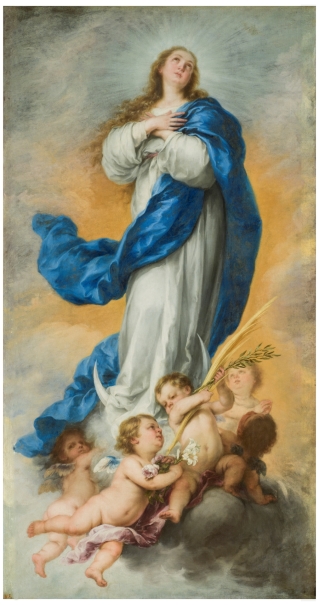
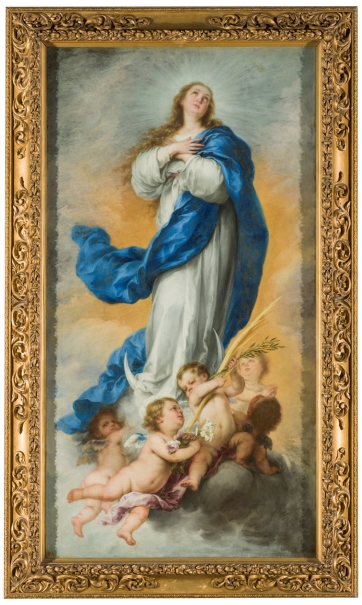
The Aranjuez Immaculate Conception

1675 - 1680. Oil on canvas.
Room 016

The Museo del Prado has five Immaculate Conceptions by Murillo, who depicted this subject in response to its remarkable popularity in Spain. This devotion became a sign of national identity. This version, formerly in Aranjuez, is among Murillo’s most mature and elegant and in which he most effectively conveys the sense of the figure rising upwards.

Over the course of a century and a half, a particular manifestation of religious devotion developed in Spain that would become one of the realm´s foremost marks of collective identity -namely, the doctrine of the Immaculate Conception. Spain was the principal defender of this and the nation that most persistently fought to have that doctrine become an article of faith. For two centuries it was a kind of particular dogma among Spaniards until, in 1854, the Roman Catholic Church declared it a dogma de fide. However, beginning in the early sixteenth century it came to be represented through the image of the Virgin surrounded by her attributes. In the figure of the Inmaculada the dual themes of collective pride and devotion to the Virgin Mary converged, which helps to explain its popularity in Spain. The result was extraordinary activity in the exaltation of her conception that had consequences for every sort of literary and artistic creation.

For generations, painters sought ways to represent the Immaculate Conception that could fully express the popular fervour the mystery inspired. In every case, artists´ images of the Immaculate Conception reflected their aesthetic ideals, so that there is no better way to discern the evolution of the canons of feminine beauty than by observing the way this aspect of Marian iconography developed over time. In their representations of the Inmaculada, Juan de Juanes (1510-79), Velázquez, Ribera, Zurbarán, Carreño de Miranda, and others all produced works of great beauty that are in some cases among the finest examples of their output. Nevertheless, only one artist succeeded in finding a formula that allowed him to express, in a single image, all the expectations, hopes and desires of his society, which had made the Immaculate Conception a distinguishing mark of its identity, representing all that were deemed its best qualities. This painter was Murillo, and throughout his life he executed around 20 different versions of the subject, of which numerous copies also circulated. Murillo´s Inmaculada is no longer Zurbarán´s or Velázquez´s young girl, nor does it include many of the descriptive and symbolic elements that were common in previous versions. In Murillo´s paintings, allusions to the Marian litanies have disappeared, and the artist has reduced the image to its essentials: the Virgin in splendour, standing on a crescent moon, being lifted heavenward surrounded by cherubs and immersed in an atmosphere of clouds and radiant light. In these works, in which the subject of the Immaculate Conception is mixed with that of the Assumption, the message is direct and extremely efficacious: it is the purest representation of the glory of the Virgin.

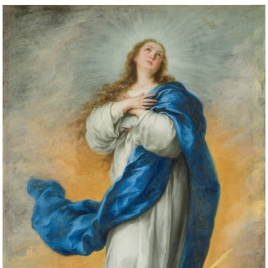
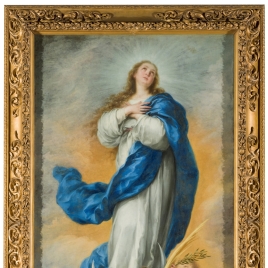
Murillo succeeded in discovering the representational formula best suited to presenting the Immaculate Conception to Baroque society and at the same time found the perfect image of Mary. No other artist managed to combine with such mastery the sense of structural solidity and command of forms with a refined delicacy in the execution and the variety of gestures and poses, or the imaginative use of colour. Consequently, one of Murillo´s contemporaries was inspired to say of one of his Inmaculadas, were our great Murillo from Seville not its painter, one could presume that it had been fashioned in Heaven itself. Since then, Murillo´s depictions of the Immaculate Conception have arguably earned him the greatest fame. This particular version was executed in the last years of the painter´s life and is remarkable for the way in which it manages to convey a sense of upward motion, an effect abetted by the fact that it is one of Murillo´s most stylised Inmaculadas and by its more attenuated vertical format. It entered the Royal Collections at the beginning of the nineteenth century and owes its title to its having hung in the chapel of San Antonio de Aranjuez before being sent to the Prado in 1819, where it became one of the principal devotional icons exhibited in the museum.

Portrait of Spain. Masterpieces from The Prado, Queensland Art Gallery, 2012, p.150-151, nº36
Multimedia

Technical data

Imagen del carrusel
Imagen del carrusel

Related artworks

Inventory number
P000974
Author
Bartolomé Esteban Murillo
Title
The Aranjuez Immaculate Conception
Date
1675 - 1680
Technique
Oil
Support
Canvas
Dimension
Width: 118 cm; Height: 222 cm
Provenance
Royal Collection (Palacio de Aranjuez, Madrid, real capilla de san Antonio, 1818, s.n.; Palacio de Aranjuez, cuarto de la Reyna. 1827).
Entry date
1827

Bibliography +

Abbad-Jaime de Aragón Ríos, Francisco, La Inmaculada de Murillo, Juventud, 1948.

Sánchez Cantón, Francisco Javier, Museo del Prado. Catálogo de las pinturas, Museo del Prado, Madrid, 1972.

Gaya Nuño, Juan Antonio, La obra pictórica completa de Murillo, Noguer, Barcelona, 1978, pp. nº71.

Esteban, Claude, Tout L'Oeuvre Peint de Murillo, Flammarion, Paris, 1980, pp. nº71.

Angulo Íñiguez, Diego, Murillo, II, Espasa-Calpe, Madrid, 1981, pp. 119.

Ayala Mallory, Nina, Bartolomé Esteban Murillo, Alianza Editorial, Madrid, 1983, pp. 43.

Museo Nacional del Prado, Catálogo de las pinturas, Museo del Prado, Madrid, 1985, pp. 449.

Velazquez en Zijn Tijd: zeventiende-eeuwse Spaanse schilderk, Rijks Museum, Amsterdam, 1985, pp. 108.

Valdivieso, Enrique, Historia de la pintura sevillana: siglos XIII al XX, Guadalquivir, Sevilla, 1986, pp. 215.

Stratton, Suzanne L., La Inmaculada Concepción en el arte español, Fundación Universitaria Española, Madrid, 1988, pp. lám.110.

Museo Nacional del Prado, Museo del Prado. Inventario general de pinturas (I) La Colección Real, Museo del Prado, Espasa Calpe, Madrid, 1990.

Portús, Javier, Pintura barroca española: guía, Museo Nacional del Prado Aldeasa, Madrid, 2001, pp. 192.

Obras Maestras del Museo del Prado, The Yomiuri Shimbun, Tokio, 2002.

Valdivieso, Enrique, Murillo. Catálogo razonado de pinturas, El Viso, 2010, pp. nº352 p.513.

Portrait of Spain. Masterpieces from The Prado, Queensland Art Gallery, 2012, pp. 150-151, nº36.

Azanza López, J,J, Severiano Marín y la restauración pictórica en los Reales Sitios durante el reinado isabelino, Reales Sitios, año LII Tercer trimeste n.203, 2015, pp. 59-77 [75].

Pérez, H, 'Adolphe Braun et Cie. La Virgen de Aranjuez. Musée du Prado à Madrid' En:, Murillo y su estela en Sevilla, ICAS, Instituto de la Cultura y las Artes de Sevilla, Sevilla, 2017, pp. 214-215 n.32 (o.r).

Hereza, Pablo, 'Bartolomé Esteban Murillo. La Inmaculada Concepción de Aranjuez' En:, Murillo y su estela en Sevilla, ICAS, Instituto de la Cultura y las Artes de Sevilla., Sevilla, 2017, pp. 124-127 n.1.

Martínez Plaza, Pedro José (Com.), Ages of Splendor: a History of Spain in the Museo del Prado, Cat. exp. Museum of Art Pudong, Shangai, Museum of Art Pudong ; Museo Nacional del Prado, 2024, pp. 132.

Other inventories +

Inv. Fernando VII, Aranjuez, 1814-1818. Núm. s. n..
Real Capilla de S. Antonio [...] {21001} 3 varas alto 1 y media ancho = La Concepcion = Murillo

Inv. Real Museo, 1857. Núm. 65.
Murillo. / 65. La Concepcion. / Vestida con túnica blanca y manto azul, está sostenida en un pequeño grupo de nubes, rodeada de cinco ángeles con palmas, rosas y azucenas. / Alto 7 pies, 11 pulg, 6 lin; ancho 4 pies, 3 pulg.

Catálogo Museo del Prado, 1872-1907. Núm. 880.
880.- La Concepción. / Alto 2,22. Ancho 1,18.- Lienzo / Con las manos cruzadas al pecho y el rostro levantado, hollando la luna y en pié sobre una nube, tiene la Inmaculada como de peana cinco hermosos ángeles, dos de los cuales ostentan una palma, un ramo de olivo, rosas y azucenas.-Figuras de cuerpo entero y tamaño natural. Cuadro del estilo llamado vaporoso. / F.L.

Inscriptions +

65.
Painted. Front, lower left corner

Exhibitions +

Ages of Splendor. A History of Spain in the Museo del Prado
Lujiazui (Shanghái), China
23.04.2024 - 01.09.2024

Murillo y su Estela en Sevilla
Sevilla
05.12.2017 - 08.04.2018

Portrait of Spain. Masterpieces from the Prado
Houston
16.12.2012 - 31.03.2013

Portrait of Spain. Masterpieces from the Prado
Houston TX
15.12.2012 - 31.03.2013

Portrait of Spain. Masterpieces from the Prado
Brisbane
22.07.2012 - 04.11.2012

Portrait of Spain. Masterpieces from the Prado
Brisbane, Australia
21.07.2012 - 04.11.2012

Obras Maestras del Museo del Prado - Tokio
Tokio
05.03.2002 - 23.06.2002

Location +

Room 016 (On Display)

Expuesto
Update date: 02-06-2026 | Registry created on 28-04-2015

Visor 360

Drag with the cursor to rotate the piece

Other works by Bartolomé Esteban Murillo

Print on demand

Print artworks available in our catalogue in high quality and your preferred size and finish.

Image archive

Request artworks available in our catalogue in digital format.

Up