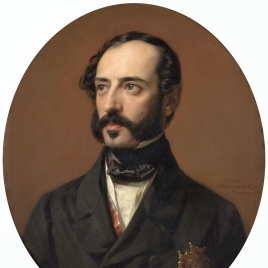
The painter Vicente Poleró
1873. Oil on canvas.Room 101
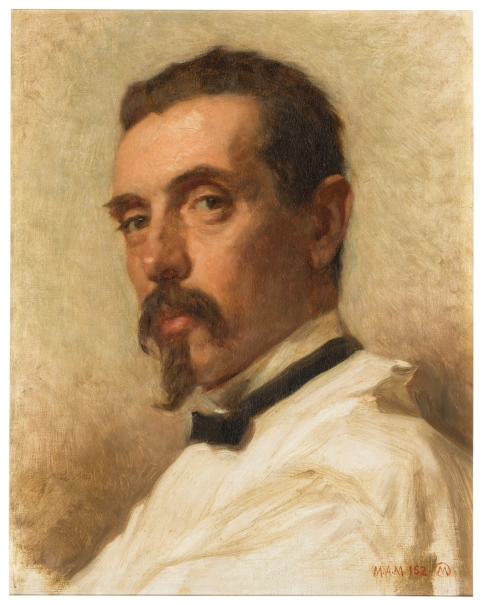
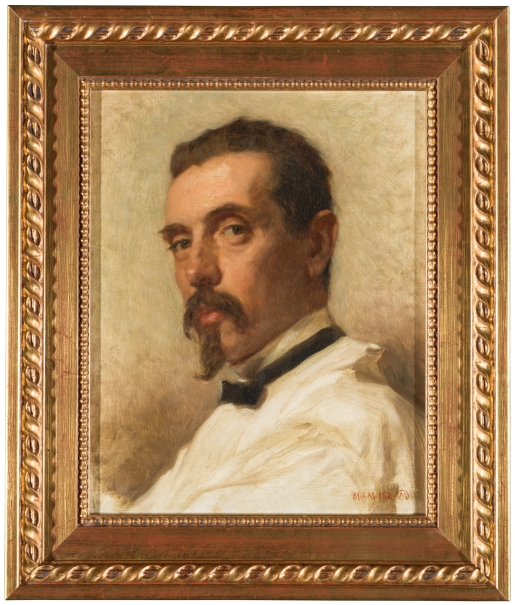
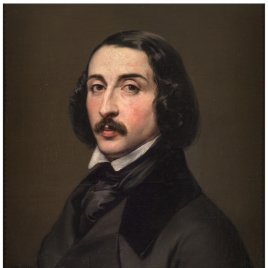
This work was painted in 1873, as indicated in the handwritten inventory of the portraits given by the painter. The work shows Madrazo´s friend at the age of 49, in profile, his face turned towards the viewer, with a bushy moustache and goatee in the fashion of the day. The dark bow tie knotted at the neck stands out against the lightness of his almost sketched shirt, the rapid, vibrant brushstrokes foreshadowing the style the artist would develop in the last phase of his output.
Vicente Poleró y Toledo, born in Cadiz in 1824, was a pupil at the School of Fine Arts in his hometown and later in Madrid at the San Fernando School of Fine Arts. His artistic life was always linked to restoration, the practice of which he theorised in 1853 through the publication of his work entitled Arte de la Restauración [The Art of Restoration].
Through José de Madrazo’s mediation, the artist was commissioned to restore the paintings at El Escorial. He carried out critical and historical studies on the collection of paintings, codices and manuscripts in the Monastery for three years until 1857. In 1863, when Federico de Madrazo was director of Museo del Prado, he was appointed the museum´s third restorer, a post he held until 1866. There was a fruitful and intense relationship of personal and professional trust between Madrazo and Poleró. They were undoubtedly mutually supportive, sometimes in tasks from which the museum benefited. As a result of this intense professional relationship, Poleró became a vocal defender of the great museum reform that, under the cover of the new political situation in the country, advocated the concentration in a single museum of the collections of the Prado and the National Museum located in the Convent of the Trinity.
His personality as a painter was somewhat subjugated by his role as a writer. He produced innumerable studies on private collections, iconography, portraits, and many others. He also excelled as a restorer. Nevertheless, he was awarded a second-class honourable mention at the 1860 National Exhibition and another one in 1867 for his settings of interior scenes staged withing monumental architecture and locations, undoubtedly an excuse to indulge his knowledge and documentary expertise. Lastly, Museo del Prado houses his piece in the same style The Chamber of King Philip IV in the Buen Retiro Palace (P006814), which was submitted to the 1881 National Exhibition (Gutiérrez, A. in: ‘El pintor Vicente Poleró Toledo’, Artistas Pintados. Retratos de Pintores y Escultores del siglo XIX en el Museo del Prado [‘The painter Vicente Poleró Toledo’. Painted Artists. Portraits of 19th-Century Painters and Sculptors in Museo del Prado]. Museo del Prado, Ministerio de Educación y Cultura and Àmbit Servicios Editoriales, 1997, pp. 134–135).
The rapid, sketch-like brushstrokes and the informal manner in which the sitter is presented, wearing a white shirt without a jacket and a black bow tie, indicates that this is a quick portrait of the kind Federico de Madrazo used to make as a gift for his friends (Quiroga Figueroa, M. in: Museo do Prado. Os depósitos no Museo Provincial de Lugo [Museo del Prado. The Deposits at Museo Provincial de Lugo]. Museo Provincial de Lugo, 2011, pp. 170–172).