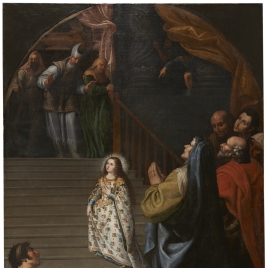
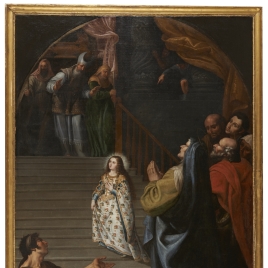
The Presentation of the Virgin at the Temple
1654. Oil on canvas.On display elsewhere
We begin to have information about Santiago Morán Cisneros, son of Santiago Morán – Philip III’s royal painter – and his wife Catalina de Cisneros, and his dedication to painting, between the mid-1630s and the beginning of the 1640s. In 1654, he signed The Presentation of the Virgin in the Temple in the Museo del Prado, and in the same year he is also known to have worked as an appraiser. The Prado’s painting is completely within the style of Vicente Carducho, as might be expected of an artist who was the son of a painter from the generation of the late 16th and early 17th century. Presumably, he trained with his father, which this canvas demonstrates despite its late date. The figures on the right are typical of Carducho, and the detail of the Virgin’s dress, with its solid silhouette, seems to date from at least 30 years earlier. Conversely, the figure of the beggar that is well-drawn yet with somewhat disproportionate hands seems to exemplify a more evolved style. The painting has two additions that changed the shape of the canvas from semi-circular to square, as can now be observed.
Angulo Íñiguez, Diego; Pérez Sánchez, Alfonso E., Historia de la pintura española: escuela madrileña del segundo tercio del siglo XVII, Madrid, Instituto Diego Velázquez, 1983, p.117,118,121