The slave
Ca. 1904. Gouache / tempera on cardboard.Not on display
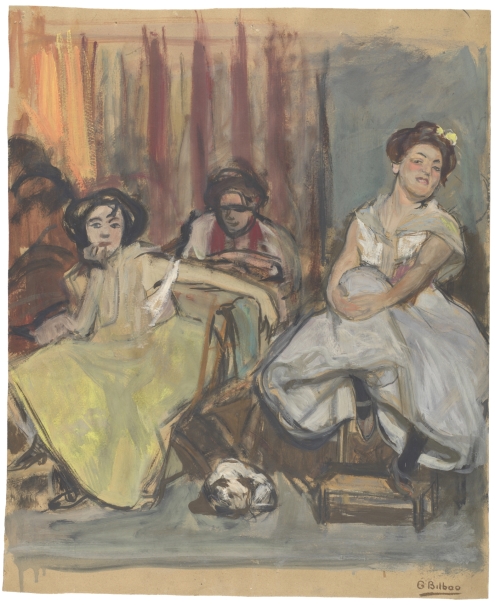
Preparatory cartoon for the artwork currently held at the Revoltella Museum in Trieste, Italy. The composition depicts the interior of a brothel. “[...] it is innovative in its approach, offering an alternative by displacing the protagonist from the center and granting greater prominence to a background figure, who has been repositioned. It should be regarded as the development of a partial study leading to the definitive conception.” At the center is the most recently incorporated woman into the system of exploitation, surrounded by others with greater experience. Through their gestures and expressions, the artist effectively conveys the psychological tension associated with the victims’ progressive assimilation into prostitution—a device through which the viewer is compelled to confront the broader societal responsibility in sustaining such practices.
They wear shawls, fans, hair ornaments, and some low-value jewelry. The protagonist stands out with a silver bracelet featuring large links and dangling charms, a model commonly known as an esclava, which Bilbao employed as a metonymic device to title the painting—likely intended to prompt a discernible micro-narrative, already evident in its earliest critical reception. Several elements in the canvas—such as the background figures, where a madam is faintly visible holding a cat and, in silhouette, a standing client; or the child innocently playing in the foreground, later painted over by the artist after the Madrid exhibition and before the painting was sent to Venice, whose outline remains perceptible in the materiality of the work, alongside a lapdog—invite the viewer’s complicity through a lens of moral discomfort, while also engaging themes at once rooted in costumbrismo and the private realities of brothel life, which certainly did not go unnoticed.
With careful plastic concentration on distilling the essence of the scene, Bilbao situates the composition in a dark interior, blocking the only natural light source—a background window—with a heavy curtain that filters the light, thereby submerging the setting in darkness and highlighting the central figure with artificial illumination. Executed with a rich yet highly refined technique and animated by a lively gestural finish, this work constitutes a substantial piece within the artist’s mature production.
Bilbao begins with gestural brushstrokes in lighter tones, which he subsequently modulates and adjusts with darker hues, ultimately unifying the forms through sinuous, rhythmic black contours that model the faces and finally articulate the highlights. The three women appear to float against an indistinct floor and background, emphasizing their presence in a deliberately ambiguous space.
A newspaper reproduced a conversation between Sorolla and King Alfonso XIII in front of the painting during the monarch’s visit to the exhibition, in which the latter downplayed the moralizing critiques of the work: “—Tragedies of poverty exist in every country! —exclaimed the King.” The fact that the painting addressed a publicly debated issue was precisely what made it one of the most favored works among visitors, as reported by numerous newspapers. Several outlets emphasized its moral dimension in a constructive manner, interpreting it as a form of denunciation—an interpretation that helped explain its popular appeal. Although the work did not receive the Medal of Honor for which it had been considered, it succeeded in entering the political and social discourse surrounding prostitution.
Particular attention should be paid to the treatment of the faces, ranging from the prominence of the woman on the far right—characterized by accentuated lips and flushed cheeks—to the dehumanization of the central figure, who remains shrouded in shadow. The two women positioned in the foreground gaze directly into the eyes of the viewer, compelling a sense of complicity, as if he were a client embedded within a society desensitized to such scenes.
G.Navarro, Carlos, 'Gonzalo Bilbao. La esclava (boceto). La esclava'. Arte y transformaciones sociales en España (1885-1910), Madrid, Museo Nacional del Prado, 2024, p.287-290 nº183