The Tooth-Puller
1844. Oil on canvas.Room 061
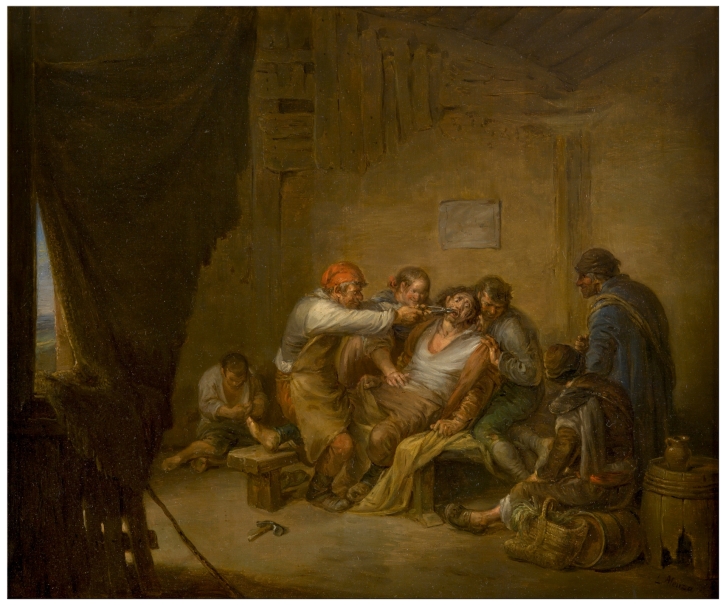
Shortly after his death, it was said that Alenza, like Goya, toured the slum areas of the Court, the taverns, the inns on the outskirts of town, and the cottages near the river, observing physiognomies, attires, manners, and popular customs in order to subsequently portray them in his pictures. The ambiance of this canvas, which is one of his best works, corresponds with one of those slums in Madrid.
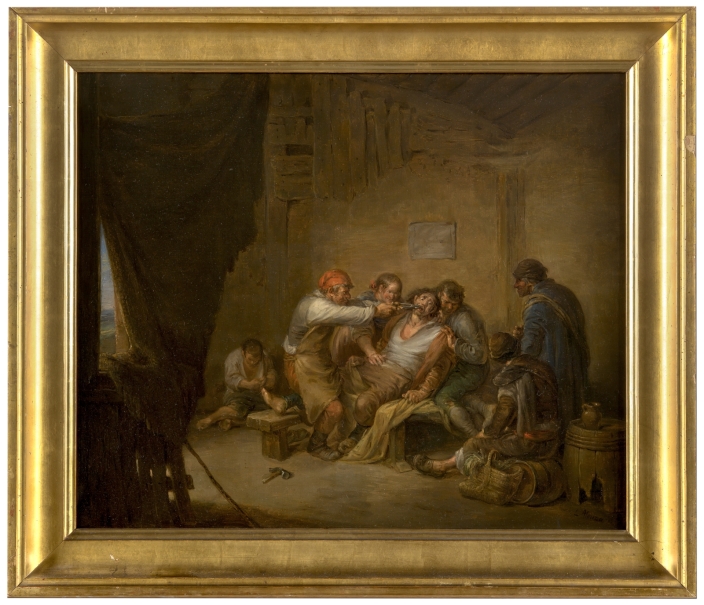
Painted in 1844, the year before he died, it not only is representative of his best moment as a painter but also provides an example of Spanish Romanticism. It demonstrates a clear relationship with Flemish and Dutch painting from the 17th century, during which time this was a common theme. The composition of the humble interior and certain details, such as the presence of paper on the wall and the barrels – one of which is broken, with a clay jug over its lid – recalls the work of Adriaen Brouwer and David Teniers, whose work was available in the Prado for the artist to see and who influenced many other of his works, revealing a taste for the grotesque that likens him to the Flemish painter. The poverty in the interior is even greater than in the aforementioned artists’ scenes. The wicker basket with scrawny vegetables – which appears in the scene, probably as a paltry payment for the pulling, since it occupies a similar place to that of the egg basket in Flemish and Dutch paintings that portray that subject – reveals the extreme poverty of the characters’ circumstances, which is also visible in their clothing. Among them, the bent position of the patient and his wide-open eyes seem to portray a hint of the main character in Alenza’s The Death of Daoíz in the Monteleón Artillery Park, although they are usual resources used to capture the greatest expressive intensity. The representation of the boy on the left, who appears to be delousing himself, was influenced by Murillo. This motif captured the painter’s attention, since an analogous figure to the boy can be found in The Delouser-Woman, an etching by Isidro Rosell made from an original drawing by Alenza. He produced other drawings around the same theme – which particularly drew his attention – as well as some canvases.
In the tooth puller’s figure, we see the artist’s preference for the canon corto. The man seizes a pair of pincers for the dental extraction, for which there is also a hammer in the ground, thus revealing the crude nature of that practice. This is emphasized by the brutal posture of the tooth puller, whose body is totally detached from his patient’s in order to apply more strength, while appearing almost always behind his patient – or sometimes before him, but close enough – in all the 17th-century paintings dealing with this subject matter. The red in the tooth puller’s hat and in the seated man’s belt on the right stand out amidst a colour palette in ochre, grey and dirty white that is typical of the artist. Moreover, Alenza was inspired by Goya, especially in the interior illumination that is coming from the left, where a tiny piece of landscape that is lacking in detail is barely visible. Nevertheless, the background wall stands out, painted in golden hues with a diluted paint applied in an undone technique. It shows in the careful gradation from gloom to brightness in the central area, a truthful sense of ambience, as well as a faithful representation of diversity in the wall textures, including bricks, plastering, a nailed plank and the patient’s right foot. The work could have been part of the delivery of 12 custom paintings to the 1844 exhibition at the Real Academia de San Fernando in Madrid.
Barón, Javier, 'Leonardo Alenza. The tooth puller'. The Nineteenth Century in the Prado, Madrid, Museo Nacional del Prado, 2007, p.137-138 nº.13