- Inventory number
-
D000673
- Author
-
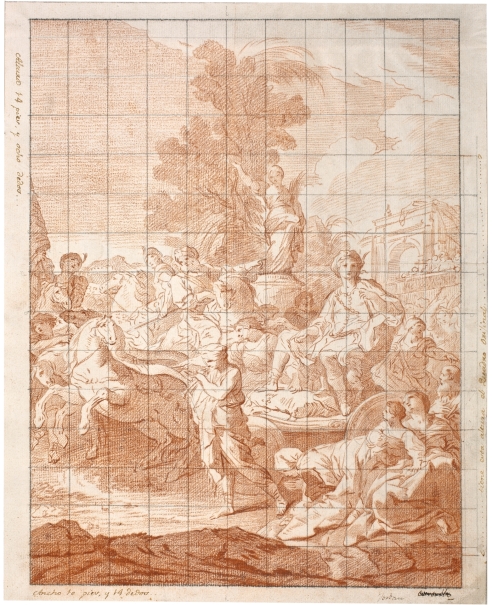
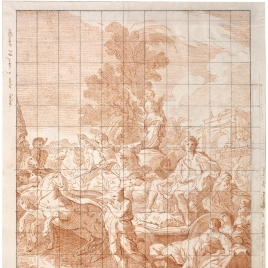
José del Castillo
- Title
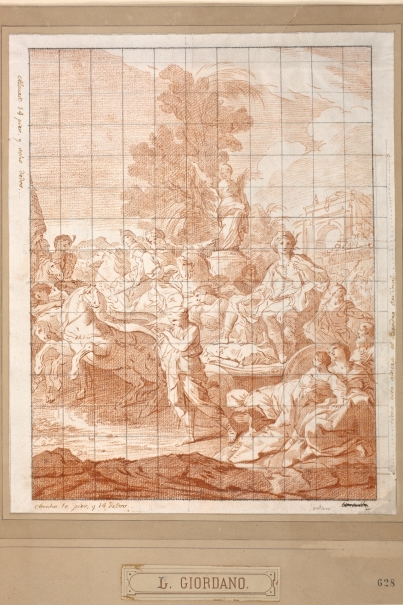
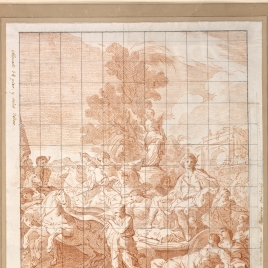
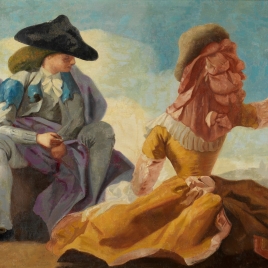
- The Triumph of Joseph
- Date
- 1770
- Technique
- Red chalk
- Support
- Laid paper
- Dimension
-
Height: 323 mm;
Width: 265 mm
- Provenance
- Royal Collection
Bibliography +
Garcia Saseta, Maria del Carmen, Corrado Giaquinto en España. Algunas Obras de Giaquinto en C..., [s.n], Mezzina, 1971, pp. 99.
Pérez Sánchez, Alfonso E., En torno a Corrado Giaquinto, Archivo español de arte y arqueología, 1971, pp. 398 / lám. VI.
Pérez Sánchez, Alfonso Emilio, Museo del Prado Catálogo de Dibujos T. III. Dibujos Españoles, Siglo XVIII C-Z, Museo del Prado, Madrid, 1977, pp. 28.
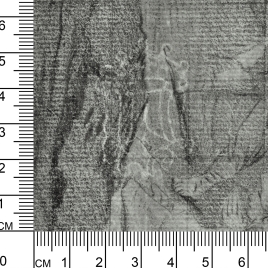
Filigree +
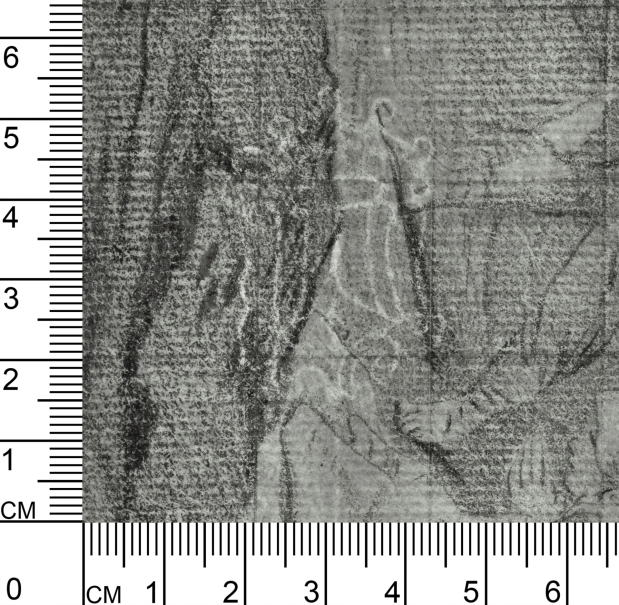
Motive: Escudo del Carmen
38 x 25 mm
Horizontales
Escudo de la orden del Carmen
La marca de agua con el escudo carmelita fue concebida y usada por vez primera por Francesc Romaní, en referencia al molino del Carmen (Capellades, Barcelona). Durante la segunda mitad del siglo XVIII y años iniciales del XIX fueron numerosos los molinos establecidos en la Riera de Carme, próxima a Capellades, y todos ellos utilizaron el escudo carmelita como motivo principal de sus respectivas filigranas: Alegre, Feliu Aloi, Bach, Joseph Barceló, Jaume Bas, Francesc Claramunt, Estevan, Esteve, Fageda, Josep Llorens, Perxas, Josep Verdaguer o Vilardell, entre otros.
Bibliography
Valls i Subirà, Oriol, Paper and Watermarks in Catalonia. Text, The Paper Publications Society, Amsterdam, 1970, pp. 310-313.
Valls i Subirà, Oriol, Paper and Watermarks in Catalonia. Watermarks, The Paper Publications Society, Amsterdam, 1970, pp. n. 775-779.
Other inventories +
Inv. General, Sección 3ª. Dibujos, grabados, acuarelas y miniaturas, 1879.
Núm. 167.
167. Triunfo de José hijo de Jacob. A. L. Jordan alto 0,33 ancho 0,27. marco negro y cristal.
Inv. Dibujos, Fondo Antiguo.
Núm. 628.
Inscriptions +
628
Printmaking.
Passepartout
tiene esta altura el quadro original
Inscribed in pen and ink.
Front, right side
Ancho 10 pies, y 14 dedos
Inscribed in pen and ink.
Front, lower left area
Altura 14 pies y ocho dedos
Inscribed in pen and ink.
Front, left side
Castillo (tachado) / Jordán (en letra posterior)
Inscribed in pen and ink.
Front, Lower right area
Update date: 20-05-2026 | Registry created on 28-04-2015