The Vision of Saint Francis
1601 - 1603. Oil on canvas.Room 004
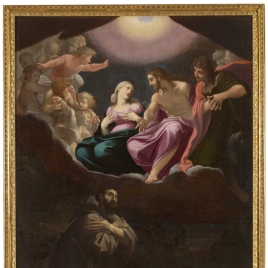
Ludovico Carracci’s Vision of Saint Francis is first described on the altar of the chapel in the Zambeccari family palace “behind Santa Maria Maggiore”, Bologna, in 1630: “An altarpiece of Saint Francis with the Blessed Virgin and Our Lord”. It is almost certain that the painting was commissioned by Luigi Zambeccari (1570–1630), perhaps soon after his marriage to Pantasilea Bentivoglio in 1600. The erudite Marcello Oretti (1714–1787) saw this Vision in another Zambeccari palace (formerly Casa Danzi), mentioning it twice in his notes. This painting is undeniably the same as the one described in the inventory of the estate of Francesco Maria Zambeccari, drawn up in 1752. It is unknown when and how the future King of Spain, Charles IV, acquired the picture, but this might have occurred even before his departure from Italy (where he was born) in 1765. Ludovico’s Vision of Saint Francis is listed in the Casita del Príncipe, at El Escorial, around 1787. It was then transported to the palace of Aranjuez, where it is mentioned in 1818.
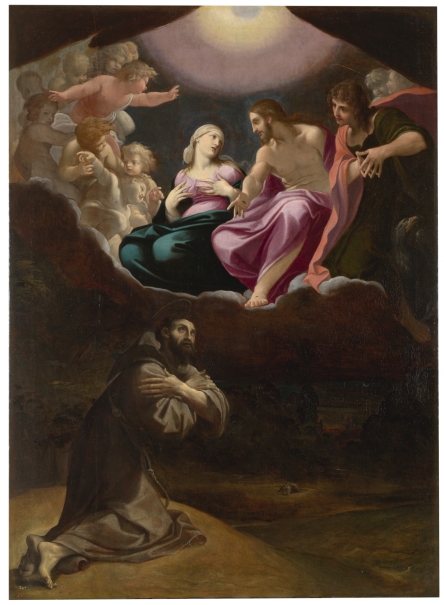
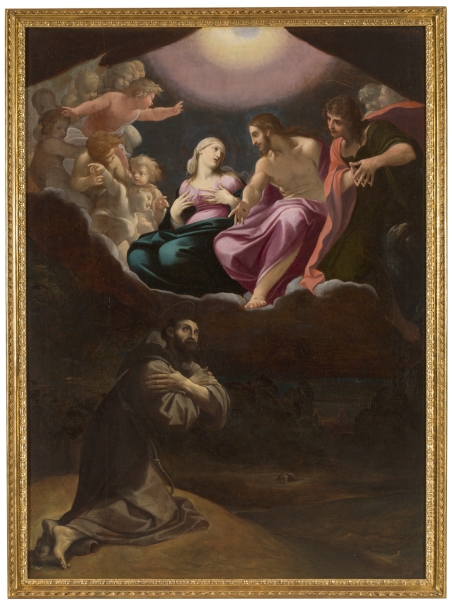
The painting seems inspired by an episode related in the Little Flowers of Saint Francis (a text written by Brother Ugolino Brunforte in 1327–37), where a young novice witnesses a miraculous event in the forest: “And reaching the place where Saint Francis was praying, he began hearing many voices speaking, and moving closer so that he might see and understand what he was hearing, he happened to see a marvelous light, which surrounded Saint Francis, and within it he saw Christ and the Virgin Mary, and Saint John the Baptist, and the Evangelist, and a great multitude of angels, who were conversing with Saint Francis.”
Although Ludovico took his cue from this account, he most probably bore in mind another episode also recorded in the Little Flowers, the vision of Brother Pietro. “One day”, Ugolino writes, “Brother Pietro, while praying and thinking most devoutly about Christ’s Passion, and how the most blessed Mother of Christ and John the Evangelist, his most beloved disciple, and Saint Francis were painted at the foot of the cross, crucified with Christ as a result of their suffering [with him] through their minds, he was overtaken by a desire to know who of the three of them had endured the greatest pain from Christ’s Passion, whether his mother, who had birthed him, or his disciple, who had rested over his chest, or Saint Francis, who had been crucified with Christ, and while dwelling on this devout reflection, the Virgin Mary appeared to him with Saint John the Evangelist and Saint Francis”.
Brother Pietro learned then that first the Virgin, then Saint John, experienced the greater pain on that occasion, but almost equal to theirs was Saint Francis’ agony, and his adherence to evangelical poverty even greater than Saint John’s.
By omitting the figure of Saint John the Baptist, and by stressing the theme of Christ’s Passion through the depiction of Jesus’ foot and hand wounds aligned with Francis’ stigmatized hand deployed in a gesture of devotion, Ludovico steers away from literally representing any of these two episodes from the Little Flowers, conflating them instead as a visual reflection on Francis’ imitatio Christi – his modelling himself entirely upon Christ – and exalting the uniqueness of his sainthood. In the painting, Ludovico stages a sort of disputatio, with the Virgin pointing to herself as a reminder of her motherly suffering, and Christ indicating Francis as if adding him to the group of those who, along with the Virgin and Saint John the Evangelist, “suffered with him” during the Passion. Prominently displayed, Christ’s palm, pierced through the nail wound, is directed to Francis below, enraptured in his vision, reminding the viewer of the famous episode of Francis’ stigmatisation at La Verna. In this manner, Ludovico highlights Francis’ role as alter Christus, while his appearing on the lower tier of the representation reinstates his different status within the theological hierarchy.
Ludovico’s Vision of Saint Francis might have been executed in 1601–3. Although Guido Reni was in Rome at the time, he had been competing with Ludovico, his former master, for different jobs since 1597–98, when he quit the Carracci workshop. In 1600, for instance, Guido had sought to snatch from Ludovico the commission of a Birth of Saint John the Baptist for the church and convent of San Giovanni Battista in Bologna to no avail. It is interesting that the patron of Ludovico’s Vision of Saint Francis, Luigi Zambeccari, became a great supporter of Guido’s, commissioning from him important paintings, such as a Samson Victorious and a Bacchus and Ariadne (Pericolo, Lorenzo, in David García Cueto (dir.), Guido Reni, Museo Nacional del Prado, 2022, pp. 156-158).
A reduced-scale copy on copper, dated around 1640, is kept in the Galleria Spada in Rome (inv. 179), from the collection of Cardinal Bernardino Spada (Information updated by the Department of Italian and French Painting until 1800 on 22/20/2021).