formularioRDF
The itinerary <em>TITULORECORRIDO</em> has been successfully created. Now you can add in works from the Collection browser
<em>TITULOOBRA</em> added to <em>TITULORECORRIDO</em> itinerary

Close Continuar a ficha de la obra Continuar a ficha de la obra
02-06-2026
Peter Paul Rubens
Siegen, Westphalia (Germany), 1577 - Antwerp (Belgium), 1640
Frans Snyders
Antwerp, 1579 - Antwerp, 1657

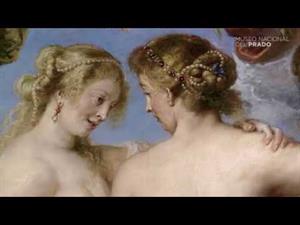
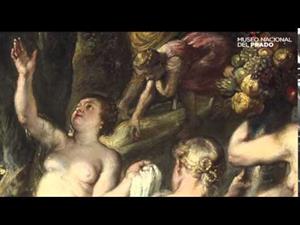
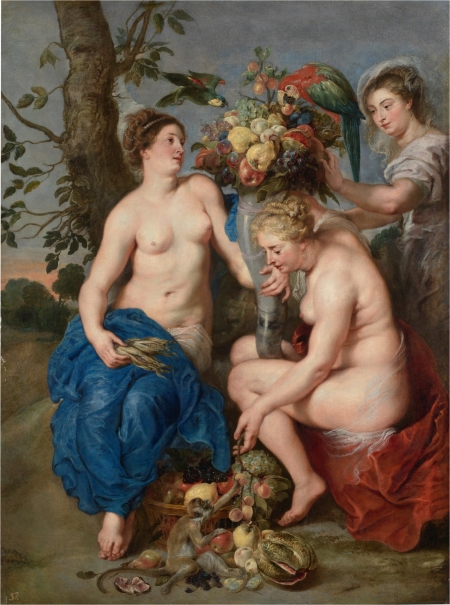
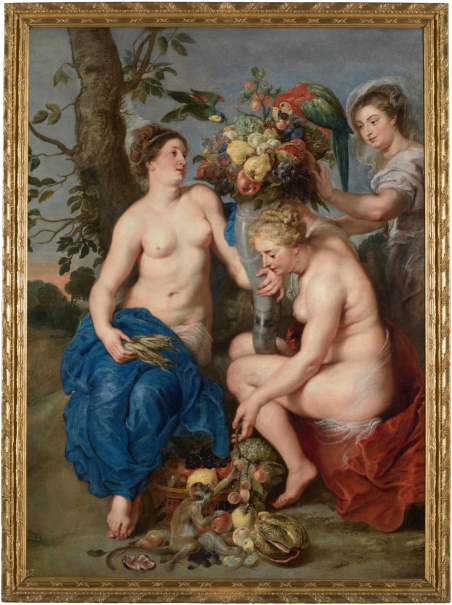
Three Nymphs with a Cornucopia

1615 - 1617. Oil on canvas.
Not on display

On Rubens’s death in May 1640, the largest collection of his works aside from his own (he was an important art collector and also retained many of his own creations) was that of King Philip IV of Spain. Philip’s attention had primarily been drawn to Rubens by his aunt, Isabel Clara Eugenia. It should be borne in mind that when the young king embarked on his reign in 1621, only a few works by the artist were to be found in Spain. From that moment on and thanks to the agency of the infanta, Rubens gradually became the king’s most highly prized painter, particularly in the last decade of his life.

The relationship between the infanta and the artist had become closer some years earlier. Around 1620, Isabel Clara Eugenia had requested that in addition to being court painter he should also act as her diplomatic adviser and she entrusted him with negotiations with representatives of the English crown which it was hoped would conclude with the signing of a peace treaty between the two monarchies. This dual relationship between Rubens and the archduchess – as a painter executing increasingly important commissions and as a 156 diplomatic representative – would have an important influence on Philip IV.

Rubens went to Spain in 1628 sent by the infanta, who considered that her nephew should be directly informed of the state of the negotiations with England. We know that the artist arrived in Madrid with eight paintings paid for by Isabel Clara Eugenia, and it is logical to think that with her close ties to the artist she was encouraging the king to focus his attention on him. One of those works was this canvas of Three Nymphs with a Cornucopia.

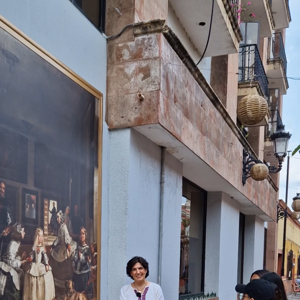
During his time in Madrid Rubens made an enormous impression on Philip IV, becoming his favourite artist. While at court he painted a now lost equestrian portrait of the monarch which was hung in the Alcázar in place of a similar one by the young Velázquez. Between 1630 and 1640 Philip commissioned Rubens to make dozens of paintings to decorate different rooms in the Alcázar. The artist seems to have been experiencing a period of fatigue at this time and he attempted to reduce his workload but with little success with regard to the Spanish monarch. One example of Philip’s passion for his art is to be seen in the background of Las Meninas, in which the paintings on the walls are depictions of works by Rubens commissioned by the king for the Torre de la Parada at El Pardo, just a few kilometres away.

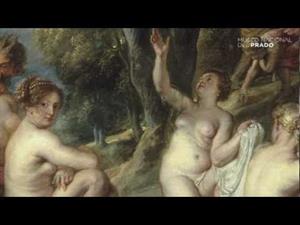
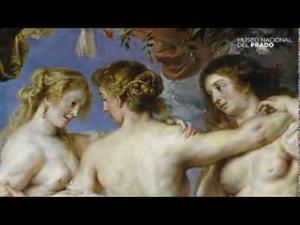
Three Nymphs with a Cornucopia is a quintessentially Rubensian image and an expression of the artist’s vision of life, indebted to the tradition of classical poetry and mythology. Here he speaks to us of concepts such as abundance, joy and fertility, which animate life and are recounted in the ancient myth of Achelous, who lost a horn that some nymphs filled with fruit and flowers (hence the term ‘cornucopia’, from the 157 Latin cornu, horn, and copia, abundance). Rubens accompanies the horn of plenty with another image which he considered to symbolise the beauty and fertility of nature and of the universe that he celebrates in this painting: the beauty of the female body depicted according to the canons of classical sculpture. Rubens became one of the principal transmitters of that classical tradition and its ideas, and it was he and his work that best expressed them at the Spanish court through the paintings that hung on the walls of the royal palaces. Once again we should not forget that the path which led Rubens to become Philip IV’s favourite painter was the one laid for him by Isabel Clara Eugenia.
Multimedia

Technical data

Imagen del carrusel
Imagen del carrusel
Inventory number
P001664
Authors
Peter Paul Rubens; Frans Snyders
Title
Three Nymphs with a Cornucopia
Date
1615 - 1617
Technique
Oil
Support
Canvas
Dimension
Height: 224.5 cm; Width: 166 cm
Provenance
Royal Collection (Real Alcázar, Madrid, Pieza nueva sobre el zaguan y puerta principal de el Palacio, 1636, s.n.; Real Alcázar, Cuarto principal Salón de los espejos, 1686, s.n.; Real Alcázar, Salón de los espejos Cuartos principales, 1701-1703, nº15; Real Alcázar, Pinturas que se llevaron a la Armería, 1734, nº37; Palacio del Buen Retiro, Madrid, Pinturas entregadas en dhas. Casas Arzobispales a Dn Santiago de Bonabia, 1747, nº37; Palacio Nuevo, Madrid, Antecámara de la Serenísima Infanta, 1772, nº37; Real Academia de Bellas Artes de San Fernando, Madrid, Pinturas que posee la Real Academia de Bellas Artes de San Fernando, 1796-1805, nº57; Real Academia de Bellas Artes de San Fernando, Sala Reservada, 1827, nº57; Museo Real de Pinturas a la muerte de Fernando VII, Madrid, Sala Reservada, 1834, nº60)

Bibliography +

Sánchez Cantón, Franciso Javier y Beroqui, Pedro, Inventarios Reales en 12 Volumenes y Un Indice (Fotocopias) (procedencia/provenance), 1923.

Bottineau, Yves, L'Alcázar de Madrid et l'inventaire de 1686. Aspects de la cour (procedencia/provenance), Bulletin Hispanique, 1, 1958.

Díaz Padrón, Matías, Museo del Prado: catálogo de pinturas: escuela flamenca, Museo del Prado Patronato Nacional de Museos, Madrid, 1975, pp. 321.

Fernández Bayton, Gloria, Inventarios reales: testamentaria del Rey Carlos II: 1701-1703 (procedencia/provenance), Museo del Prado: Patronato Nacional de Museos, Madrid, 1975.

Robels, Hella, Frans Snyders. Stibellen-Und Tiermaler 1579-1657, Deutscher Kunstverlag, Munich, 1989, pp. 374-375.

Díaz Padrón, Matías, El siglo de Rubens en el Museo del Prado: catálogo razonado, II, Prensa Ibérica, Barcelona, 1995, pp. 1094.

Anes, Gonzalo, Las colecciones reales y la fundación del Museo del Prado, Amigos del Museo del Prado, Madrid, 1996, pp. 202.

Vergara, Alejandro, The Presence of Rubens in Spain, I-II, A Bell & Howell Company, Ann Arbor, 1999, pp. 219-220.

Vergara, Alejandro, Rubens and his spanish patrons, Cambridge University Press, Cambridge, 1999, pp. 51.

V.V.A.A, El arte en la corte de los Archiduques Alberto de Austria e Isabel Clara Eugenia (1598-1633): un reino imaginado, Sociedad Estatal para la Conmemoración de los Centenarios de Felipe II y Carlos, Madrid, 1999, pp. 278.

Aterido Fernández, A.; Martínez Cuesta, J.; Pérez Preciado, J. J., Colecciones de pinturas de Felipe V e Isabel Farnesio: inventarios reales, Fundación de Apoyo de la Historia del Arte Hispánico, Madrid, 2004.

Balis, Arnout, Rubens l' atelier du génie, Racine, Bruselas, 2007, pp. 124.

Greub, Thierry, Der Platz des Bildes und der 'Platz des Königs', Diego Velázquez 'Las Meninas' im Sommer-Arbeitszimmer Philipps IV, Zeitschrift für Kunstgeschichte, Heft 3-4, 2015, pp. 441-487 [470 f.22].

Die Brueghel Familie : The Brueghel family, Städtische Galerie in der Reithalle, Paderborn-Sch..., 2015, pp. 273 n.83.

Barbeitio, J. M., De arte y arquitectura. El Salón de los Espejos en el Alcázar de Madrid, Boletín del Museo del Prado, XXXIII (51), 2015, pp. 24-43 [32].

Prado 12 Raksturi = 12 Characters from Prado Museum, Latvian National Museum of Art, 2017, pp. n.6.

Vergara, Alejandro, 'P.P. Rubens. Tres ninfas con el cuerno de la abundancia (Dulwich Picture Gallery)', En: Rubens pintor de bocetos, Museo Nacional del Prado,, Madrid, 2018, pp. 100-103 f.49.

Paolini, Cecilia, Peter Paul Rubens e gli arciduchi delle Fiandre meridionali, Ginevra Bentivoglio editoria, Roma, 2019, pp. 535.

Scott, Jennifer, 'Peter Paul Rubens and Frans Snyders. Three Nymphs with a cornucopia', En: Rubens & Women, Dulwich Picture Gallery, 2023, pp. 164 nº41.

Other inventories +

Inv. Felipe IV, Alcázar de Madrid, 1636. Núm. s.n..
Pieza nueva sobre el zaguan y puerta principal de el Palacio [...] {2421} Otros dos lienços yguales, del tamaño de los dichos [...] el otro, es la diosa Ceres con dos ninphas que tienen vna cornucopia de frutas y vn mico a los pies, que esta comiendo otras frutas

Inv. Felipe IV, Alcázar de Madrid, 1686. Núm. s.n..
Cuarto principal Salón de los espejos [...] (81) Otros dos quadros yguales de â dos varas y media de alto y dos varas de ancho [...]y el otro de vnas nimias con vna cornucopia de flores y frutas ambos de mano de Rubenes.

Inv. Testamentaría Carlos II, Alcázar de Madrid, 1701-1703. Núm. 15.
Salon de los expejos / Quarto prinçipales [...] 15 / Yten dos quadros iguales de a dos Varas y media de Altto y dos Uaras de Ancho [...] = Y el otro de Vnas Nifas con Vna Cornucopia de flores y fruttas ambos de mano de Rubenes tasado Cada Vno a tresçientos Doblones ... 600

Inv. Alcázar, Madrid, 1734. Núm. 37.
Pinturas que se llevaron á la Armería despues del incendio [...] 37 / Otra de dos varas y media de alto y dos de ancho, con marco dorado, bien tratado, de la Diosa Ceres, con diferentes figuras, de Rubens.

Inv. Felipe V, Buen Retiro, 1747. Núm. 37.
Pinturas enttregadas en dhas. Casas Arzobispales a Dn Santiago de Bonabia [...] 37 / Ottro Lienzo de dos varas y media de altto y dos de ancho de la Diosa Ceres con diferentes figuras originales de rubenes en quinze mil rrs

Inv. Carlos III, Palacio Nuevo, 1772. Núm. 37.
Antecámara de la Serenísima Infanta [...] 37 / Vn quadro que contiene a Ceres con diferentes nimphas que la vna tiene vna cornucopia de frutas de dos varas y media de alto y dos de ancho original de Rubenes

Pinturas que posee la Real Academia de San Fernando, 1796. Núm. 57.
Noticia de las pinturas que posee la Real Academia de San Fernando según el orden de su numeración [1796-1805] [...] 57 / Ceres y Pomona con el simbolo de la Abundancia donativo del R.N.S.

Academia, Sala Reservada, 1827. Núm. 57.
La abundancia y Pomona. / [Autor] Rubens / [Alto] 6 [pies] 5 [pulgs.] / [Ancho] 3 [pies] 5 [pulgs.]

Museo Real de Pinturas a la muerte de Fernando VII, 1834. Núm. 60.
SALA RESERVADA / Sesenta. La Abundancia: tres mugeres hermosas sosteniendo la cornucopia / Rubens Yd. [Escuela flamenca] / Lº / 40.560

Inv. Testamentaría Fernando VII, Real Museo, Sala Reservada, 1834. Núm. 60.
SALA RESERVADA [...] Sesenta. La Abundancia. Tres mugeres hermosas sostienen la cornucopia Rubens. Yd [Flamenca] Lº 40.560
Catálogo Museo del Prado, 1854-1858. Núm. 1662.

Inv. Real Museo, 1857. Núm. 1662.
Rubens y Sneyders / 1662. Ceres y Pomona. / Entre ambas tienen asido el cuerpo de / la abundancia que sostiene también una / ninfa, y al pie hay un cesto lleno de fruta, / entre la cual está sentado un mico. / Alto 8 pies; ancho 5 pies, 9 pulg, 6 lin.
Catálogo Museo del Prado, 1873-1907. Núm. 1585.
1585.-(1662-M.)-Céres y Pomona.-Tienen asido el cuerno de Amaltea ó de la Abundancia, que sostiene tambien una ninfa, y al pié hay un cesto lleno de fruta, entre la cual está un mico.-Figuras de tamaño natural. Col. de Felipe IV, R. Alc. y Pal. de Madrid. Alto 2,23; ancho 1,62.-L.

Inscriptions +

57.
Inscribed in white. Front, lower left corner

1662
Inscribed in orange. Front, lower left corner

Exhibitions +

Rubens and Women
Londres
27.09.2023 - 28.01.2024

The Female Perspective. Women Patrons of Art in The Museo Del Prado (1451–1633)
Madrid
14.12.2022 - 09.04.2023

On Tour through Spain
España
26.11.2018 - 08.12.2019

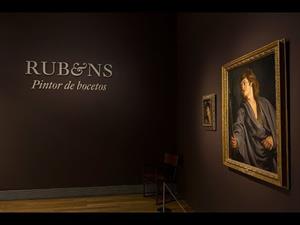
Rubens, pintor de bocetos
08.09.2018 - 13.01.2019

Rubens. Painter of Sketches
Madrid
10.04.2018 - 05.08.2018

12 Characters from Prado Museum
Riga
24.03.2017 - 16.07.2017

Rubens
Madrid
05.11.2010 - 23.01.2011

Rubens, a Genius at Work (Rubens and the Brussels Museums)
Bruselas
14.09.2007 - 10.02.2008

El arte en la corte de los archiduques Alberto e Isabel Clara Eugenia (1598-1633). Un reino imaginario
Madrid
02.12.1999 - 27.02.2000

Update date: 02-06-2026 | Registry created on 28-04-2015

Visor 360

Drag with the cursor to rotate the piece

Print on demand

Print artworks available in our catalogue in high quality and your preferred size and finish.

Image archive

Request artworks available in our catalogue in digital format.

Up