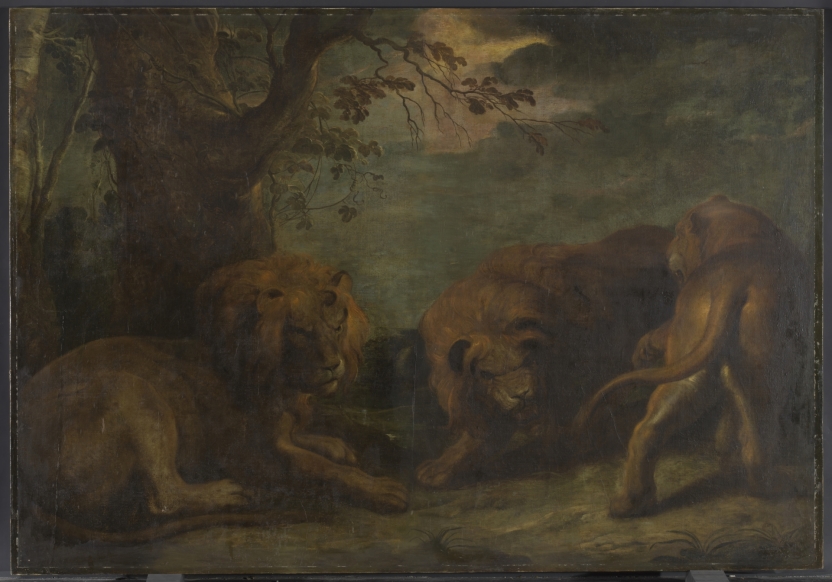
Two lions and a lioness
Ca. 1620. Oil on canvas.Not on display
This is an ambitious painting that has been well executed. The scene features three animals that repeat others from an important painting by Rubens, Daniel in the Lions’ Den, painted in around 1614 (National Gallery of Art in Washington DC). In a letter written on 28 April 1618, Rubens stated that he painted this picture ‘from life’, implying that he had studied at least some of the animals from live specimens.
There are several drawings of lions made by Rubens around 1612–13 in Brussels. The Archdukes Isabella Clara Eugenia and Albert of Austria, rulers of the Southern Netherlands, had some specimens there. He was also able to study lions in Ghent. Several of the drawings by Rubens (in the Albertina Museum in Vienna, the British Museum in London, and one in a private collection in the same city) show the same animals featured both in this painting and in Daniel in the Lions’ Den. Furthermore, one of the animals – the lioness – is known to be based on drawings by Rubens of Renaissance bronzes. Taking this information into account together with the knowledge we have of the artist’s working style, we can speculate on the origin of this painting. Firstly, Rubens must have studied lions from life and from Renaissance bronzes. He shared these drawings with his friend Jan Brueghel the Elder, who painted lions basing them on a painting of his, Noah’s Ark, 1613 (J. Paul Getty Museum). Rubens himself used these drawings as models in the abovementioned painting Daniel in the Lions’ Den, of which there are several versions, most probably by collaborators in the painter’s workshop. Furthermore, some of the lions were also used in the workshop of Rubens, or at least with the master’s permission, in order to produce different compositions. In this case, Rubens must have asked (or allowed) Snyders and Wildens – two of his collaborators who specialised in painting animals and landscapes, respectively – to use his drawings and paintings as models.
It is likely that the trees are by Jan Wildens, a specialist who worked with Rubens –especially between 1616 and 1620 – and who created the landscape backgrounds for some of his paintings (one example is in the Prado: Act of Devotion by Rudolf I of Habsburg, P001645). Judging from the quality and style of the lions’ heads, they are possibly by Frans Snyders, who worked with Rubens from 1609 onwards and painted the animals in some of his paintings. In the Museo del Prado there are several examples, the first and most important of which is The Recognition of Phililpoemen (P001851).
The provenance of the painting is not known with certainty. The owner only recalls that it was bought ‘from one of the infantes of the house of Orleans’. In spite of its poor state of preservation, due to its apparent quality and especially its proximity to Rubens, in whose workshop it was probably painted, this is a very interesting work.
Vergara, Alejandro, Atribuído a Frans Snyders y Jan Wildens. Dos leones y una leona. en: Memoria de actividades 2021 Museo Nacional del Prado, Ministerio de Cultura y Deporte, 2022, p.60-62