Andrea Belvedere
Naples, 1652 - Naples, 1732He was the last and most refined representative of the Neapolitan still-life tradition, which, following his death in 1732, seems to have nearly faded away. De Dominici describes him as a tall man with a prominent beard, aquiline nose, and brown eyes, dressed in luxurious fabrics appropriate to the season.
He began working in his native city in 1674. His style appears to have developed within the circle of Paolo Porpora and was notably inspired by the early works of Giuseppe Recco, as seen in the few preserved pieces from that period (Museo di Capodimonte, Naples; Museo Correale Terranova, Sorrento). Closely aligned with the style of Gian Battista Ruoppolo—of whom many of his works are considered indebted—he also shows the influence of the Flemish painter Abraham Brueghel, who had settled in Naples around 1671. From both artists, he drew a sense of sumptuous opulence, which he combined with his own natural inclination toward sentimentality and refinement. However, the most decisive influences on his creativity came from two foreign artists based in Rome: Karel von Vogelaer and Franz Werner von Tamm.
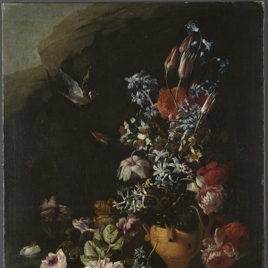
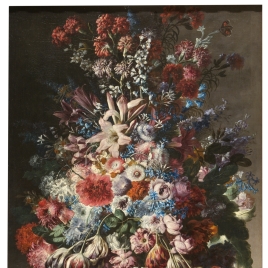
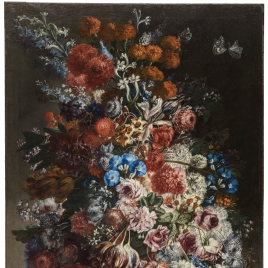
Best known for his floral paintings, he was called to the Madrid court of Charles II around the same time as Luca Giordano, residing there from 1694 to 1700. He worked actively for both the royal family and the aristocracy. De Dominici recounts that Giordano once embarrassed him by painting an elaborate still life filled with numerous elements after Belvedere had claimed that no one could surpass him in his genre. Nonetheless, Belvedere completed his commissions for the court and collaborated with both Giordano and Francesco Solimena. He was granted a pension and returned to Naples in 1700.
Upon his return, he largely abandoned painting and turned to theatrical pursuits, working as a playwright, set designer, and theatre impresario. According to his biographer, he spent his final years indulging in “entertainments, pastimes, conversations, and comedies.” He engaged in the study of literature, enjoyed philosophical discussions, and spent long hours exchanging ideas with friends.
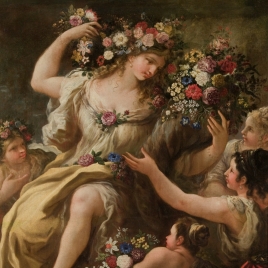
His large floral compositions, marked by exquisite chromatic refinement, undeniably foreshadow—through their compositional arrangements and tonal variety—many of the aesthetic and technical qualities that would later spread across Europe during the Rococo period. Indeed, he may be considered the Italian counterpart to what Jean-Baptiste Monnoyer was accomplishing in France and Britain at the time, discounting the rhetorical grandeur of the respective schools.
His workshop attracted a number of artists now recognized in their own right, many of whom collaborated on his works. Among them were the amateur physician Gaetano d’Alteriis, the gentleman Ferdinando di Fusco, Giuseppe Lavagna, Nicola Casissa, Gasparo López, and especially Tommaso Realfonso, known as “Masillo", who was the most involved in Belvedere’s paintings and encouraged him to resume painting after his return from Spain.