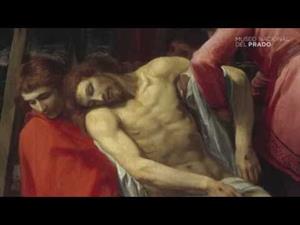
Bartolomé Carducho
Florence (Italy), ca. 1560 - Madrid (Spain), 1608Of this Italian painter, sculptor and architect, Ceán Bermúdez observed: "Few painters from Italy have been as useful for the fine arts in Spain as Carducho." And indeed, he is a key figure for understanding the development of painting at the Spanish court at the beginning of the 17th century. This is due not so much to his work as to the school of artists that trained under him, beginning with his brother, Vicente, who was eight years old when he arrived in Spain. Bartolomé had studied with Bartolomeo Ammannati, with whom he worked at the behest of the Grand Duke of Tuscany. He later collaborated with Federico Zuccaro, who had been requested to help decorate the monastery at El Escorial. While Federico returned to Italy, Carducho chose to remain at El Escorial, as he was apparently much appreciated by Phillip II. Period treatise writers praised his frescoes of “The Seven Liberal Arts” at the monastery's library, where they accompanied ceiling frescoes by Pellegrino Tibaldi. Beginning in 1590, there is documentation of other works by him for convents and private clients, as well as of his relation with El Greco, whom he probably met through their mutual friend, Zuccaro. Carducho was also much appreciated by the court of Philip III, especially by the king's favorite, the Duke of Lerma, who charged him with the task of obtaining artworks from Florence. In fact, he had already been active for many years as a dealer in Italian painting.
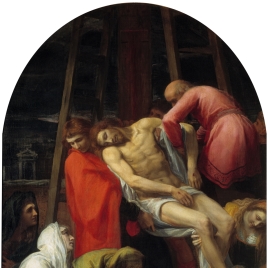
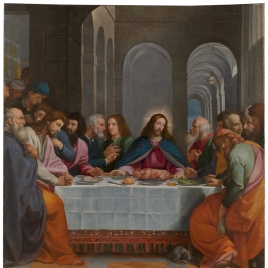
He accompanied the court when it moved to Valladolid, always in the company of the powerful Duke of Lerma, and he returned with it to Madrid in 1606. He died in El Pardo in 1608 while working on the decoration of that palace's Mediodía gallery. All of Bartolomé Carducho's works are marked by his training in the Tuscan tradition, with excellent drawing that situates it within the style known as reformed mannerism, a practice that assigned fundamental importance to a clear exposition of the subject matter. Like that period's Florentine painters, Bartolomé was also interested in aspects farther removed from his artistic outlook up to that time, including Venetian lighting effects and color, as well as naturalist effects. These discoveries are already masterfully present in his superb “Death of Saint Francis” (Museo Nacional de Arte Antiga, Lisbon), which dates from early in his career (1593). His two canvases at the Museo del Prado are the finest known works by his hand. The “Descent from the Cross” is more directly linked to the earlier mannerist tradition and justifies Palomino's affirmation that it alone "is sufficient to make this creator's name immortal." It was originally painted for the Chapel of Saint Rita at the convent of San Felipe el Real. And according to Palomino, his “Last Supper”was painted for the queen's prayer chapel at Madrid's Alcazar palace, but was later moved to the Buen Retiro palace, where it appears in the 1794 inventory (García López, D., Enciclopedia M.N.P, 2006, vol. II, p. 630-631).