Carstian Luyckx
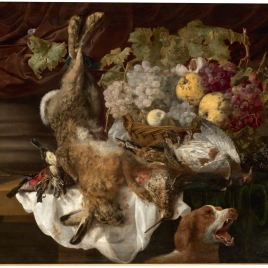
Amberes, 1623, post. 1653Luyckx was a Flemish painter who specialised in still life paintings in all their forms: vases, vanitas, banquets, festoons of flowers, fruit bowls, garlands. At the same time, he also produced several history paintings. From 1639 to March 1642, he received training from Philips de Marlier and was subsequently a pupil of Frans Francken III. He attained the rank of master on 17 July 1645. In 1646, he appears documented as a painter to the King of Spain in a record from the political chamber des tuteurs (of guardians) in the town of Antwerp. However, there is no other historical information to corroborate this fact.
The formal characteristics he employs are based on those of Jan Fyt, although on occasions, his works are closer in style to that of Jan Davidsz de Heem. He additionally worked in collaboration with other artists: for instance, with David Teniers II, exemplified by their work Garland with Chronos (Lazienki Palace in Warsaw), as well as with Nicolaes van Verendael. The style of his floral still lifes demonstrates the influence of Daniel Seghers’s work. He often produced funeral wreaths, the most famous of which was for the painter Victor Wolfveot in 1652. With respect to his work in the Museo del Prado Garland with three Putti, it is worth mentioning the balance of its triangular composition, which is considerably lighter than other similar works. This painting originates from the royal collection, into which it entered in the 17th century (Pérez Preciado, J. J., E.M.N.P., 2006, tomo IV, p. 1434).