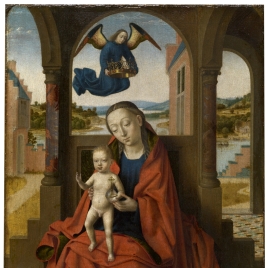
Petrus Christus
Baarle-Hertog, Antwerp, ca. 1410/20 - Bruges, post. 1475The earliest record of this artist born in Baarle, near Breda, dates from 1444, when Petrus Christus acquired citizenship rights in Bruges, where he presumably aimed to establish himself as an artist. Even so it is likely he was already living in the city before then. In Bruges he produced various commissions and many portraits of members of the Netherlandish aristocracy and bourgeoisie, progressively evolving towards realistic depictions set in very lifelike enclosed spaces. Many works are signed and dated between 1446 and 1457, such as “A Goldsmith in his Shop” (long identified as Saint Eligius) executed in 1449, now in New York (Metropolitan Museum of Art, inv. 1975.1.110), which has made it possible to ascribe many other paintings to him on the basis of their characteristic style and creative concerns.
Although it is doubtful whether Christus ever served in the workshop of Jan van Eyck, who died in 1441, he is assumed to have completed a few works begun by the latter, such as the “Virgin and Child with Saint Barbara, Saint Elizabeth and Jan Vos” in New York (Frick Collection, inv. 54.1.161) and the “Saint Jerome in his Study” in Detroit (Detroit Institute of Arts, inv. 25.4). The evident influence of Van Eyck, from whom he copies compositions and motifs, is combined with that of other artists such as Rogier van der Weyden, visible for example in his Brussels “Lamentation” (Koninklijke Musea voor Schone Kunsten, inv. 564). In addition, he occasionally drew on the oeuvre of the Master of Flémalle.
While the originality of the inscriptions bearing the signature and date on several of his works is debatable, they have made it possible to tentatively establish a sequence for his production. Indeed, his paintings attest to a progressive and increasing mastery of perspective and space based on geometric studies. These aspects show him to be a highly advanced artist and suggest a possible trip to Italy, which is not documented. He died between 2 September 1475 and 19 December 1476, most likely before 13 March that year, when his illegitimate son Bastyaen became a master of the Brussels guild (J.J. Pérez Preciado, "Fifteenth-century netherlandish painting at the Museo Nacional del Prado. Catalogue raisonné", Museo del Prado, 2024, p. 102).