Jan van Eyck
Maaseik (Belgium)?, ca. 1390 - Bruges, 1441Jan van Eyck originated from Maaseik (Meuse Valley) in the Netherlands. His date of birth is unknown, but he appears to be no older than fifty in what is presumed to be a self-portrait of him dated 1433 now in London (National Gallery, inv. NG222). Hailing from a family of artists, he had two brothers who were also painters and are documented between 1425 and 1442. There is no record of his early training, but he is known to have initially worked for John of Bavaria, Prince and Bishop of Liège and Count of Holland and Zeeland. Following John’s death in 1425 Van Eyck joined the service of Philip the Good, Duke of Burgundy, as painter and valet de chambre. With Philip’s financial support he was able to pursue an artistic career. He likewise made several trips on the duke’s behalf, including a visit to the Iberian Peninsula
in 1428–29. Around 1431 he established himself in Brussels, where he died in 1441.
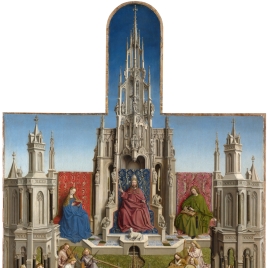
Jan’s main commission, the altarpiece of the “Adoration of the Mystic Lamb” for the church of Saint Bavo’s in Ghent (later the cathedral, Sint Baafskathedraal) – in which his brother Hubert († 1426) was also involved – was completed before 6 May 1432, according to an inscription. His many paintings that are dated and signed with great pride provide a basis for attributions grounded on his characteristic, personal style and make it possible to establish the 1430s as his most productive period, when he worked for prominent people in the Netherlands. Notable among the paintings dating from this decade that can be securely attributed to him are the “Arnolfini Portrait” of 1434 in London, the “Virgin and Child with Canon Joris van der Paele” of 1436 in Bruges (Groeningemuseum, inv. GRO0161.I), the “Triptych of the Virgin and Child with Saint Michael and Saint Catherine” of 1437 in Dresden (Gemäldegalerie, inv. 799), and the “Virgin and Child at the Fountain” of 1439 in Antwerp (Koninklijk Museum voor Schone Kunsten, inv. 411). His arresting style enjoyed great success on account of his mastery of oils and use of brilliant transparent brushstrokes and attractive glazes in highly realistic compositions deeply imbued with intellectual symbolism.
The large workshop he is documented as running, which employed many assistants – none of whose names are known – explains the large number of paintings executed under his influence or imitating his style, though they fall short of the quality of his documented works. In addition, there are doubts about his artistic activity prior to 1432 as there are no documented works by him before that year. His training as a miniaturist – an assumption based on certain scenes of the so-called Turin–Milan Hours dating from the previous decade – also points to an artist who was innovative in both technique and composition from early on (J.J. Pérez Preciado, "Fifteenth-century netherlandish painting at the Museo Nacional del Prado. Catalogue raisonné", Museo del Prado, 2024, p. 135).