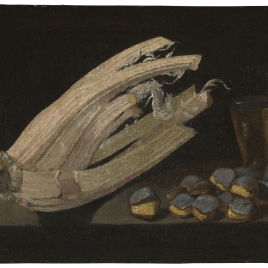
Francisco de Burgos Mantilla
Burgos (Spain), 1612 - Madrid (Spain), 1672He was the son of a lawyer at the Royal Court of Burgos but must have moved to Madrid when quite young. His second marriage—to a painter's daughter—took place there in 1645. According to Palomino, he learned the rudiments of art in Pedro de las Cuevas's workshop, but Lázaro Díaz del Valle called him a disciple of Velázquez, whose "manner" he follows, and added that he specialized in portraiture. The inventory of his property in 1648 describes a workshop full of drawings, as well as both Italian and Flemish engravings that he must have used for his work. There were also numerous copies of works by the great masters. Still, to date, nothing is known about the numerous portraits and religious works he must have painted. Only a still life signed by him in 1631 has served to link him with a similar work that entered the Museo del Prado from the Pablo Bosch legacy. Stylistically, these works are consistent with those made by still life painters from the sixteen thirties, that is, during Burgos Mantilla's youth. They must therefore be very different than the looser, Velázquez-oriented style that, according to his contemporary, Díaz del Valle, characterized his later work.