Francisco de Herrera the Elder
Sevilla (Spain), Hacia 1590 - Madrid (Spain), Hacia 1654Spanish painter and engraver. This artist is enormously representative of the evolution of the painting style developed in Seville in the first half of the 17th century, from the gradual imposition of the new naturalistic airs and the abandonment of the already outdated mannerism to the definitive arrival of freer and looser forms that would define the full Baroque. Even the artist's definitive transfer to Madrid in 1650 is eloquent of the situation of generalized crisis that is lived in those years in the Sevillian city. His father, Juan de Herrera y Aguilar, was a painter, illuminator and engraver, an activity that his brother Juan continued, a family trend that our painter also transferred to his own son, Francisco de Herrera el Mozo. Some old sources suggest that he was a disciple of Francisco Pacheco, understanding that he was first educated in his father's workshop. In any case, even if this is not fully confirmed, he did leave evidence of his good relationship with this master, which is not trivial in the case of Herrera, since the sources portray him as a particularly intransigent and difficult person, as proven by the documents that show his continuous lawsuits and conflicts.
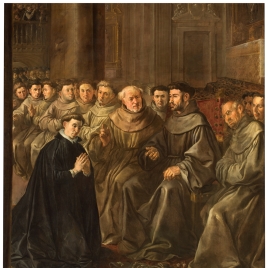
According to Palomino, Velázquez himself was a victim of this harsh character, who entered his workshop while still a child, where he only stayed for a few months before moving to his future father-in-law Pacheco's workshop. Herrera's first known work dates from 1609, the composition of an engraved book cover. It was in 1619 when he was sued to demand that he took the guild examination that he had not yet passed despite having been working for several years and having contracted in 1616 an important series of paintings for the convent of San Francisco. From the following decade on, he became one of the most praised and esteemed masters in Seville, receiving important commissions and being required from outside the city. In addition to practicing oil on canvas, he also cultivated fresco painting; an example of this is the decoration of the church of the Franciscan college of San Buenaventura in Seville (1626-1628), for which he developed his art in both modalities. One of the canvases of this cycle belongs today to the Prado Museum: "San Buenaventura receives the habit of San Francisco", undoubtedly the most interesting work of his hand that the museum possesses.
In the early years of his activity, he appears indebted to the art of illumination practiced by his father, especially in his concern for the linear. The late Mannerist formulas practiced by Pacheco are also present in this initial stage. But the most noticeable influence in the work of the mature Herrera was the art of Juan de Roelas, one of the leading figures of Sevillian painting in those years. From him derives above all the execution, with loose touches and Venetian roots, which Herrera exacerbated until he reached an extreme looseness of brushstroke. Thus, even though his works still have compositional schemes that are certainly mannerist, they are softened by the uninhibited technique he uses. His works reveal, at the same time, an unequal artist, in whom certain roughness and disharmonies can be noticed, which coexist with tonalities and atmospheres of an extraordinary finish (García López, D. in: Encicplopedia M.N.P., 2006, volume IV, pp. 1278-1279).