Jan Fyt
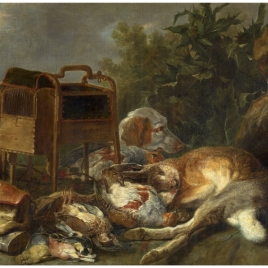
Antwerp, 1611 - Antwerp, 1661He began painting under the guidance of Hans van den Berch, with whom he began training around 1621. His great master, however, would be Frans Snyders. He attained the rank of master of the painters’ Guild of Saint Luke in Antwerp around 1629–1630, although he continued to work for Snyders for some time. In 1633–1634, he was in Paris, and later in Italy. He visited Naples, Florence and Genoa. Some data sources suggest he even travelled to Spain. In 1641 he returned to his hometown, where he was admitted into the select group of Romanists (an influential association with exclusive admission for those who had known the city of Rome). On numerous occasions, he collaborated with artists including Erasmus Quellinus, Jan Peeters and Jan Brueghel. His style is based on that of Snyders, some of whose works have been confused with Fyt’s, even though his paintings are notable for their characteristic general colour scheme, in contrast to his master’s taste for local colour. Fyt’s colouring is based on browns, greens and greys. This colouring may have been influenced by his visits to Paris and Italy. The selection of subject matter also distances him from Snyders, since Fyt preferred more concentrated compositions with motifs always placed in an asymmetrical manner, within a hierarchy inside and out of the main picture plane. The contrasts of light and shadow that suffuse the depicted elements endow them with greater plasticity and dynamism, as does the inclusion of vertical elements, where crossbows, rifles, stones and antique sculpture can be perceived. His still lifes are often situated in an outdoor setting, where the appearance of trees in the background and hunting dogs guarding their prey are frequent. His hunting scenes are also common, based on those of Snyders, as well as farmyard scenes. The paintings in the Museo del Prado encompass all the capabilities of the painter’s artistic creation. The high quantity of his works lies in the aristocratic and princely predilection of his paintings. In the 17th century, some collectors, including the Marquess of Carpio and the Count of Monterrey, already owned works by Jan Fyt. Nevertheless, it would not be until the 18th century, with Philip V, King of Spain, and Isabella Farnese, when most of his paintings in the Museo del Prado would be incorporated into the royal collection. The rest of them were donated in 1889 and came from the Duchess of Pastrana’s collection, an imitation of the aristocratic collections that had endorsed the appreciation of Jan Fyt’s oeuvre in previous centuries. He also achieved great mastery in the depiction of flowers, above all through the chromatic contrasts between the flowers and the ochre tones of their surrounding settings. In addition to canvases, Fyt is renowned for a large collection of drawings and engravings, in which he employed the same characteristics and manner as in his paintings. He had a great influence on the still-life painting of later years, particularly through his pupils Peeter Boel and David de Conick (Pérez Preciado, J. J. in: E.M.N.P., Madrid, 2006).