Artemisia Gentileschi
Rome (Italy), 1593 - Naples (Italy), 1652/3She was an Italian painter, daughter of the painter Orazio Gentileschi, from whom she received her artistic training and to whom she was indebted, particularly in her early works. After a stay in Florence (1614-1620), she settled in Rome between 1620 and 1627, with brief trips to Genoa and Venice. By 1630 she was in Naples, where she established her studio and maintained close contact with Stanzione. This is where she produced the most prolific part of her work, becoming one of the most significant artistic figures in the city and influencing the Neapolitan art scene, particularly Stanzione, Finoglia, and Cavallino.
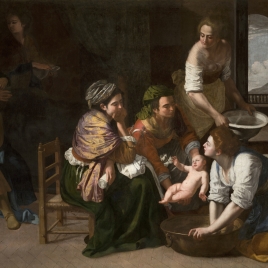
Between 1638 and 1639, she had a brief interlude in Naples, traveling to London, where her father was located. During this period, she continued to paint, with works known to have been created for the English nobility. Her earliest signed and dated work is "Susanna and the Elders" (1610), completed at just seventeen years old, which already displayed two concerns that would frequently appear in her art: the representation of heroines and the female nude. Her extensive travels placed her in a privileged position for both the appreciation of contemporary painting and the great examples of the previous century. Trained in her father's softened Caravaggism, which she also reproduced in his elegant style, she showed a preference for more dramatic tones than his. Additionally, she utilized color and light effects in ways that Caravaggists had not yet explored, making her a leading figure in the transformation of Neapolitan painting during the 1630s. This period marked a shift from strict naturalism to an appreciation of atmospheric and chromatic values characteristic of Neo-Venetianism (García López, D. in Encyclopedia of the Friends of the Prado Museum Foundation, 2006, vol. IV, pp. 1148-1149).