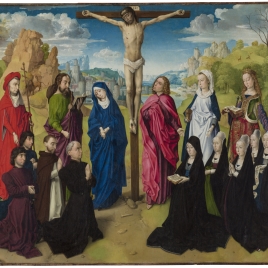
Hugo Van Der Goes
Gante (Belgium), ca 1440 - Oudergem (Belgium), 1482Born in Ghent around 1440, Hugo van der Goes is first documented in 1467, the year he registered with the painters’ guild in the city, where he was involved in several decorative projects for public celebrations during the following years. He performed similar work in Bruges in 1468 for the wedding of Charles the Bold and Margaret of York. In 1480, by which time he was already an acclaimed artist, he was dispatched to Leuven to value the paintings Dirk Bouts had left unfinished at his death. Shortly afterwards he withdrew from public life and went to live in an Augustinian monastery near Brussels, where he carried on painting. There he suffered from a mental disorder that apparently stemmed from his yearning to achieve artistic excellence. He died in 1482.
His best-documented work is the so-called “Portinari Triptych”, now in the Gallerie degli Uffizi in Florence. According to much later sources such as Giorgio Vasari and Lodovico Guicciardini, it was executed for Tommaso Portinari, a Bruges merchant, by a certain Hugo of Antwerp, whose identification as Van der Goes is fully accepted. Other important paintings have been attributed to him based on the style of this work, including the four panels of the “Trinity Altarpiece” depicting King James III of Scotland, his wife and son, a donor and a Trinity, which were part of an ensemble commissioned in the 1470s for the Holy Trinity Church in Edinburgh, now in the National Galleries of Scotland on permanente loan from the British Royal Collection (inv. NG 1772). Other works that are similarly undocumented but unreservedly attributed to him are the “Adoration of the Magi” from the college of Nuestra Señora la Antigua in Monforte de Lemos and an “Adoration of the Shepherds”, both in Berlin (Gemäldegalerie, inv. 1718 and 1622A, respectively), as well as the “Death of the Virgin” in Bruges (Groeningemuseum, inv. GRO0204.I) from the abbey of Ten Duinen in Flanders.
Van der Goes’s highly idiosyncratic and recognisable style is also found in various paintings by other artists referred to in the sources as copies of the master’s works. His artistic interests were based on the fine, detailed technique of Jan van Eyck and the characteristic concern with perspective of Petrus Christus and Dirk Bouts, as well as on very striking reflections on pictorial illusionism and the artificiality of artistic representation; for example, in the Berlin “Adoration of the Shepherds” two figures draw back a curtain allowing the spectator to witness the event.
Despite his short career, which spanned barely fifteen-years, Van der Goes was a key figure in the development of art in Ghent together with Joos van Wassenhove (Justus of Ghent, act. 1460–c. 1480), with whom he had a close relationship. Both influenced other local artists (J. J. Péez Preciado,"Fifteenth-century netherlandish painting at the Museo Nacional del Prado. Catalogue raisonné", Museo del Prado, 2024, p. 148).