Margherita Caffi
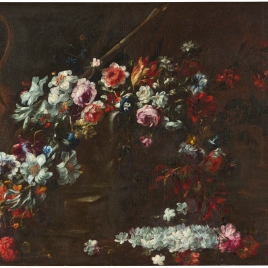
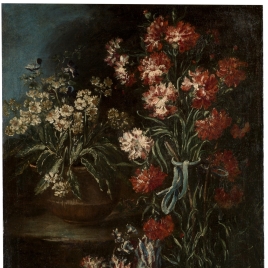
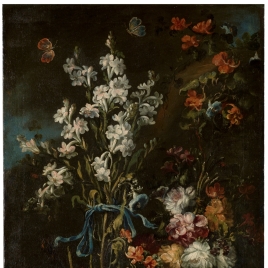
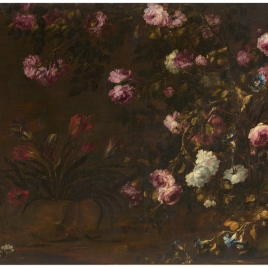
Milan (Italy), 26.03.1648 - Milán, 20.09.1710She was considered a Venetian artist in the seventeenth-century inventories of the collections of the Florentine Medici family. However, it has been confirmed that she was born in Milan, and that she was the daughter of a still life painter named Vincenzo Voló. She took Caffi as a last name after marrying Francesco Caffi, a Cremonese artist also specialized in painting flower arrangements and tapestry design. She worked in Tuscany for the Medicis and in Innsbruck and in Madrid for the House of Austria. She primarily devoted herself to painting flower arrangements. Her compositions are characterized by the chromatic predominance of blue and carmine, as well as by the contrast between bright white spots against shadowed backgrounds. She rarely used landscape backgrounds to set her still life paintings. The flower arrangements are usually displayed in two irregularly sized groups, giving a certain movement to the composition. Unlike her Northern European contemporaries, she does not seem to show a scientific intention in describing the flowers, often inventing flower species using her imagination (Sánchez del Peral, J. R., Encyclopedia of the Friends of the Prado Museum Foundation, 2006, T.II, pp. 587-588).