Pedro de Camprobín
Almagro, Ciudad Real, 1605 - Sevilla, 1674He is known to have signed an apprenticeship contract with well-known painter Luis Tristán in Toledo when he was fourteen years old (1619). That explains his strong tenebrist approach, which decidedly contrasts with what could be presumed to have been his education as a child, given that his mother, Juana Passano, was related to the wives of the Peroli brothers, Juan Bautista and Esteban, Genoese painters who had decorated the Marquis of Santa Cruz's Viso del Marqués Palace in a highly mannerist style.
In 1630, Camprobín took his exam with the Painters' Guild in Seville, and from then on, his activity there is abundantly documented, including a variety of contracts ranging from altarpiece restorations (1652) to a series of flower paintings for different convents. In 1660, he was listed among the founders of the Academy of Painting in Seville, alongside Murillo, Herrera "the younger", Valdés Leal and others, and he belonged to it for the rest of his life.
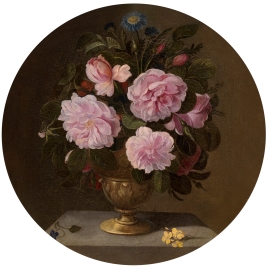
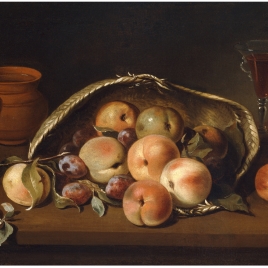
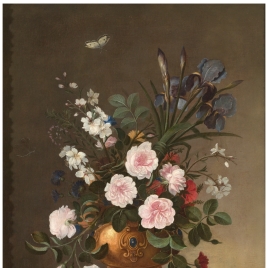
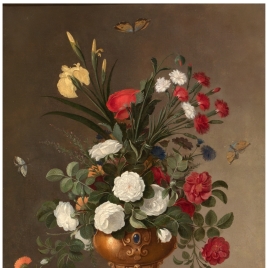
Knowledge of his work has been enriched in recent years by a variety of valuable contributions that have completed his profile. His oldest surviving work is a Still life at the Meadows Museum in Dallas (1623), which is from his early youth and clearly reflects the approach to painting in Toledo at that time. Later, in Seville, he seems to have taken an interest in Zurbarán's art; both his canvases with figures—Mary Magdalene (1634), church of El Salvador, Seville—and his characteristic flower canvases, which are elegant and austerely expressive, with a sober and reduced range of colors and a treatment of certain elements of Flemish origin (butterflies and insects) that reveal an extraordinarily personal degree of measure and contention.