Caravaggio (Michelangelo Merisi da Caravaggio)
Milan (bapt.), 1571 - Porto Ercole, Grosseto, 1610Caravaggio revolutionized painting in a realistic sense and had a fundamental influence on numerous artists of the 17th century. He was apprenticed to Simone Peterzano from 1584 to 1588 and also benefited from the works of other Lombard painters. In mid-1592 he moved to Rome, where there is no direct documentary evidence until 1599. With other painters, especially Giuseppe Cesari, called Knight of Arpino, he formed a partnership to sell his works, of small size, with the single figure of a boy represented with all realism, including lights coming from the left and light colors. "Buona ventura" (The Capitoline museums, Rome) and "I bari" (Kimbell Art Museum, Fort Worth, Texas) attracted the attention of Cardinal Francesco del Monte around 1595, who became his patron and lodged him in his palace until 1600. A great lover of the arts, he commissioned several genre artworks (Musica, Metropolitan Museum of Art, New York), religious ("Santa Caterina d'Alessandria", Thyssen-Bornemisza Museum, Madrid) or mythological (decoration of his casino) and provided him with other distinguished clients: Cardinal Borromeo ("Canestra di frutta", Pinacoteca Ambrosiana, Milan), the banker Costa, the Marquis of Giustiniani and Cardinals Barberini and Aldobrandini. Along with a greater spatial dominance and more dramatic emotion, around 1598 he gradually darkened the backgrounds and abandoned the previous clarity.
In 1599, del Monte himself provided his first public commission: the paintings of St. Matthew in the Contarelli Chapel (San Luigi dei Francesi). Although he was not accustomed to large canvases and numerous figures, he achieved masterpieces that made him famous for their radically Christian interpretation and human realism. In 1600 he received another public commission from Cardinal Cerasi for his chapel of Santa Maria del Popolo: "Vocation of St. Paul" and "Martyrdom of St. Peter", which confirmed his ability to interpret the sacred theme with unsurpassed dramatic emotion, as a transcendental situation in the life of men. At the beginning of 1601, the Mattei brothers, in whose palace he lived until 1605, became his new patrons ("Cena in Emmaus", 1601, National Gallery, London; "Cattura di Cristo", 1602, National Gallery of Ireland, Dublin). The commissions of the great collector Giustiniani were of considerable importance ("Amore vittorioso", 1601-1602, Staatliche Museen, Berlin; "Incredulità di San Tommaso", ca. 1602, Schloss Sanssouci, Potsdam). There were other commissions for Roman churches: "Deposizione" (1603-1604, Chiesa Nuova), "Madonna dei Pellegrini" (1605, Sant'Agostino), "Madonna dei palafrenieri" (1605-1606, Galleria Borghese, Rome), "Morte Della Vergine" (1605-1606, Musée du Louvre, Paris); he also obtained private commissions with St. John the Baptist, St. Jerome and St. Francis as protagonists. In May 1606, the painter killed Ranuccio Tomassoni, leader of a band of bandits, in self-defense. He fled from Rome to the Colonna territories and was sentenced to three years' banishment from the papal territories. In Naples (October 1606 to July 1607) he painted "Sette opere della Misericordia" (Pio Monte della Misericordia), "Flagellazione di Cristo" (Museo Nazionale di Capodimonte, Naples) and "Crocifissione di Sant'Andrea" for the Count of Benavente (Cleveland Museum of Art). In Malta (until 1608) he painted portraits of the Grand Master Alof de Wignacourt (Louvre) and the great "Decollazione del Battista" (Museum of the Cathedral of Valletta), a masterpiece of tragic desolation in the death of the innocent. In Sicily (until October 1609) he painted "Seppellimento di santa Lucia" for his church in Syracuse, "Resurrezione di Lazzaro" and "Adorazione dei pastori" (Museo Regionale di Messina), and "Natività con San Lorenzo e San Francesco" for San Lorenzo in Palermo. He returned to Naples, where he continued to paint intensely ("Salomè con la testa del Battista", Royal Palace, Madrid) until May ("Martirio di Sant'Orsola", deposited in Capodimonte, for Marcantonio Doria).
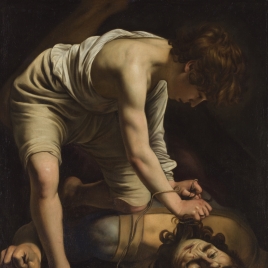
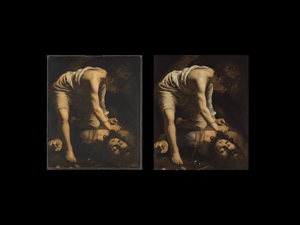
He had sent a "David con la testa di Golia" - a work in which he portrayed himself - to Cardinal Borghese, Prefect of Grace and Justice, as a sign of repentance. Waiting for the promised pardon, he left Naples for Rome, but probably due to dysentery, he died on July 18, 1610 in Porto Ercole, on the border with the Papal States (Cruz Valdovinos, J. M. in Enciclopedia M.N.P., 2006, volume II, pp. 623-624).