formularioRDF
The itinerary <em>TITULORECORRIDO</em> has been successfully created. Now you can add in works from the Collection browser
<em>TITULOOBRA</em> added to <em>TITULORECORRIDO</em> itinerary

Metabuscador

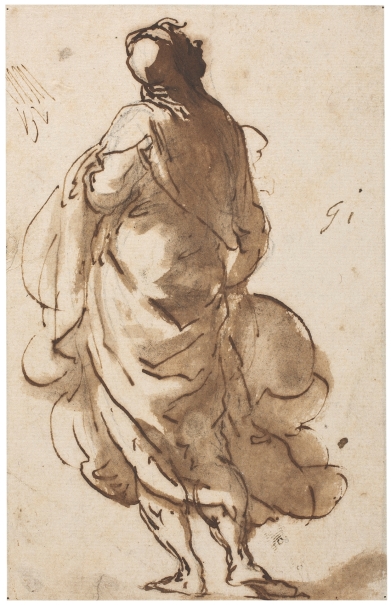
Figure Seen from Behind
Wash, Pencil ground, Grey-brown ink, Pencil on paper. Late XVI - Primer tercio del siglo XVII century
The traditional attribution to Domenico may well be correct, though some aspects of the style suggest the work of Alessandro Maganza (1556-after 1630).
ARTWORK
Domenico Tintoretto – (Attributed to)
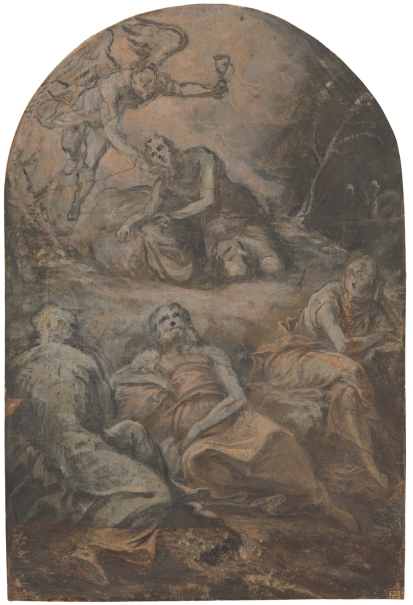
Prayer in the Garden
Gouache / tempera on paper. Late XVI - Primer tercio del siglo XVII century
As Anna Forlani has observed in a note on the museum mount (1980), this drawing is a typical work of the son of Jacopo Tintoretto (1519-1594), Domenico, who was taught by his father and assited him in his workshop. The drawing has been extensively restored, especially in the lower half of the design, presumably in the eighteenth century.
ARTWORK
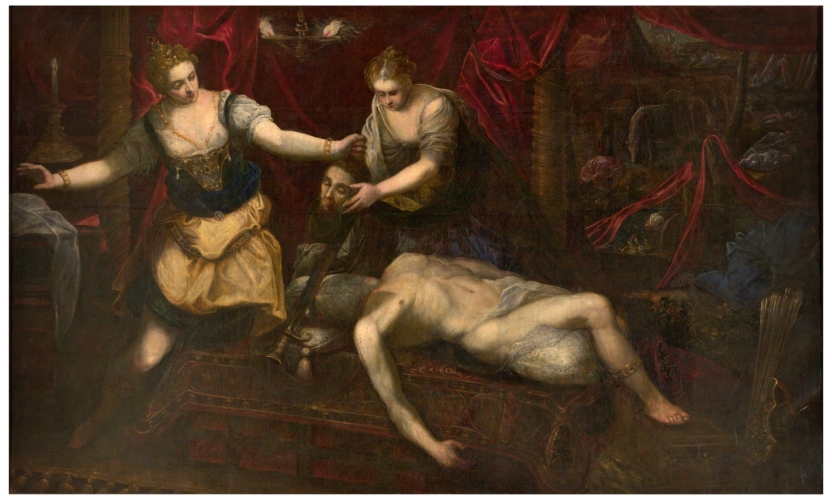
Judith and Holofernes
Oil on canvas. 1560 - 1600
Judith was one of the biblical heroines. The Old Testament narrates how this beautiful and honourable Israelite widow freed her people from the subjugation of the Syrian army by seducing the general Holofernes and then killing him with her own sword while he slept in a drunken stupor. This led to the flight of the Syrian army and the victory of the Israelites. Judith was the personification of moral rectitude and faith in God, but also of valour and courage; a woman willing to risk her life to a
ARTWORK
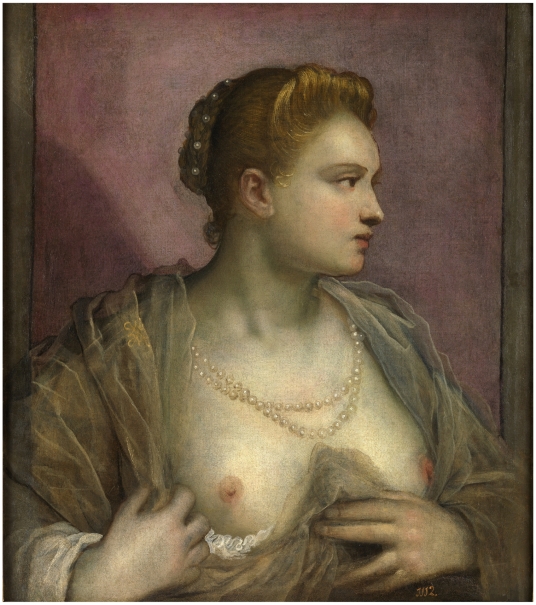
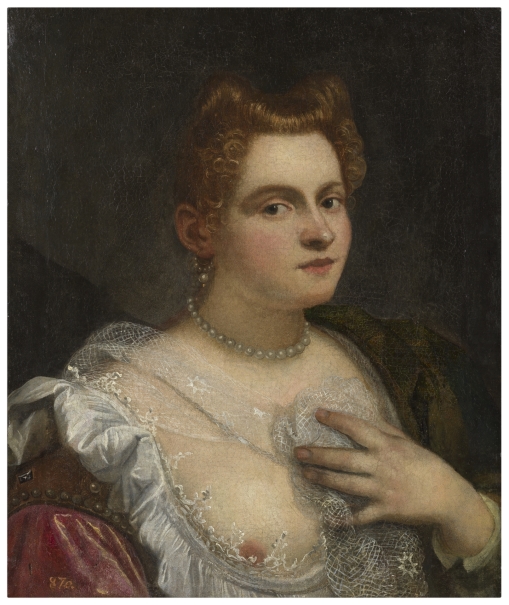
Lady revealing her Breast
Oil on canvas. 1580 - 1590
A number of portraits of Venetian ladies entered the Spanish royal collection between 1636 and 1666. One is known to have hung close to Las Meninas and beside Guido Reni’s Girl with a Rose in Philip IV’s summer study at the Alcázar in Madrid, as part of a decoration programme designed by Diego Velázquez (1599–1660). Given the absence of detailed descriptions in the inventories, coupled with changes to the format of some of these works, it is difficult to identify the canvas in ques
ARTWORK
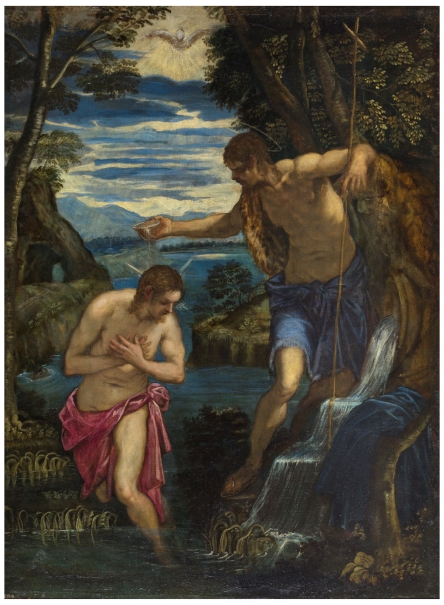
The Baptism of Christ
Oil on canvas. Ca. 1585
Dressed in camel skins, Saint John the Baptist baptizes Christ in the River Jordan. According to the New Testament, the Holy Ghost descended at that very moment in the form of a dove —depicted in the upper part of the composition— and a voice was heard from on high, saying: “This is my Beloved Son, in whom I am well pleased.” (Matthew 3, 13-17; Mark 1, 9-11; Luke 3, 21-22). Previously attributed to Jacopo Tintoretto, this work is rather by his son Domenico. This painting is considered the one li
ARTWORK
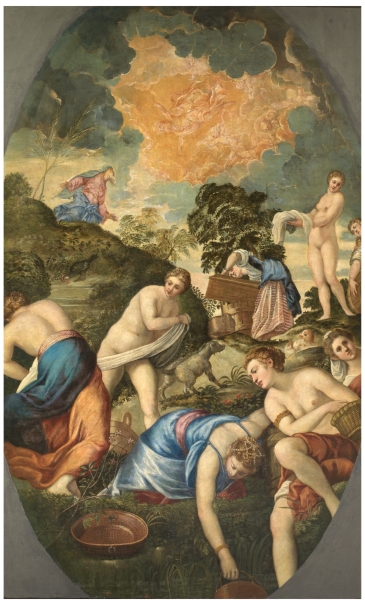
The Purification of the Midianite Virgins
Oil on canvas. Last quarter of the XVI century
This is one of seven canvases (P00386, P00388, P00389, P00393, P00394, P00395, P00396) in a group linked by the same color scheme, a general accentuation of surface drawing and a rhythm of curved forms that link on painting to another. The scenes were designed to be seen together, at a certain height and laid out on canvases conceived as inclined planes that converged on a central painting. Clearly, this group was intended for a profane setting. The biblical themes have lost their dramatic chara
ARTWORK
Jacopo Robusti Tintoretto – (and workshop)
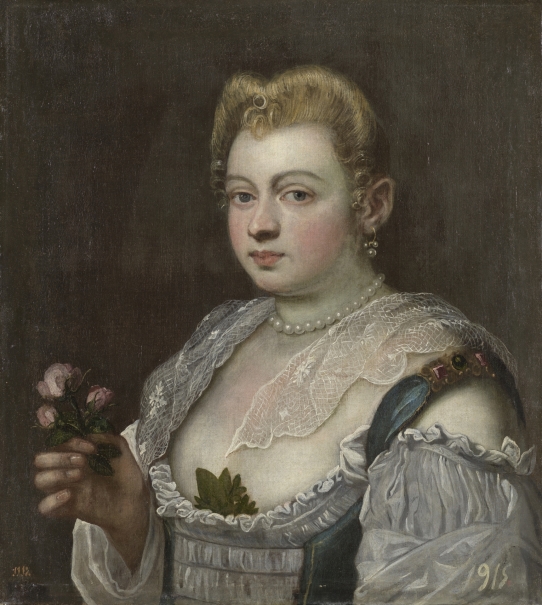
Flora
Oil on canvas. Ca. 1590
There are two classical Floras: the mythological goddess, wife of Zephyrus and an example of marital harmony and fertility; and the legendary Roman prostitute of that name. The two became associated in the Middle Ages, and by the Renaissance both young brides and courtesans were identified with Flora. The wild rose held by this figure has a similarly dual meaning: a symbol of both marital fecundity and carnal love.
ARTWORK
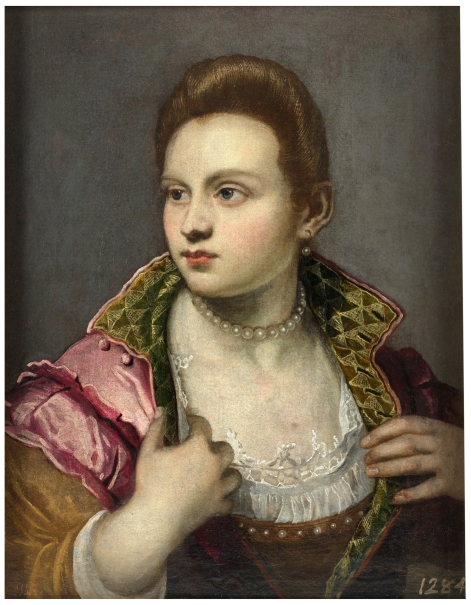
Lady covering her Breast
Oil on canvas. 1580 - 1590
The two canvases P382 y P384 are by the same artist and were probably intended as a pair. Their meaning can be gleaned from L’arte de Cenni (1616), the most important treatise on gestures of its day, written by the jurist Giovanni Bonifacio. According to Bonifacio, revealing a bare breast signifies sincerity, “as the breast is the location of the heart and when referring to speaking truly and sincerely we say it is done from the heart.” In contrast, covering the breast means “concealing the hear
ARTWORK
Loading...

Loading...

Up