formularioRDF
The itinerary <em>TITULORECORRIDO</em> has been successfully created. Now you can add in works from the Collection browser
<em>TITULOOBRA</em> added to <em>TITULORECORRIDO</em> itinerary

Metabuscador

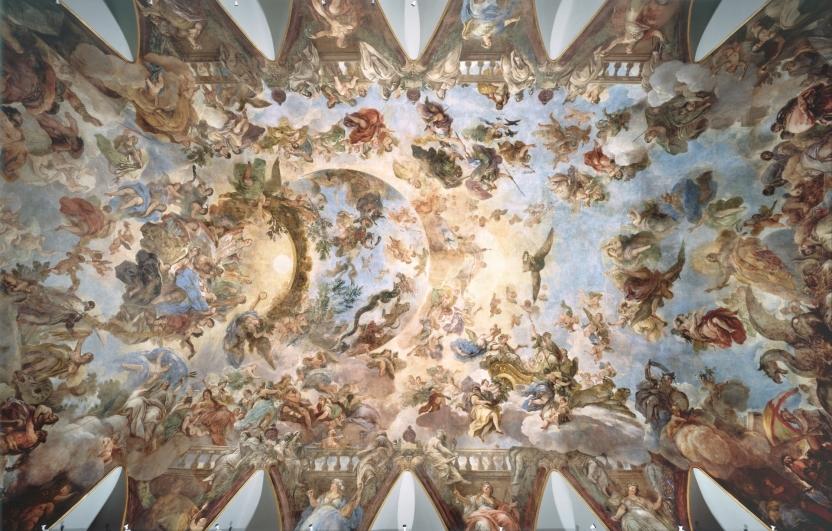
Vault with the Apotheosis of the Spanish Monarchy
Fresco painting, Fresco-secco on wall covering. Ca. 1697
The vault of the former Hall of Ambassadors at the Buen Retiro Palace, constructed alongside the former Royal Quarters of San Jerónimo at the behest of the Count-Duke of Olivares as a royal residence for leisure and for the monarchs’ public and official receptions. In the eastern part of this complex, a small building was erected after the palace itself was completed (1632). It was designed by Alonso Carbonel but the works were completed in 1692. The only surviving remains are the Cas&oac
ARTWORK
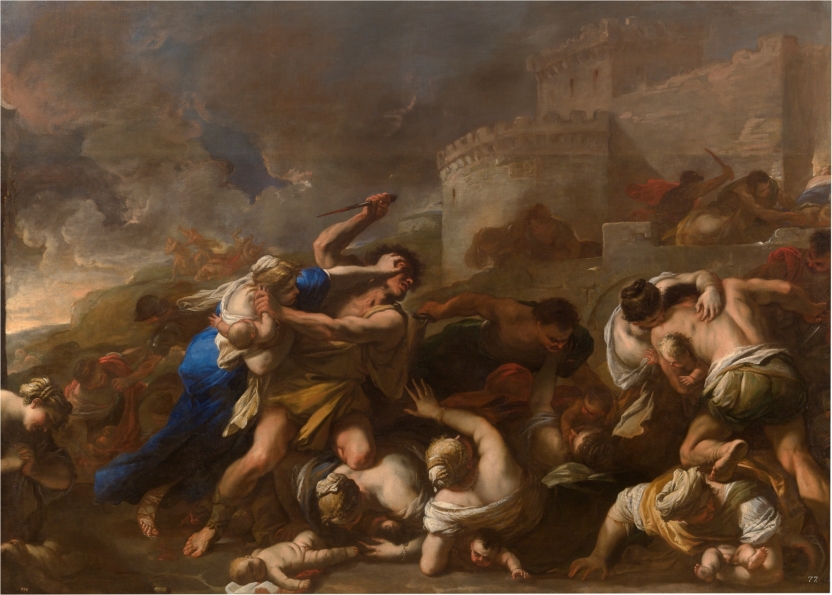
Massacre of the Innocents
Oil on canvas. Ca. 1663
A. E. Pérez Sánchez publicó en 1970 su fotografía y su identificación en los inventarios antiguos de El Escorial (Madrid 1970a). En la actualidad, el formato de la obra aparece alterado en todos sus lados, principalmente por mutilaciones en la parte baja y el lado izquierdo; hasta su reciente restauración presentaba un aspecto muy desvirtuado. Hasta ese momento no se había apreciado la costura en el borde superior (De Vito 2006), que une dos telas pintadas por manos diferentes: la inferior, del
ARTWORK
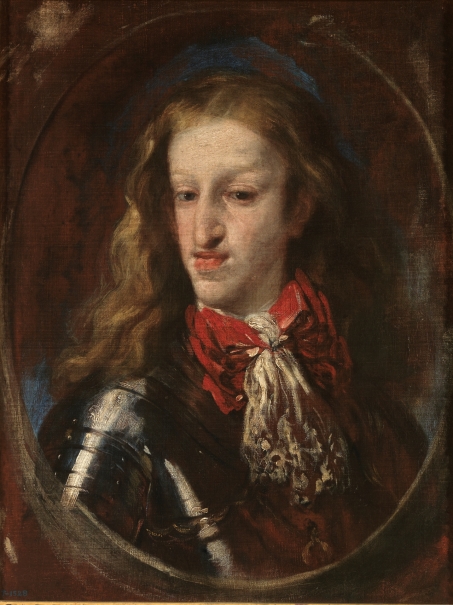
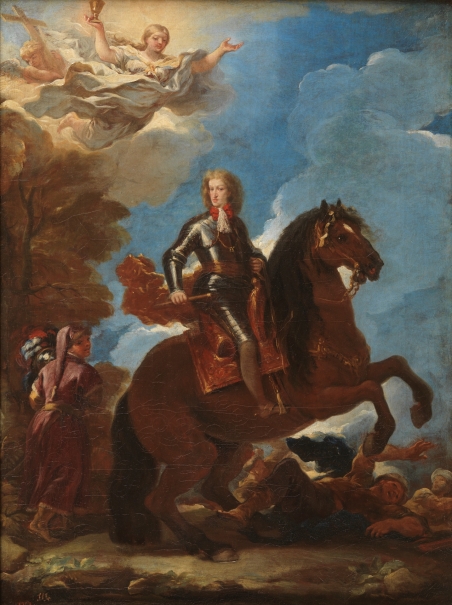
Charles II
Oil on canvas. 1693
Charles II is depicted in armour, wearing the emblem of the Golden Fleece and an ornate neck tie in the French style, an accessory he favoured when outside Madrid from around 1677. Despite these formal elements, Giordano makes little effort to disguise the King’s unattractive appearance. This canvas was previously considered to be by Claudio Coello (1642-1693).
ARTWORK
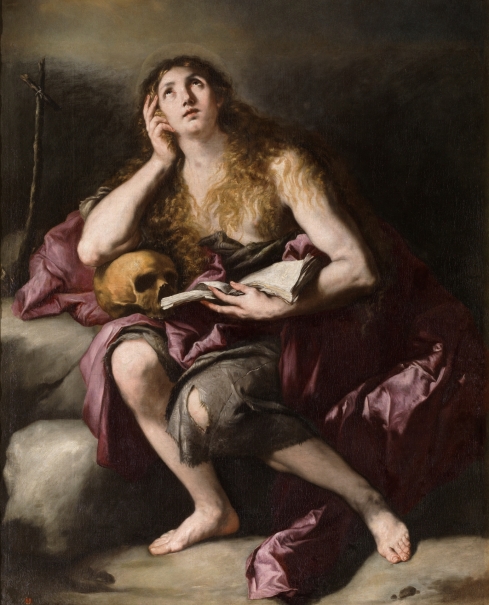
Penitent Magdalen
Oil on canvas. Ca. 1665
La Magdalena penitente de Giordano ilustra sobre las dudas que sus imitaciones suscitaron en épocas diversas. A pesar de que ingresó en la Colección Real en el siglo XVIII con la atribución correcta, muy pronto fue citada como obra de Ribera, Murillo y otros, hasta que a mediados de 1950 fuera restituida al artista napolitano. Giordano imita el ambiente cerrado, oscuro y desértico del maestro valenciano; la actitud meditativa de la santa, la técnica suelta y empastada, los colores terrosos, las
ARTWORK
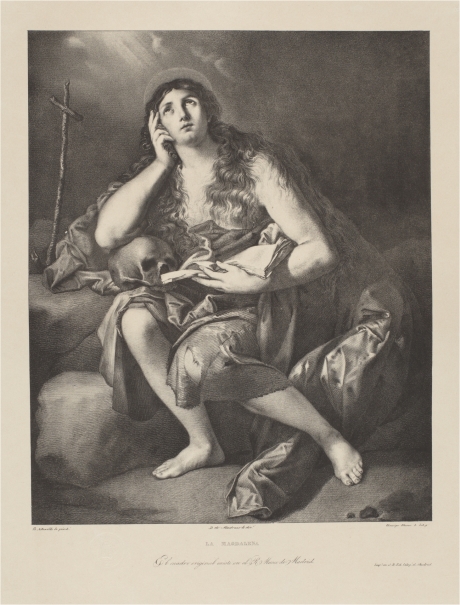
The penitent Magdalen
Lithographic aquatint, Pen lithography, Crayon lithography, Scraper on wove paper. 1832 - 1837
The Company for the engraving of the paintings from the Royal Palaces was one of the Spanish Enlightenment’s major undertakings during the second half of the 18th century. It supervised the reproduction of prints of paintings from the Royal Collections and its early projects were carried out by Francisco de Goya, who reproduced some of Velázquez’s paintings in 1778, and by Juan Barcelón and Nicolás Barsanti, who reproduced The Labors of Hercules after the fresco that Luca Gi
ARTWORK
Enrique Blanco – Lithographer – (The original work, according to inscriptions, attributed to: Bartolomé Esteban Murillo)
Luca Giordano – (Author of the original work)
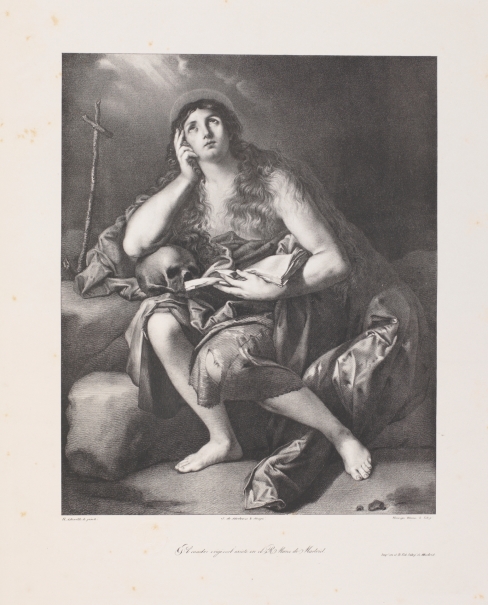
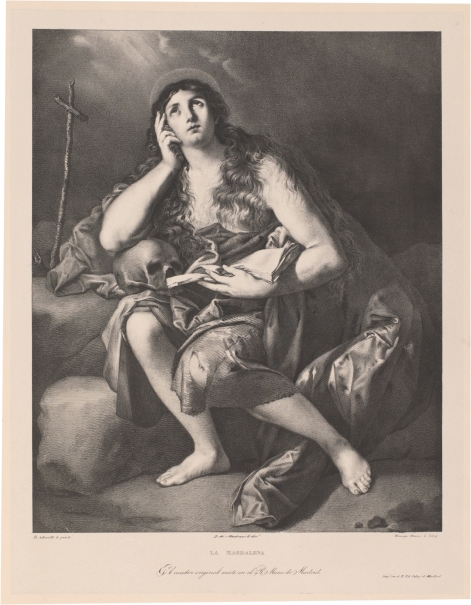
Penitent Magdalene
Lithographic aquatint, Crayon lithography, Printing on japon, Scraper, Pen lithography on wove paper. 1832 - 1837
Es una litografía de Enrique Blanco (activo en Madrid entre 1826 y 1837) que reproduce el óleo de Luca Giordano conservado en el Museo Nacional del Prado (P01105), anteriormente atribuido a Bartolomé Esteban Murillo. Esta estampa se entregaba con el cuadernillo CLXXXI acompañado de un texto explicativo de Pedro de Madrazo. Iba encuadernada en el tomo III de la serie dirigida por José de Madrazo, Colección litográfica de cuadros del rey de España el señor don Fernando VII, editada por el Real Est
ARTWORK
Enrique Blanco – Lithographer – (The original work, according to inscriptions, attributed to: Bartolomé Esteban Murillo)
Luca Giordano – (Author of the original work)
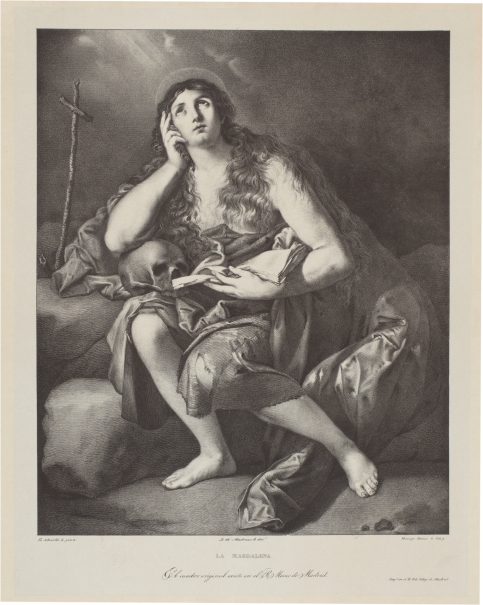
Penitent Magdalene
Crayon lithography, Lithographic aquatint, Pen lithography, Scraper on wove paper. 1832 - 1837
Es una litografía de Enrique Blanco (activo en Madrid entre 1826 y 1837) que reproduce el óleo de Luca Giordano conservado en el Museo Nacional del Prado (P01105), anteriormente atribuido a Bartolomé Esteban Murillo. Esta estampa se entregaba con el cuadernillo CLXXXI acompañado de un texto explicativo de Pedro de Madrazo. Iba encuadernada en el tomo III de la serie dirigida por José de Madrazo, Colección litográfica de cuadros del rey de España el señor don Fernando VII, editada por el Real Est
ARTWORK
Enrique Blanco – Lithographer – (The original work, according to inscriptions, attributed to: Bartolomé Esteban Murillo)
Luca Giordano – (Author of the original work)
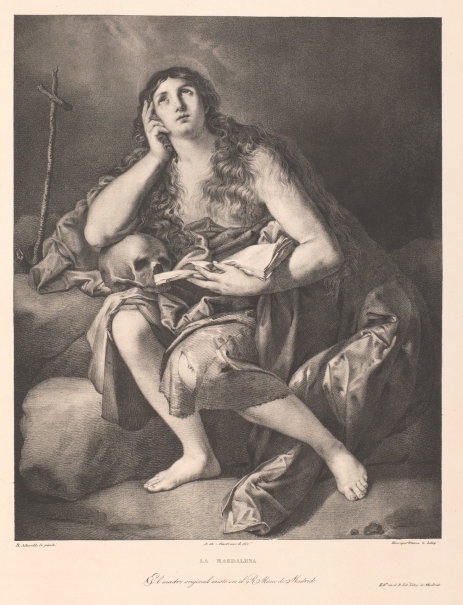
The Penitent Magdalen
Lithographic aquatint, Pen lithography, Scraper, Crayon lithography, Printing on japon on wove paper. 1832 - 1837
Es una litografía de Enrique Blanco (activo en Madrid entre 1826 y 1837) que reproduce el óleo de Luca Giordano conservado en el Museo Nacional del Prado (P01105), anteriormente atribuido a Bartolomé Esteban Murillo. Esta estampa se entregaba con el cuadernillo CLXXXI acompañado de un texto explicativo de Pedro de Madrazo. Está encuadernada en el tomo III de la serie dirigida por José de Madrazo, Colección litográfica de cuadros del rey de España el señor don Fernando VII, editada por el Real Es
ARTWORK
Enrique Blanco – Lithographer – (The original work, according to inscriptions, attributed to: Bartolomé Esteban Murillo)
Luca Giordano – (Author of the original work)
The penitent Magdalen
Crayon lithography, Lithographic aquatint, Scraper, Pen lithography on wove paper. 1832 - 1837
Es una litografía de Enrique Blanco (activo en Madrid entre 1826 y 1837) que reproduce el óleo de Luca Giordano conservado en el Museo Nacional del Prado (P01105), anteriormente atribuido a Bartolomé Esteban Murillo. Esta estampa se entregaba con el cuadernillo CLXXXI acompañado de un texto explicativo de Pedro de Madrazo. Está encuadernada en el tomo III de la serie dirigida por José de Madrazo, Colección litográfica de cuadros del rey de España el señor don Fernando VII, editada por el Real Es
ARTWORK
Enrique Blanco – Lithographer – (The original work, according to inscriptions, attributed to: Bartolomé Esteban Murillo)
Luca Giordano – (Author of the original work)
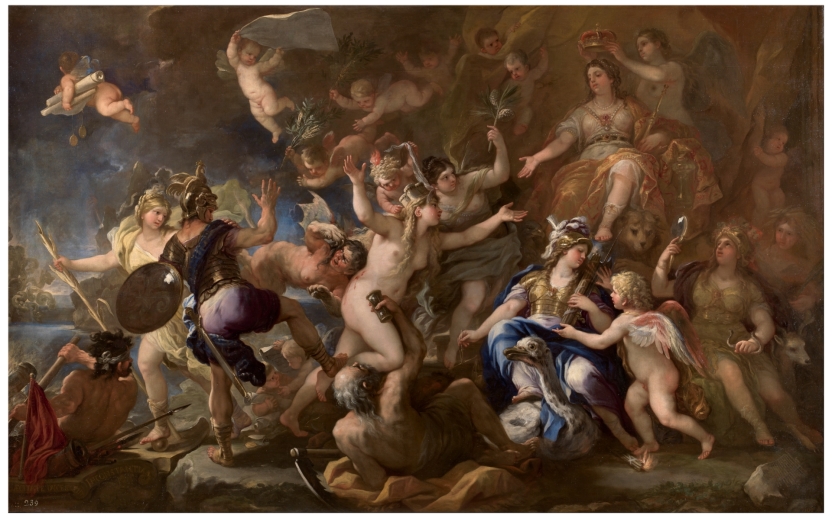
Messina returned to Spain
Oil on canvas. 1678
This work is a magnificent example of works from the middle period of Luca Giordano, the Italian artist known in Spains as Lucas Jordán. It shows the decorative character that predominated in Italian Baroque painting during the second half of the seventeenth century, as well as the chromatic richness and dynamism that made this artist famous. This allegorical scene symbolizes Spain in the figure of a woman who is being crowned and enthroned over the four cardinal virtues (Prudence, Justic
ARTWORK
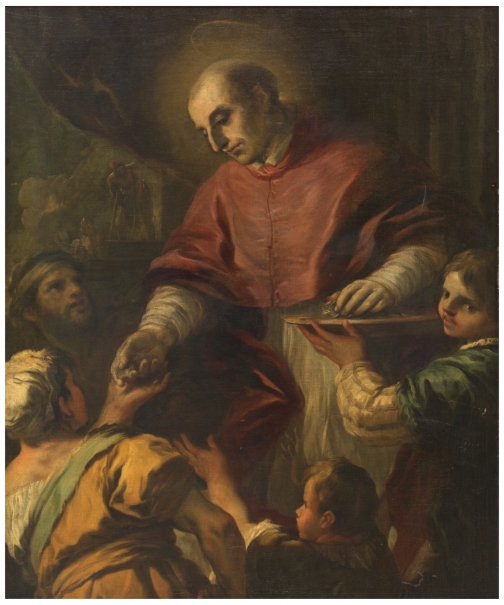
Saint Charles Borromeo
Oil on canvas. Ca. 1702
El santo se sitúa en un ambiente palaciego señalado por el fuste de columna y el cortinaje que se ven a sus espaldas. Distribuye monedas a tres mendigos que, junto con el niño que sujeta la bandeja y el propio santo, forman el óvalo que define la composición. Al fondo aparece un personaje con muletas que se acerca para recibir su limosna.La pintura parece una reducción de la presente en la iglesia de San Antonio de los Alemanes de Madrid. De ella recupera la figura del santo y el tema tratado: l
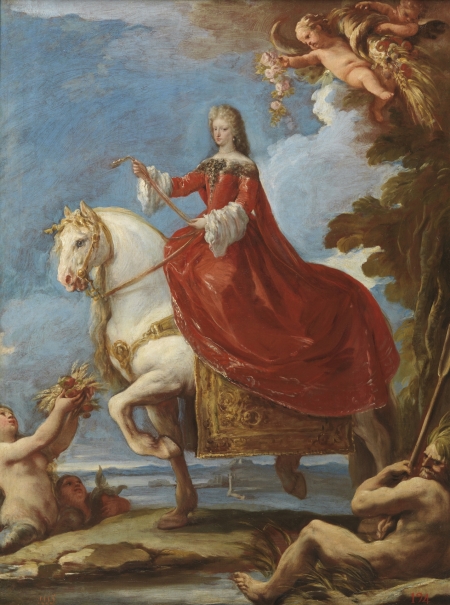
ARTWORK
Queen Maria Anna of Neuburg on Horseback
Oil on canvas. 1693 - 1694
Barely six months after the sudden demise of Marie Louise of Orléans, who died without producing the much-desired heir who would ensure dynastic continuity, Charles II married Maria Anna of Neuburg (1667–1740). In a context in which the arrival of a successor to the throne was an issue of greatest importance, the fact that the new queen’s mother had given birth to 17 children seemed a guarantee of success. Nonetheless, the couple had no children, a fact which brought the Spanish branch of
ARTWORK
Charles II, King of Spain, on Horseback
Oil on canvas. Ca. 1693
Luca Giordano (1634-1705) made an equestrian portrait of Charles II for the Hall of Mirrors at Madrid’s Alcázar palace to emphasize the dynastic continuum in which Charles II constituted the latest link in a chain that had begun with Titian’s portrait of Charles V: Charles V at Mühlberg. The loss of Titian’s work in the fire that ravaged the Alcázar in 1734 makes it impossible to know its appearance but we can assume that the need to continue an earlier group must have conside
ARTWORK
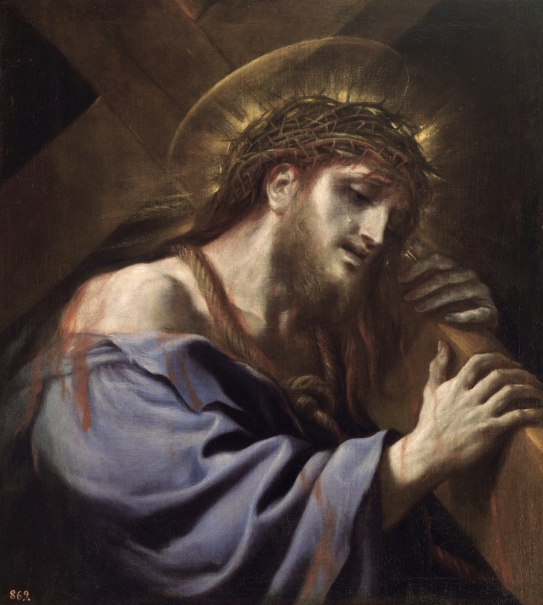
Christ carrying the cross
Oil on canvas. Ca. 1697
The first known reference to this painting from the Spanish Royal Collection dates from 1700, when it was mentioned as being in the Alcázar, Madrid, along with another painting by Luca Giordano, Mater Dolorosa, now lost. It is in magnificent condition, and was restored in 2007.The powerful foreground shows Christ, rope around his neck, painfully carrying the cross. The general tone evokes the scene’s pathos with a dramatic monochrome broken only by flesh tones, a glistening halo around hi
ARTWORK
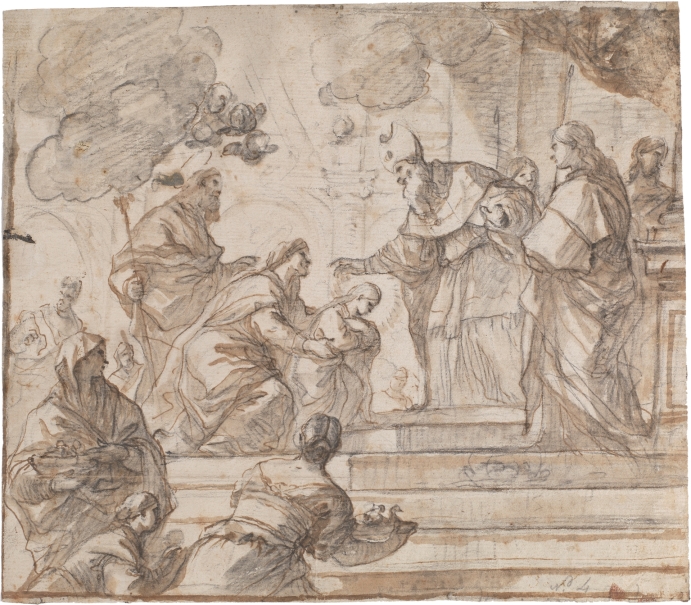
The presentation of the Virgin at the Temple
Grey-brown wash, Ink, Black chalk on laid paper. Ca. 1697
When the Virgin Mary was three years old her parents, Anna and Joachim, led her to the Temple of Jerusalem. There the young Virgin, without the assistance of her parents, climbed the staircase leading to the priest, who, surrounded by the women of the temple, embraced and blessed her.The episode is contained in the Gospel of James and in the Golden Legend (c.1250). Since the 1960s this drawing has been correctly viewed in relation to Luca Giordano’s painting The presentation of the Virgin at the
ARTWORK
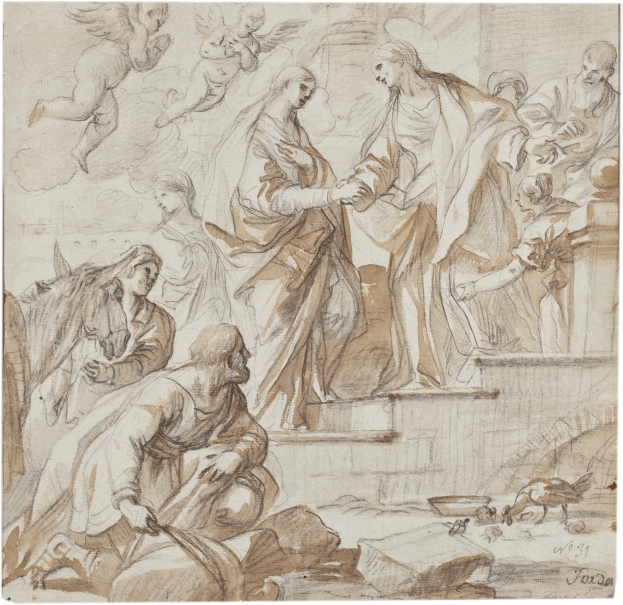
The Visitation
Grey-brown wash, Black chalk on white paper. Ca. 1697
Se trata de un dibujo preparatorio para el lienzo del Museo de Viena, que forma parte, con el de la Presentación de la Virgen en el Templo (D02158) de una escena de la Vida de la Virgen. Fechable entre 1696 y 1698, durante el periodo español del artista. En el primer término de la composición, a la izquierda, aparece representado San José, arrodillado; al fondo, sobre una escalinata, Santa Isabel recibe a la Virgen, rodeada de numerosas figuras.En la Colección Pierre Rosenberg de París existe un
ARTWORK
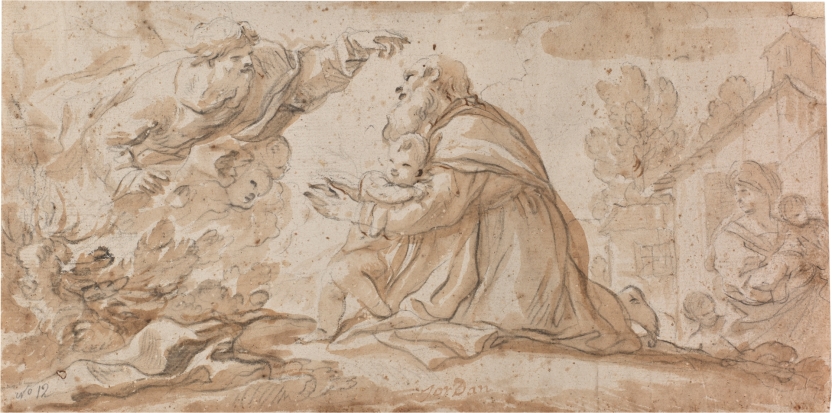
God commanding Abraham to sacrifice
Grey-brown wash, Black chalk on white paper. 1694 - 1696
The drawing is in effect one of many by the Neapolitan painter Luca Giordano executed during the course of his decade-long activity in Spain. The corresponding painting, from which this study differs in several aspects, is held in the Royal Palace of La Granja de San Idelfonso. The canvas is recorded in the so-called Testamentaría of King Charles II, as an overwindow in one of the minor buildings of the Buen Retiro Park, Madrid, the Hermitage of San Juan, as part of an original series of
ARTWORK
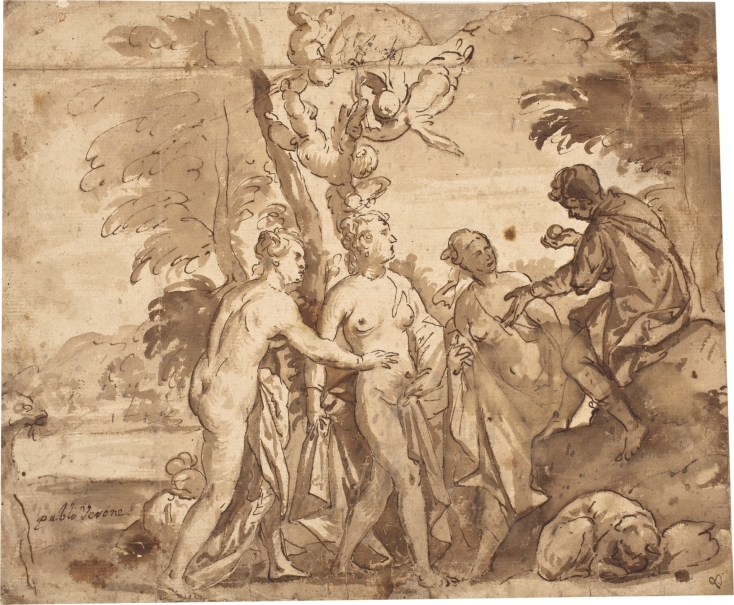
The Judgement of Paris / Legs and Torso of a Nude Man
Wash, Grey-brown ink, Red chalk, Pencil ground, Pencil on yellow paper. Second half of the XVII century
The composition is that of a lost painting of the subject by Veronese, carried out for the Fondaco dei Turchi, Venice, the appearance of which is known from an engraving published in 1691. A painted version of the same composition, from the School of Veronese, is in the Ellen Clarke Bertrand Library, Bucknell University, Lewisburg. The Lewisburg picture corresponds in all essentials to the design of the Prado copy. the free pen-and-wash style of the drawing is strongly reminiscent of the work of
ARTWORK
Luca Giordano – (Copy after: Paolo (Paolo Cagliari) Veronese)
Loading...

Loading...

Up