formularioRDF
The itinerary <em>TITULORECORRIDO</em> has been successfully created. Now you can add in works from the Collection browser
<em>TITULOOBRA</em> added to <em>TITULORECORRIDO</em> itinerary

Metabuscador

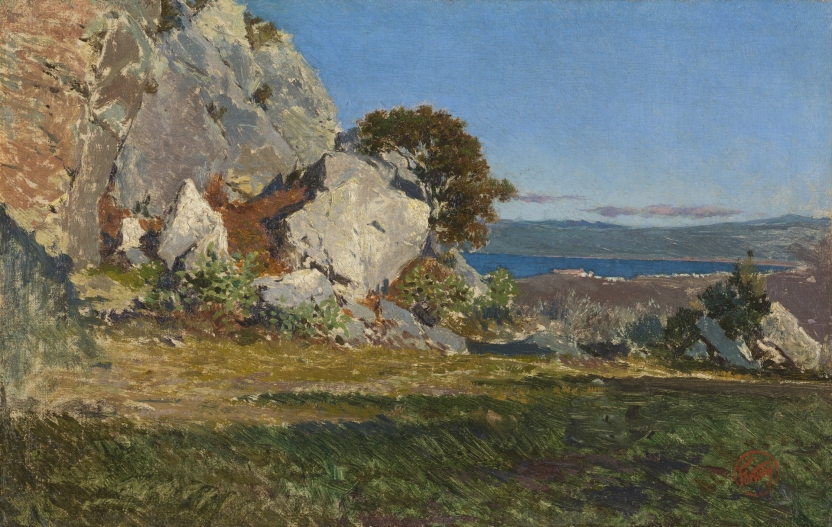
Neapolitan Landscape
Oil on canvas. 1874
This painting summarises many of Fortuny’s artistic concerns during his summer stay in Portici on the Neapolitan coast in a more complete manner than the other landscapes from this period in the Prado. It reveals his practice of working from life (here on the seashore for the first time), the use of pure colour, varied brushstrokes and the technique of leaving the preparation visible.
ARTWORK
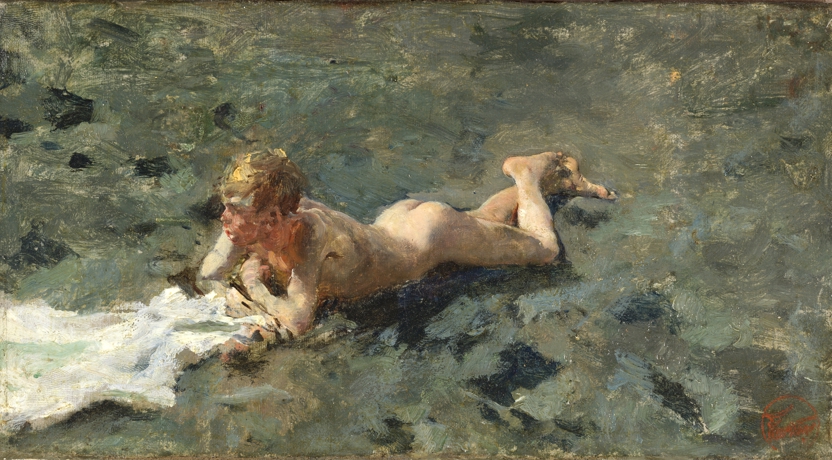
Naked Boy on the Beach at Portici
Oil on canvas. 1874
As in other works on this subject by the artist, the figure creates a diagonal composition extended by the white canvas and the legs are crossed. The high viewpoint and absence of a horizon emphasise the immediacy of Fortuny’s study from life. The broad brushstrokes reveal his interest in purples, blues and greens.
ARTWORK
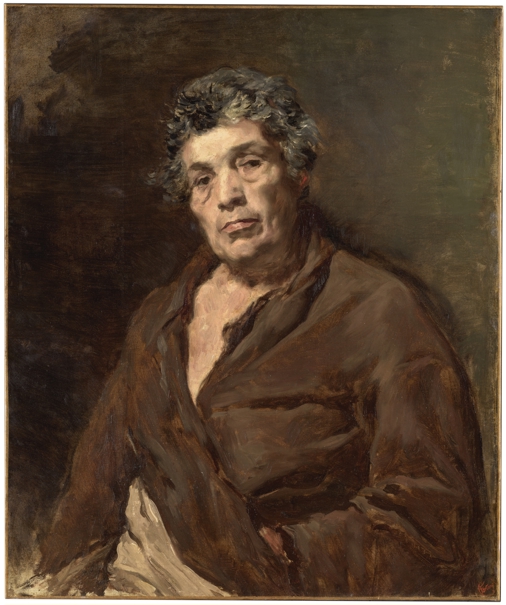
Aesop (copy after Diego Velázquez)
Oil on canvas. Ca. 1867
Between 1866 and 1868, Fortuny made numerous copies of paintings by Velázquez in the Museo del Prado, particularly in watercolours, a technique better suited to Velázquez’s style. Here, however, Fortuny opted for oils, which he used mostly when copying works by Ribera and Goya. As elsewhere, he focused on the subject’s expressive gaze, dispensing with the spatial effects that interested some of his contemporaries.
ARTWORK
Mariano Fortuny – (After: Diego Rodríguez de Silva y Velázquez)
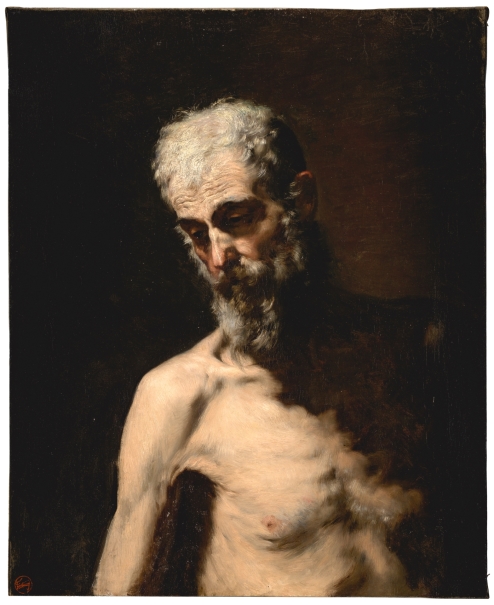
Saint Andrew (copy after Ribera)
Oil on canvas. Ca. 1867
Fortuny produces a faithful interpretation of Jusepe de Ribera’s painting in the Museo del Prado, though his attention is focused exclusively on capturing the effects of the light on an elderly man’s naked torso and he dispenses with the saint’s iconographic attributes. He thus attaches greater importance to the human figure, as in his later studies of old men made in Granada.
ARTWORK
Mariano Fortuny – (Copy after: Jusepe de Ribera lo Spagnoletto)
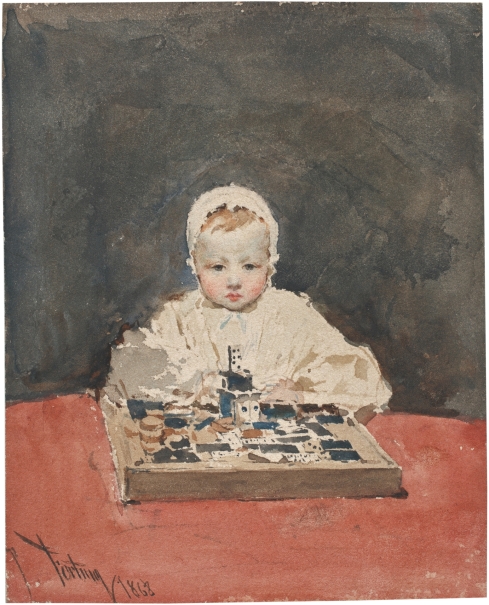
María Teresa de Madrazo y Madrazo
Watercolour on continuous paper. 1868
This watercolour is part of a group of works Fortuny painted shortly before returning to Rome in 1868 using the people around him as models. María Teresa was the only child born of the marriage between Luis and Luisa de Madrazo, uncle and sister of Fortuny’s wife respectively, and the artist portrayed her aged two and a half. She is accompanied by a construction on a draught board and her face attests to the painter’s mastery at capturing childish innocence and tenderness.
ARTWORK
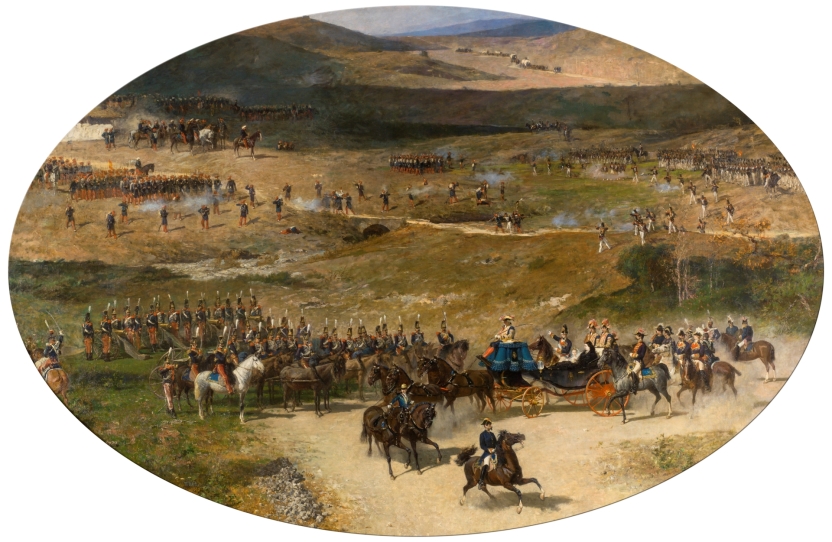
Queen María Cristina and her Daughter, Isabel II, reviewing the Artillery Batteries defending Madrid in 1837
Oil on canvas. 1865 - 1866
This canvas was displayed on the ceiling of the Salon Rouge of the Duke and Duchess of Riánsares’ Paris mansion. The decoration of this hall, which was designed to receive visitors, glorified María Cristina’s regency and the legitimacy of her daughter Isabella II, which was opposed by the supporters of Carlos María Isidro de Borbón, rival aspirant to the throne. The work depicts the skirmishes of September 1837 between loyal forces and Carlist troops, which proved dec
ARTWORK
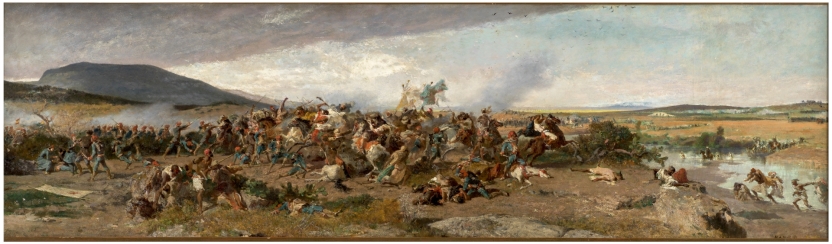
The Battle of Wad-Rass
Oil on paper attached to cardboard. 1860 - 1861
Shortly before Mariano Fortuny concluded the second year of the pension he had received from the Regional Government of Barcelona in 1858 to complete his studies in Rome, that same institution commissioned him, on January 10, 1860, to travel to Morocco as a graphic reporter of the African War. There, Spanish troops were fighting in the northern Maghreb -especially the battalion of Catalan volunteers recruited by their Regional Government and commanded by General Juan Prim y Prats (1814-1870). Th
ARTWORK
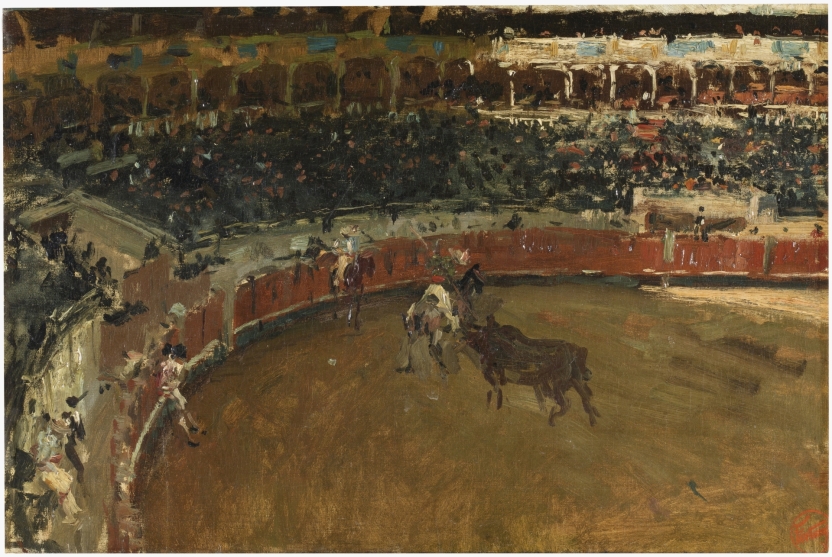
Bullfight
Oil on canvas. 1867 - 1868
The sketch, almost schematic character of this composition makes this one of the most attractive bullfighting scenes ever painted by Fortuny. It offers a panoramic view of a bullring -probably in Madrid- in which the powerful contrast of light between the part in the sun and the part in the shade is outstanding. The painter treats the hustle and bustle of the spectators as an undefined mass, with multiple patches of black and small touches of ochre, showing his preference for the most colorful a
ARTWORK
Chicken Coop
Oil on canvas. 1869
Fortuny featured groups of hens in a number of his compositions, as their dynamism, texture and luxuriant colours enriched and enlivened his works. This painting, however, is a study in its own right -a free exercise designed to capture the birds’ light, fast movements rather than intended as a detail of a larger composition.
ARTWORK
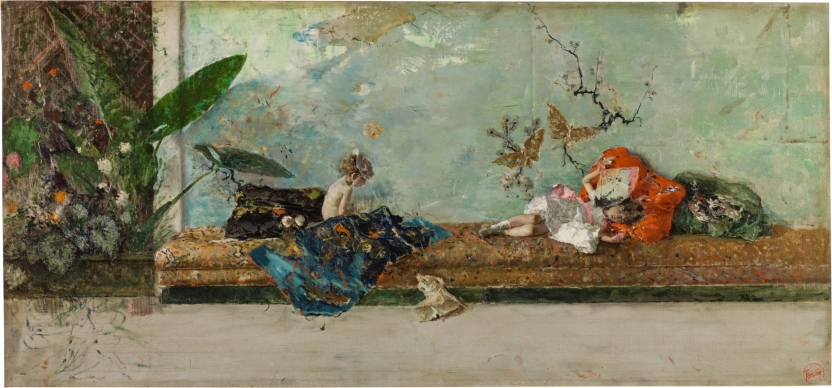
The Painter's Children in the Japanese Room
Oil on canvas. 1874
Fortuny’s sudden death left this painting unfinished, yet it remains one of his finest pieces, and the maximum expression of the audacious pictorial modernity that characterizes his mature work.The two children that appear in this canvas are the artist’s own son and daughter, Mariano and María Luisa. They rest on the long divan in the Japanese Room at Villa Arata, the Fortuny family’s summer residence in Portici. This smooth-walled room was decorated exclusively by the branch of a floweri
ARTWORK
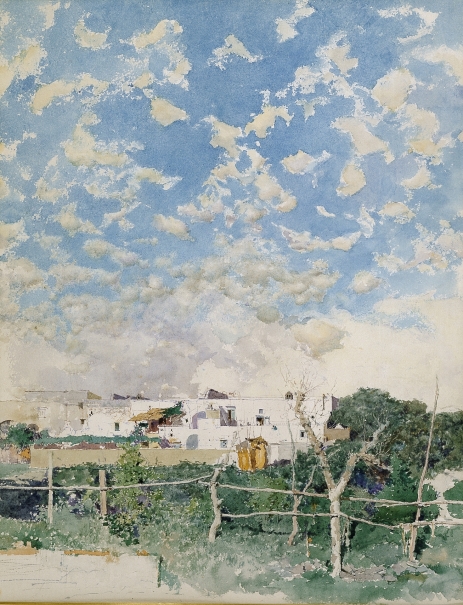
Lanscape at Portici
Watercolour, Gouache / tempera on paper. 1874
In the summer of 1874 Fortuny settled in a seaside villa in Portici, near Naples, where he painted several landscapes and seascapes that show his interest in the study of painting from life. This interest is clear in this view of the surrounding area of his house, in which the arrangement of clouds in motion suggests the instability of the changing atmosphere of that place.
ARTWORK
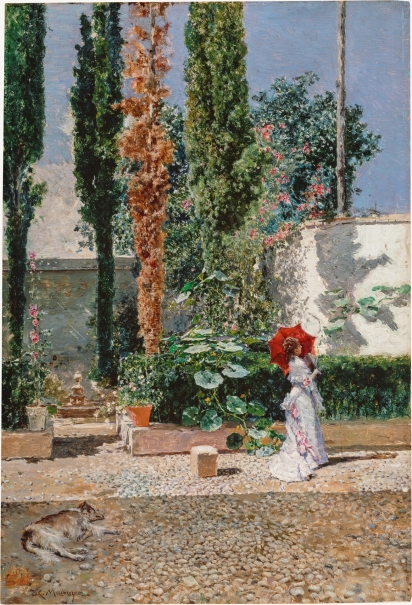
The Garden of the Fortuny Residence
Oil on panel. 1872 - 1877
This work bears exceptional witness to the concurrence of Fortuny’s painting with that of his close friend, Raimundo de Madrazo. Begun by the former, it was completed after his death by the latter with a completely concordant style that does not, however, hide Madrazo’s own individuality. Fortuny had been living in Granada since the summer of 1870 and he spent the best days of his life there before returning to Rome in 1872. At first, he lived in the Fonda de los Siete Suelos, renting a house fo
ARTWORK
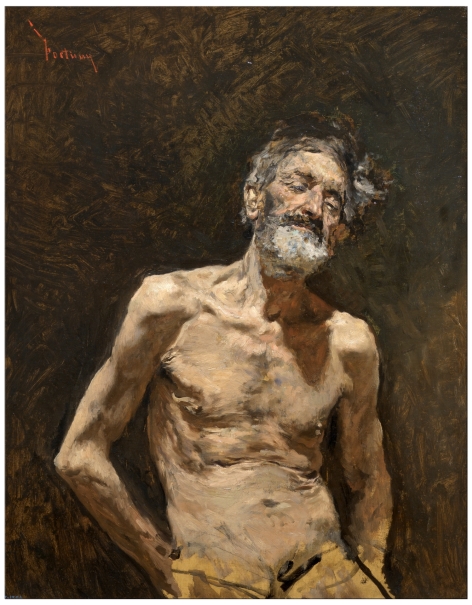
Nude Old Man in the Sun
Oil on canvas. Ca. 1871
This work is an excellent example of the way in which an interest in the art of Spain´s Golden Age combines in Mariano Fortuny´s paintings with the close study of subjects made from life. Nude Old Man in the Sun reveals Fortuny´s familiarity with the work of Jusepe de Ribera, whose painting Saint Andrew (P1078) he had copied on a previous occasion. And as in that copy and others Fortuny made (such as his watercolour version of Velázquez´s Menippus 1866; D7416), in this painting the artist
ARTWORK
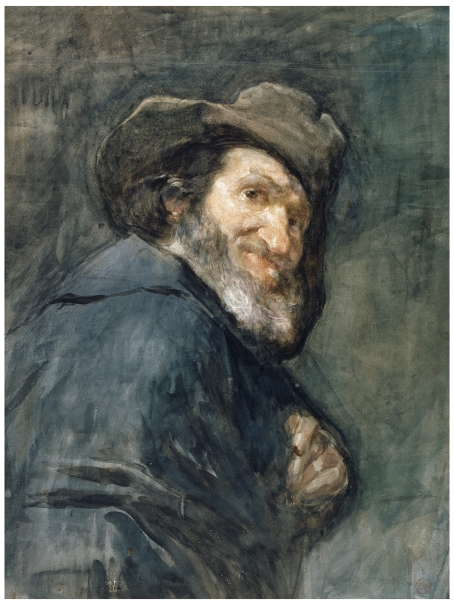
Menippus, detail (copy after Velázquez)
Watercolour, Gouache / tempera on paper. 1866 - 1868
Fortuny made an ample number of copies of famous paintings, some as late as the end of the 1860s. They reveal his interest in deepening his knowledge of the painting of the great masters, especially Velázquez and Goya, and to a lesser extent, Raphael, Dürer, Tintoretto, El Greco, Ribera, Rubens, Van Dyck and Tiepolo, as well as Rembrandt and the Japanese engravers, all of whom had a fundamental influence on his work. Fortuny made these copies in oils and also in watercolors, as the l
ARTWORK
Mariano Fortuny – (Copy after: Diego Rodríguez de Silva y Velázquez)
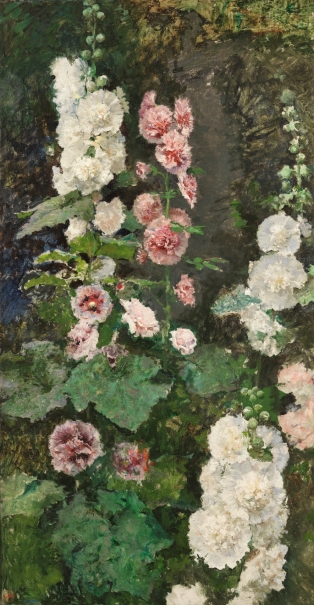
Hollyhocks
Oil on canvas. 1872 - 1873
Fortuny enjoyed painting flowers in bloom in his scenes. Attracted by their colours, he also made separate studies of them. His favourites were hollyhocks on account of their pleasing hues and the elegant verticality of their stalks, which is accentuated by the format used here. As the background is devoid of references, their corollas appear to float in an indeterminate space, with varying degrees of finish, and the ground layer is visible in some areas of the canvas.
ARTWORK
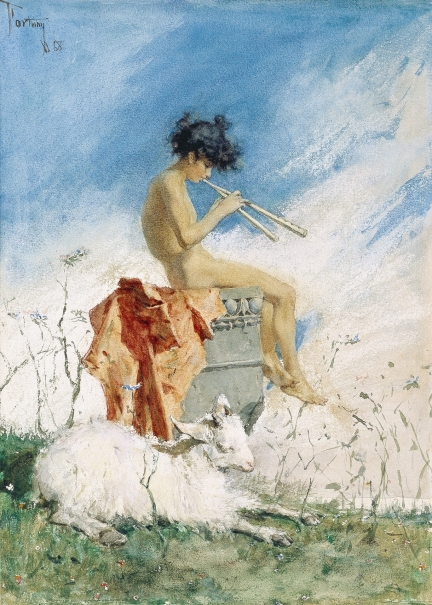
Idyll
Watercolour, Gouache / tempera on paper. 1868
This watercolor offers a profile view -similar to a low relief- of a child or young faun sitting on a fragment of an Ionic entablature with egg-and-dart decorations above an astragal. The slender, nude child recalls the Italian boys who worked as models in academies and were depicted by European painters and sculptors. At the academies where he studied, Fortuny had drawn numerous nude boys, some playing the flute, but his first concrete approach to the model was a drawing now at the Biblioteca n
ARTWORK
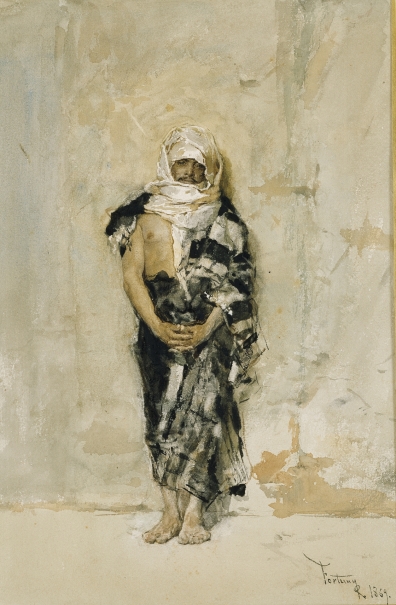
A Moroccan
Watercolour on paper. 1869
This work is a typical example of the watercolours Fortuny produced in his Roman studio during winter and early spring afternoons and evenings. In them he painted Arab subjects based on free interpretations of European models. The simple composition featuring a figure against a wall, whose material properties are painstakingly depicted, the solid and lifelike anatomical rendering, and the refinement of the reduced palette are highly characteristic.
ARTWORK
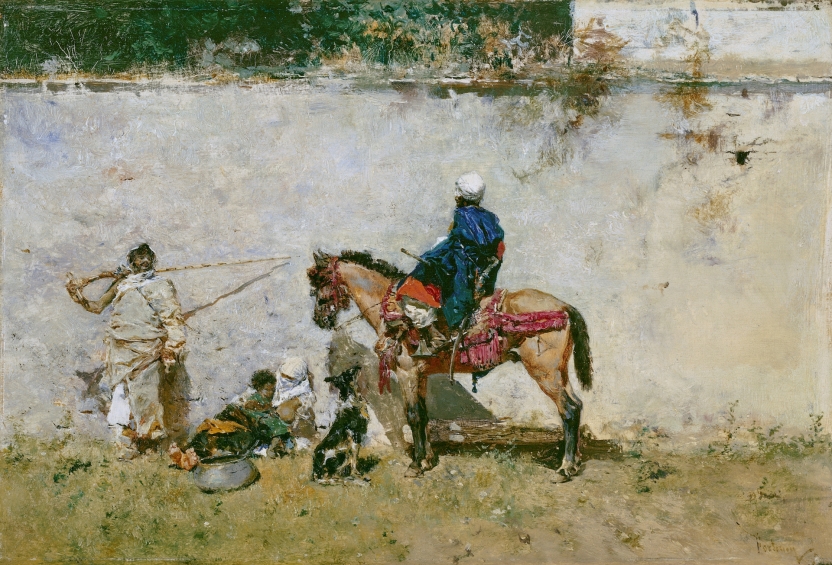
Morocans
Oil on panel. 1872 - 1874
Fortuny’s predilection for beautifully colored and very carefully painted panels is perfectly exemplified by the present work, which reveals his mastery of tableautin, a type of painting that garnered considerable commercial success for artists such as Jean-Louis-Ernest Meissonier (1815-1891), although the latter’s execution was much more meticulous and drawn. The Orientalist genre was also the object of growing international interest and, as one of its leading exponents, Fortuny made it a maxim
ARTWORK
Loading...

Loading...

Up