
Loading...
Music in the Gallery
Thursdays and Saturdays, March
Music
Music in the Gallery
Thursdays and Saturdays, March
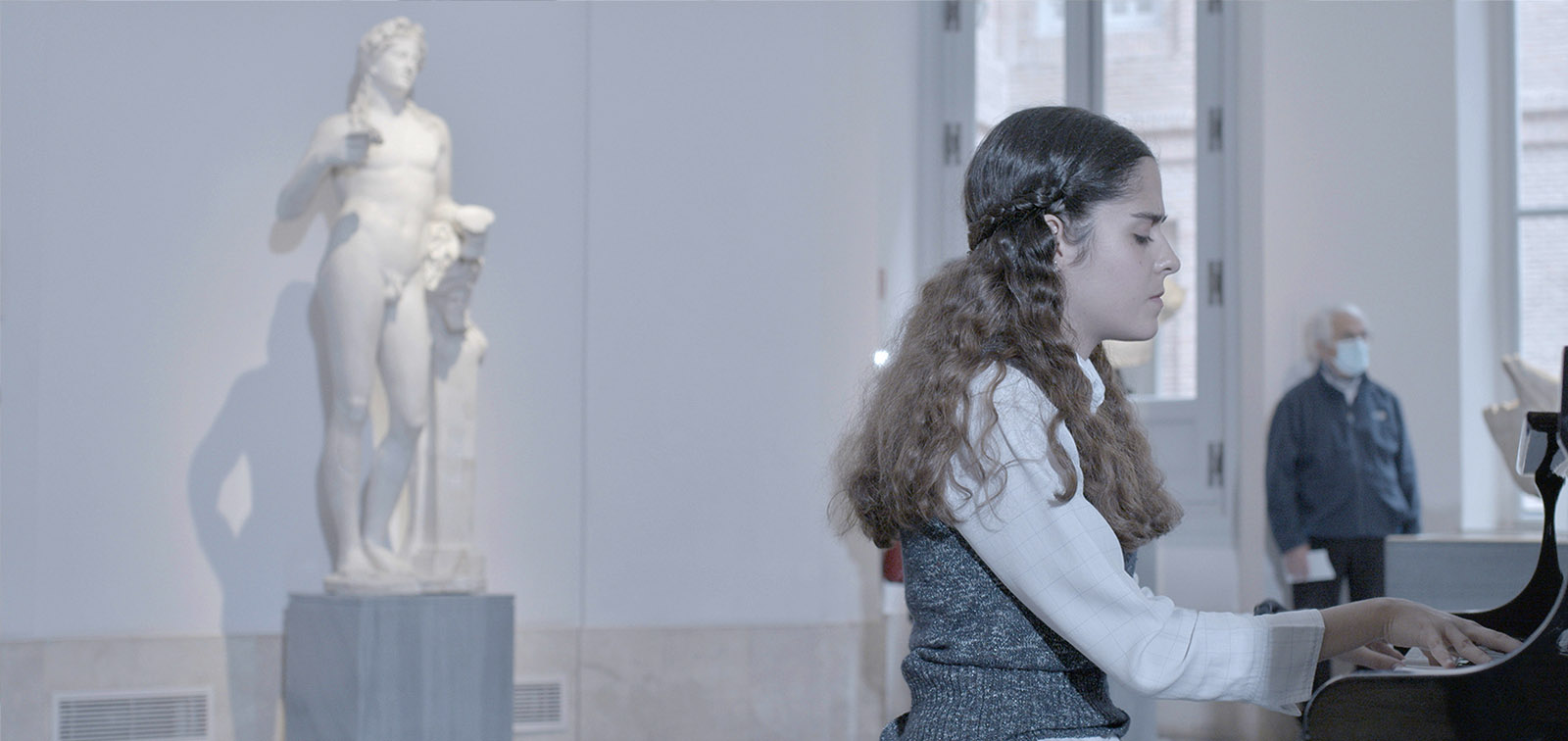
The pianist Cristina Sanz Hernán will perform a program twice a week that will vary monthly, as will the location of the piano in the Villanueva building. Every day there will be 3 passes (12.00, 1.00 and 4.00 p.m.) lasting approximately 20 minutes.
- With the collaboration of:
-

- Schedule
- Thursdays and Saturdays, 12.00, 1.00 and 4.00 p.m.
- Location
- Room 74. Villanueva Building
- Price
- Free
Activity
Clara Schumann
(Leipzig, 1819 - Frankfurt am Main, 1896)
- Four fleeting pieces, Op. 15
(Vier flüchtige Stücke) - Larghetto, in F major
- Un poco agitato, in A minor
- Andante espressivo, in D major
- Scherzo, in G major
This set of 4 pieces exemplifies the Romantic style in music through the work of composer Clara Schumann, one of the great figures of the 19th century. Her work has been chosen with the aim of highlighting the role of women in the history of music.
The first of the four pieces reflects the beauty of the Romantic style with great simplicity and sincerity. The second, which is very lively and dramatic, creates a passionate mood. The third envelops the listener in an intimate atmosphere with a masterly use of harmonies through which the composer transmits purity and profundity. The fourth and last piece in the set references a
fast, playful dance with touches of irony achieved through the articulation.
Claude Debussy
(Saint-Germain-en-Laye, 1862 - Paris , 1918)
- Study 3 in fourths
(Étude 3 pour les quartes )
Creating a contrast with the previous pieces, this work exemplifies a different musical style, Impressionism, of which Claude Debussy was a leading exponent. Through his new compositional techniques Debussy influenced the evolution of almost all musical genres of this period, while the notable influence on him of the effects and sensations produced by a contemplation of
the visual arts explains his inclusion in this programme.
Among Debussy’s 12 Études this one captivates the listener from the outset with its new sounds and through the use of the interval of the fourth, which is the basis of the entire work. Its almost mystical atmosphere transports the listener through distant landscapes and universes before dissolving into a colourful finale.