formularioRDF
The itinerary <em>TITULORECORRIDO</em> has been successfully created. Now you can add in works from the Collection browser
<em>TITULOOBRA</em> added to <em>TITULORECORRIDO</em> itinerary

Exhibition

Nel segno del genio. Velázquez in the records of the Archivio di Stato di Roma

Museo Nacional del Prado. Madrid 12/5/2024 - 2/9/2025

The Museo Nacional del Prado, Royal Collections Gallery and Real Academia de Bellas Artes de San Fernando will temporarily house three manuscripts from the Italian archives that prove Velázquez’s influence extended beyond his legacy as a painter. The documents will be on view until 9 February 2025, each at a different museum, thanks to the project Nel segno del genio. Velázquez in the records of the Archivio di Stato di Roma.

The manuscripts contain information pertaining to the painter’s second visit to Rome, between 1649 and 1651, and illustrate his role as a cultural intermediary between Spain and Italy during the Spanish Golden Age. Specifically, the records describe several orders that Velázquez placed for bronze copies of classical Italian sculptures.

For the first time, this exhibition has assembled a series of priceless historical documents that shed light on Velázquez’s activities during his time in Rome. The documents, dated between 1649 and 1657, were found in the official records of Antonius Franciscus Maria Simius, a notary who worked for the Court of the Vicar General. The bulk of them are contracts with craftsmen and sculptors who had been commissioned to make plaster and bronze copies of antique monuments by Velázquez and his deputy, Juan de Córdoba Herrera.

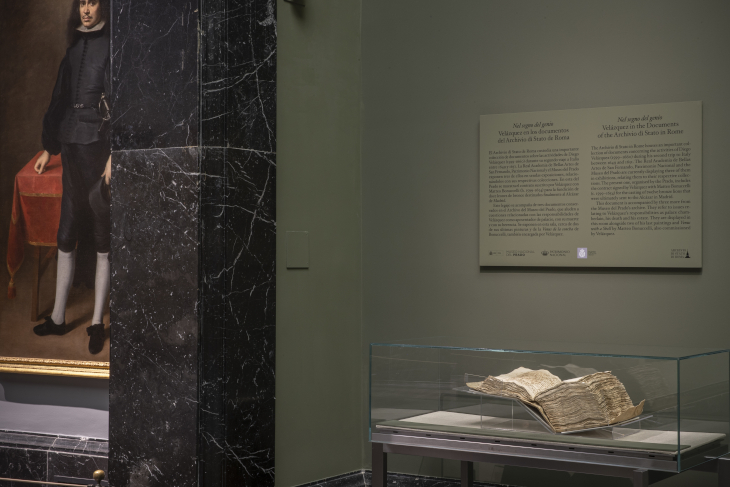
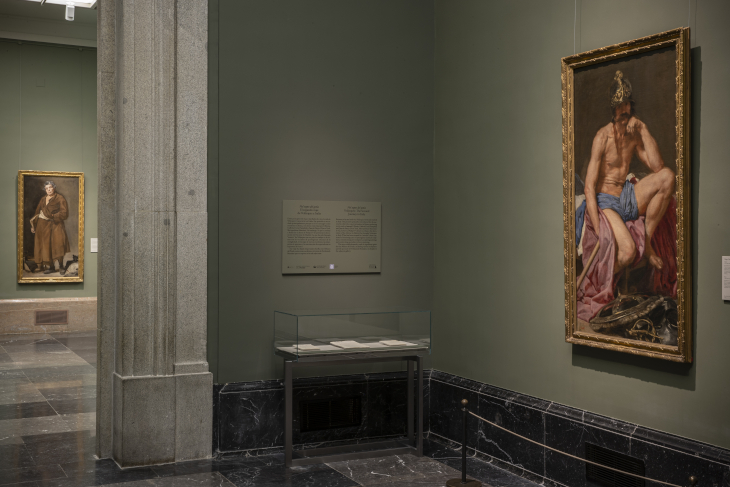
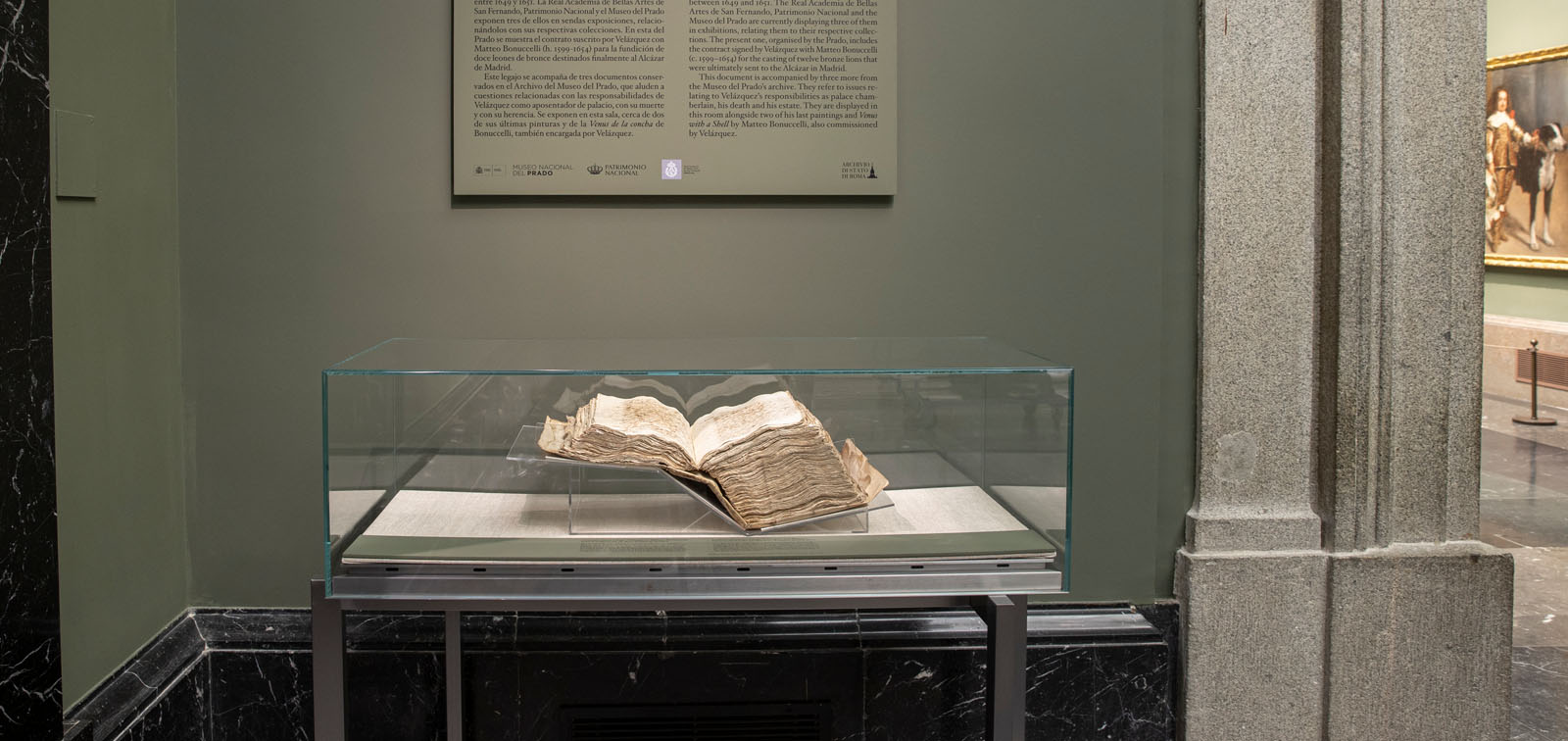
The documents can be seen in two display cases in Room 15 A of the Villanueva Building at the Museo Nacional del Prado. One contains the contract from the Archivio di Stato di Roma, while the other shows three additional documents from the Prado’s own archives.

This joint exhibition was made possible by the collaborative efforts of the Archivio di Stato di Roma, Patrimonio Nacional, Museo Nacional del Prado and Real Academia de Bellas Artes de San Fernando. The initiative offers further proof that Spanish institutions are firmly committed to promoting art-historical heritage and to strengthening cultural ties between Spain and Italy.

Access

Room 15A . Villanueva Building

RDF

RDF

With the collaboration of:
Archivio di Stato di Roma

Exhibition

Display case 1

Display case 1
Image of Showcase 1 in Room 15A (Museo Nacional del Prado)

Archivio di Stato di Roma, 30 Notai Capitolini, Ufficio 32, vol. 144, fols. II4r-v; I2Ir 

Contract between Diego Velázquez and Matteo Bonuccelli for the production of twelve bronze lions

On 7 January 1650 in Rome, Velázquez hired Matteo Bonuccelli to make twelve bronze lions that would support six porphyry slabs destined for the Hall of Mirrors in the Alcázar of Madrid, which appear in Juan Carreño de Miranda’s portrait of Charles II (Room 16 A). At a later date, several of these lions were reused as legs for pietre dure tabletops now on display in the museum’s Central Gallery.

Display case 2

Display case 2

Image of Showcase 2 in Room 15A (Museo Nacional del Prado)

Archives of the Museo Nacional del Prado 

Note of petition from Diego Velázquez to the Count of Montalbán requesting additional cleaning in the Alcázar of Madrid

In the performance of his duties as palace aposentador (steward/harbinger), on 3 March 1653 Diego Velázquez asked the Junta de Bureo—the council responsible for provisioning and managing the finances of the royal household, among other things—to improve the upkeep of certain courtyards and other areas in the Alcázar.

Copy of the inventory of precious objects and papers found in the Prince’s apartments at the Alcázar of Madrid after the death of Diego Velázquez

Certified list, drawn up on 10 August 1666, of the pictures, frames, sculptures, medals, reliquaries, maps, mirrors and other valuable items that belonged to Philip IV and were in the rooms occupied by his son, Prince Balthasar Charles, until his death in 1646, and later used by Velázquez as a workshop.

Note of petition from Juan Bautista Martínez del Mazo to the Junta del Bureo, requesting a review of Velázquez’s accounts as palace aposentador

This petition was made on 21 February 1661 by the painter Juan Bautista Martínez del Mazo, son-in-law and executor of Diego Velázquez, with regard to the division of the latter’s estate among his heirs, as one of them was preparing to leave for Naples.

Print on demand

Print artworks available in our catalogue in high quality and your preferred size and finish.

Image archive

Request artworks available in our catalogue in digital format.

Up