formularioRDF
The itinerary <em>TITULORECORRIDO</em> has been successfully created. Now you can add in works from the Collection browser
<em>TITULOOBRA</em> added to <em>TITULORECORRIDO</em> itinerary

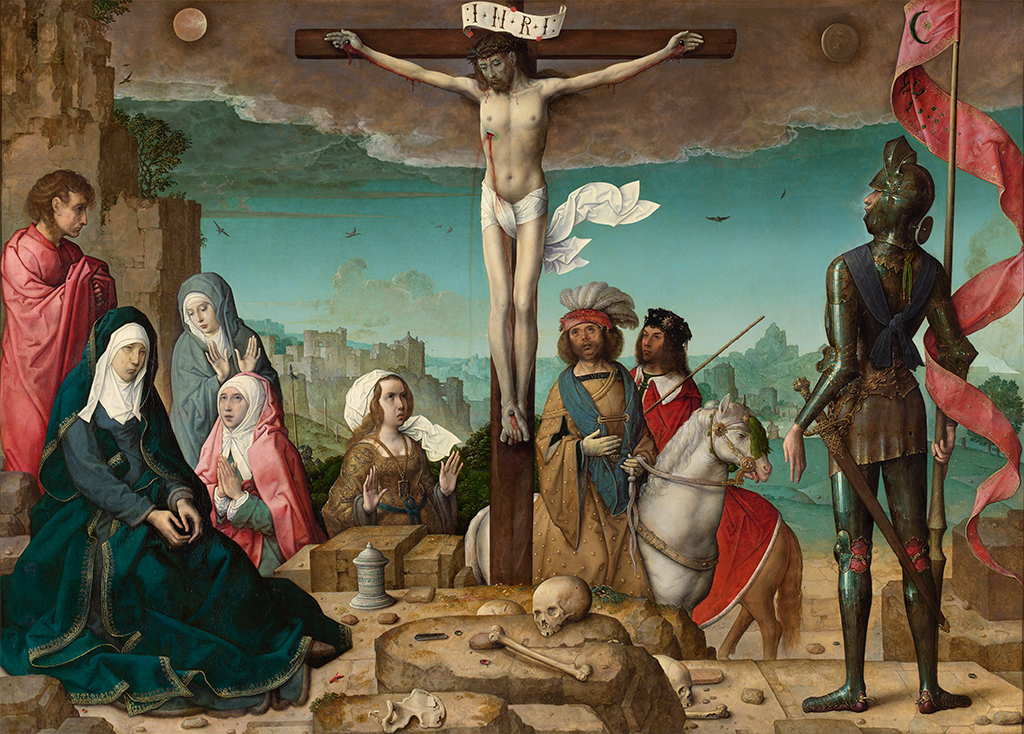
The Crucifixion. Juan de Flandes

The Crucifixion is a painting by Juan de Flandes.

The painter was born in the region that today belongs to the Netherlands.

ETR (Easy to Read) icon
© Easy-to-read european logo: Inclusion Europe. More information at: Easy-to-read

What is the artist depicting?

This painting depicts the moment of the death of Jesus Christ on the cross, as narrated in the Gospel.

The Gospel is the book of the Bible that describes the life and teachings of Jesus Christ.

The artwork was part of the main altarpiece in the Palencia Cathedral.

An altarpiece is a structure behind the altar in churches.

The altarpiece usually contains paintings or sculptures of religious scenes, such as episodes from the Bible or the life of the Virgin Mary and saints.

This painting was placed between 2 others depicting the moment before the Crucifixion, known as the Way of Calvary, and the Burial of Christ, the moment after the Crucifixion.

All 3 artworks are still displayed together in the Palencia Cathedral.

They form a set to be seen together as a whole.

The Crucifixion
The Crucifixion by Juan de Flandes

Who are the people represented in the painting?

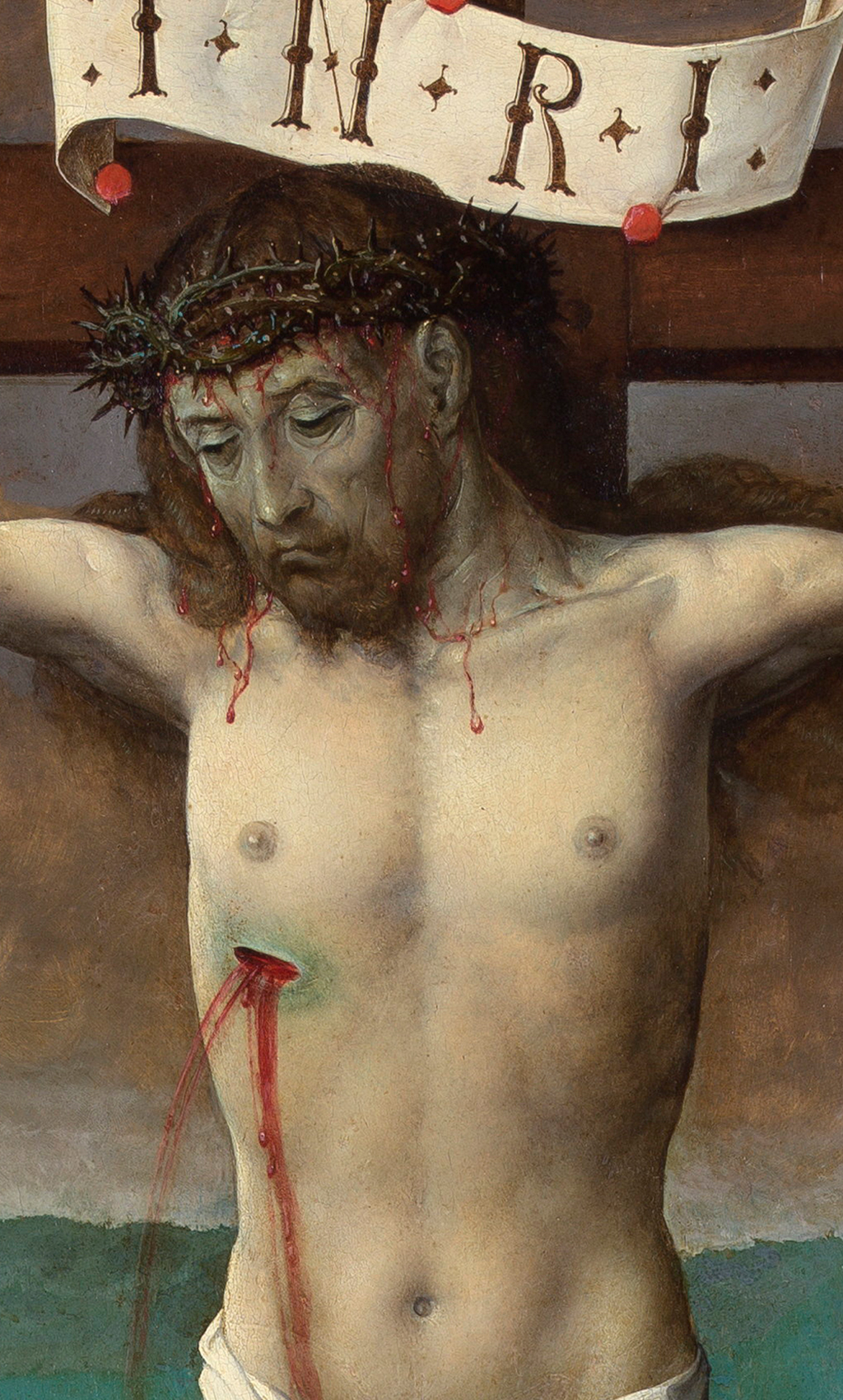
In the centre of the image is Jesus Christ, nailed to the cross, wearing the crown of thorns, with blood flowing from his side wound.

Surrounding him are other significant figures.

On the left, relatives and followers of Jesus are depicted grieving.

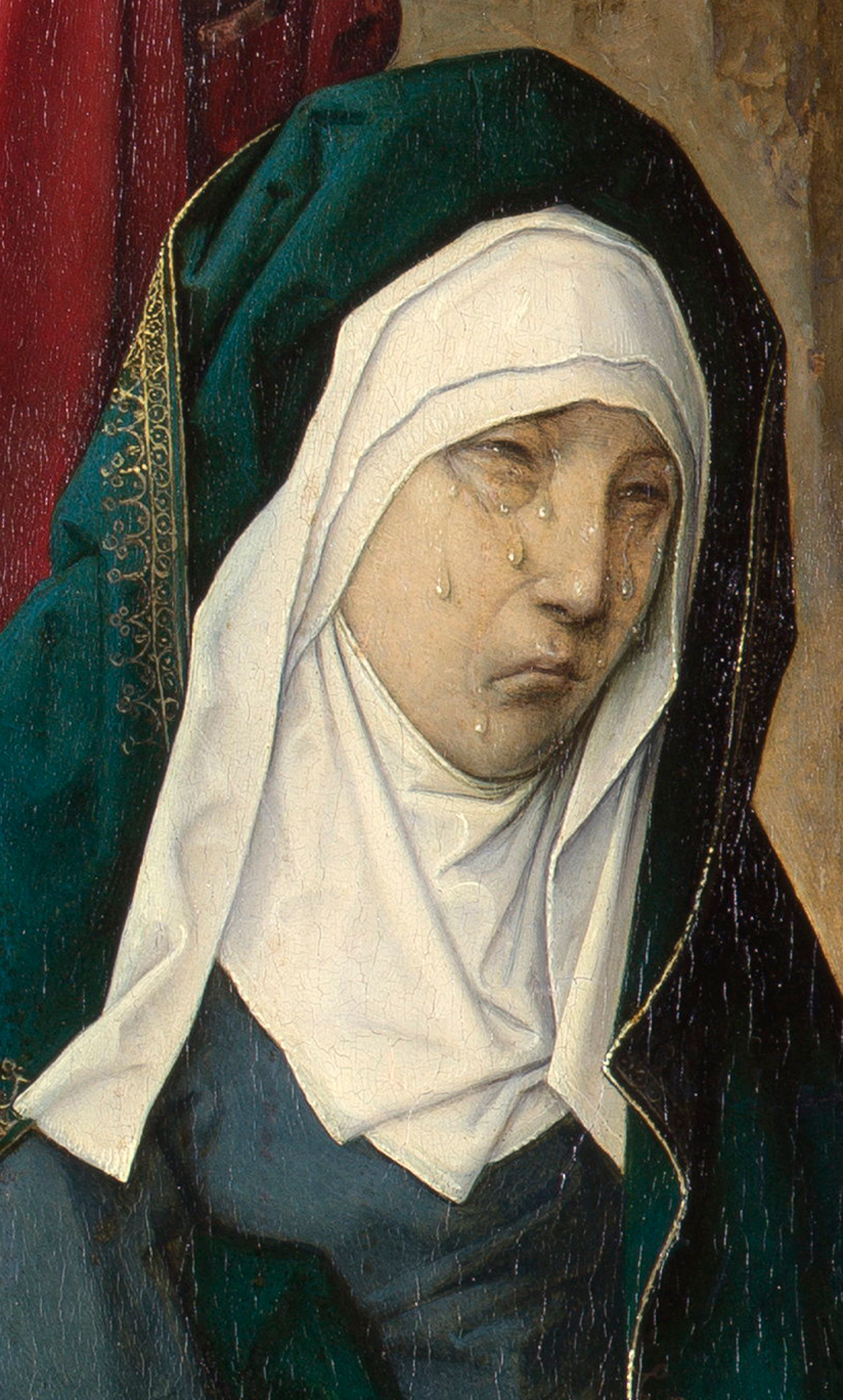
The sorrowful woman seated with a tear-covered face is the Virgin Mary.

The 2 women behind her are Mary Cleophas and Mary Salome.

The man dressed in red is Saint John, and the woman closest to the cross is Mary Magdalene.

On the right, some figures began to believe in the divinity of Jesus Christ as they witnessed his death.

It is evident as all of them gaze towards Jesus.

For example, a Roman centurion on horseback and another rider are behind the crucified Christ.

Facing away and wearing armour is the Roman soldier who had thrust his spear into the side of Jesus.

All figures appear static, calmly expressing emotion, and each seems disconnected.

They do not make eye contact.

The painting includes several symbols.

Below the cross, there is a skull and a bone representing Adam.

Adam was buried at Golgotha, where Jesus was crucified.

Also, the red coral near the Virgin Mary's shoe symbolises the spilt blood of Christ.

The artwork draws attention to the significance of the landscape and the use of colour, with a softened palette indicating distance in the background.

In the sky, the dark cloud represents the darkness that covered the Earth when Jesus died.

Juan de Flandes pays meticulous attention to detail, which is evident in the armour of the soldier, the fabric of the clothing, and the rocks.

The artist chose a low perspective to let the viewer look at Jesus on the cross from the same level as the figures in the scene.

Detail Virgin
Detail of the Virgin

The painter

Experts believe that Juan de Flandes began his painting career in Bruges.

Bruges is a city that today belongs to Belgium.

When he returned to Spain, he became a painter for Queen Isabella I of Castile.

After the queen died, he worked in Salamanca and Palencia.

Detail Jesus Christ
Detail of Jesus Christ

This work belongs to the following tours:

Easy-to-read content of Museo del Prado
Funded by the European Union - NextGenerationEU Government of Spain - Ministry of Culture Recovery, Transformation and Resiliency Plan Museo Nacional del Prado

Funded with the National Recovery and Resilience Plan (NRPP) , Spain’s Next Generation EU financing and according to the initiatives within the component C.24.I3 Digitization and valorization of major cultural services. The project is part of Campus Prado within Accessibility and Signage: Revitalization of the Urban Environment action line and as a universal accessibility activity.

Up