formularioRDF
The itinerary <em>TITULORECORRIDO</em> has been successfully created. Now you can add in works from the Collection browser
<em>TITULOOBRA</em> added to <em>TITULORECORRIDO</em> itinerary

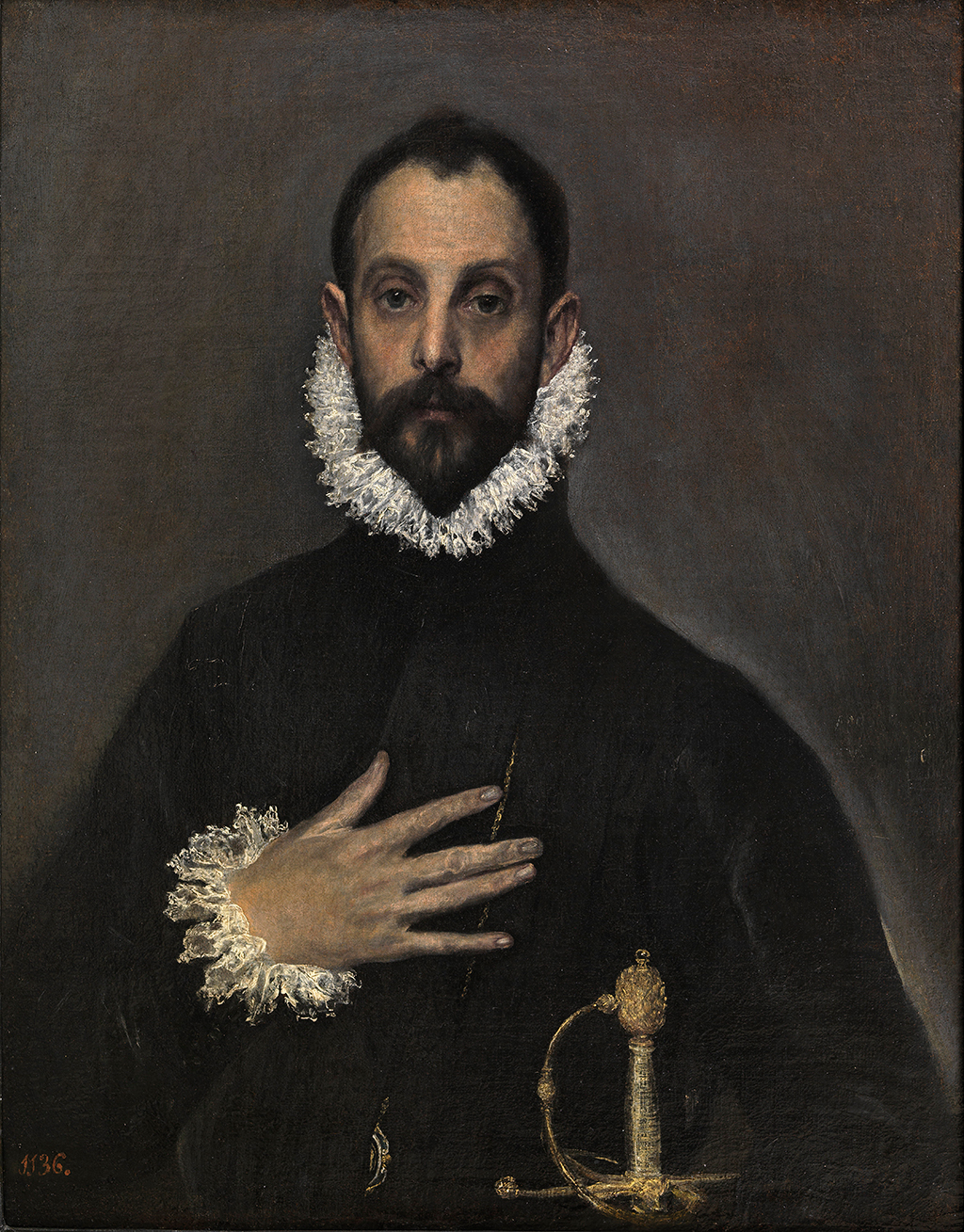
The Gentleman with his Hand on his Chest. Greco

The Gentleman with his Hand on his Chest is painting by Greco, a Greek painter who lived in Spain.

The painting is from 1580.

ETR (Easy to Read) icon
© Easy-to-read european logo: Inclusion Europe. More information at: Easy-to-read

Where was it painted?

This painting is one of the first portraits that El Greco painted when he arrived in Spain when he was 36 years old.

Greco moved to Spain from Italy where he lived and learned about the style of Italian artists.

Greco lived in Toledo where he painted for monasteries, parishes, and chapels.

The Gentleman with his Hand on his Chest
The Gentleman with his Hand on his Chest by Greco

Who is the person represented in the painting?

This painting shows a gentleman of about 30 years of age dressed in 16 century fashion.

He wears black, but the ornament around his neck, called a ruff, and the cuff at the end of the sleeve are white.

Greco used white to highlight the face and hand of the portrayed man.

The ruff, cuff, hilt of the sword and chain with a large medal, half covered by the clothes, contrast with the overall dark colour.

The portrayed man has a serious facial expression and a reflective gaze.

El Greco often painted this facial expression on the figures in his paintings to create a religious atmosphere.

There were many debates about who this gentleman really is.

Some experts believed it was a self-portrait of Greco, others thought it was the writer and poet Miguel de Cervantes, and others believed it was Antonio Pérez, the secretary of King Philip the Second.

The idea that seems most accurate is that this gentleman is Juan de Silva y de Ribera, the third Marquis of Montemayor.

King Philip the Second appointed him warden or military commander of the Alcázar of Toledo and Chief Notary to the Crown.

The marquis remained in these posts until his death.

It is possible that he put his hand on his chest to take an oath for the post of warden.

This position of the hand was common in religious paintings but is uncommon in portraits of non-religious figures.

Detail hand and grip
Detail of hand and grip.

The painter

This painting by Greco is an example of what Spanish gentlemen of the time were like.

This painting was always used to describe the idea of what is Spanish.

It is also an example of a portrait of the time.

This portrait shows the man in front of the viewer.

This man is very brightly lit against a neutral background.

In this painting, Greco used techniques and styles that he learned during the time he lived in Italy.

Detail of face
Detail of the face

This work belongs to the following tours:

Easy-to-read content of Museo del Prado
Funded by the European Union - NextGenerationEU Government of Spain - Ministry of Culture Recovery, Transformation and Resiliency Plan Museo Nacional del Prado

Funded with the National Recovery and Resilience Plan (NRPP) , Spain’s Next Generation EU financing and according to the initiatives within the component C.24.I3 Digitization and valorization of major cultural services. The project is part of Campus Prado within Accessibility and Signage: Revitalization of the Urban Environment action line and as a universal accessibility activity.

Up