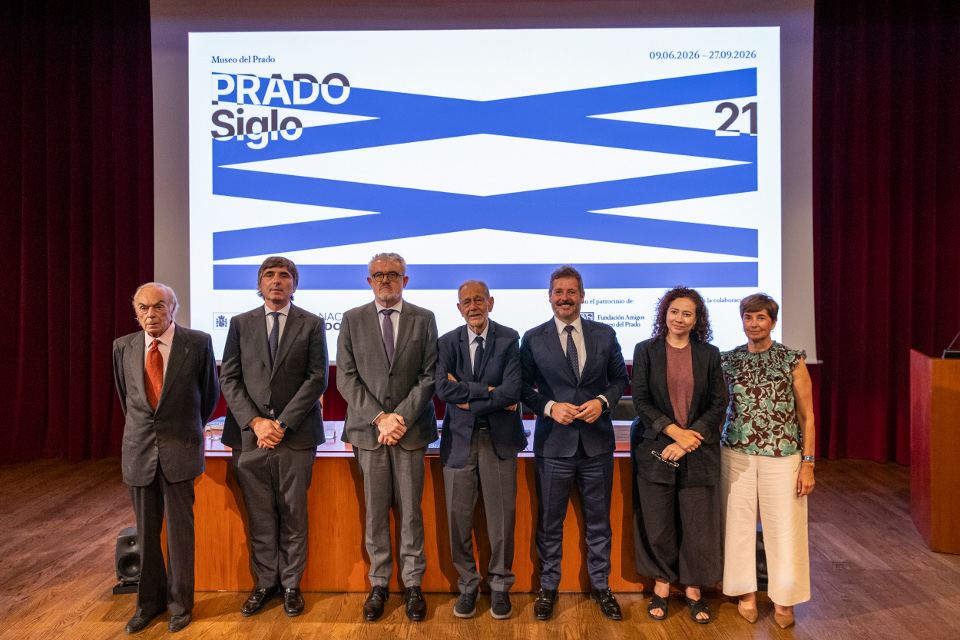
An overview of the transformations to the Museo del Prado since the year 2000, with a view to the next 25 years
Prado. 21st Century, an exhibition that invites us all to build the Museum of the futureTuesday, June 9, 2026
The Museo Nacional del Prado has such a solid presence that it is easy to think of it as a fixed, unchanging institution. In fact, in the last 25 years nearly a thousand new paintings, including absolute masterpieces by Fra Angelico, Velázquez and Goya, have entered the Museum’s collection. During that time, the Prado has been able to expand and develop in all fields—artistic, financial, and in terms of social impact and outreach—thanks to its own law (2003) arising from an agreement among all the parliamentary groups in Spain.
This exhibition, sponsored by the Fundación Amigos del Museo del Prado and with the collaboration of the Autonomous Community of Madrid, will be on display until 27 September in Rooms C and D of the Jerónimos Building. Prado. 21st Century is a journey through the milestones and phases of the Museum’s recent history which have shaped its day to day management, its academic mission and its place in the international cultural scene.
The narrative unfolds through 98 works—paintings, sculptures, drawings, prints, photographs, books and archival documents—together with audiovisual material and display elements. Rather than a self-congratulatory summary of what has already been achieved, they aim to encourage us to continue building the Prado, a museum for everyone.
Prado. 21st Century is a project that follows the transformation of the Museo del Prado over the past twenty-five years. Displayed in Rooms C and D of the Jerónimos Building, it will be on show until 27 September 2026.
Through a carefully chosen and representative selection of 98 works that have been added to the collection since the year 2000, shown alongside documentary, bibliographic, audiovisual and statistical material, the exhibition offers a reflection on the Prado's contemporary identity. The exhibition presents the Museum as an institution in motion, aware of its historical heritage but also of its present and future responsibilities.
Curated by Alfonso Palacio, Deputy Director of Curatorship and Research, and Elena Cenalmor, Curatorial Assistant in the Deputy Directorate of Curatorship and Research, both at the Museo del Prado, the exhibition focuses on the structural, academic and social changes that have allowed the Prado to strengthen its position among the world's leading art museums. This is a collective narrative which highlights both the growth of the collection and the evolution of its models of management, conservation, research, communication and public engagement.
Prado. 21st Century opens with an infographic that highlights the quantitative, qualitative and physical transformations which the Museo del Prado has experienced in the last 25 years, together with a large-scale model of the planned and scheduled Prado Campus. The exhibition is structured around the growth and enrichment of the collections, one of the central focuses of the Museum in recent decades. The 98 works on display, dating from the Middle Ages to the late 20th century, allow visitors to trace how the Museum has added key works to its collections through acquisitions, donations, bequests, State assignations and models of community-based participation. Paintings, sculptures, drawings, photographs, books and archival documents construct a narrative that emphasises both the artistic quality and the institutional context which has made it possible to add these works to the Museum’s collection.
Among the most significant are examples of medieval and Renaissance art that reinforce areas historically less represented in the Prado’s collections, such as the Altar Frontal from Solanllong. Christ Pantocrator with the Tetramorph (1200–1210) donated by the Várez Fisa family, the monumental Roman Torso ofAphrodite (1st century BC-1st century CE) donated by Claudio Bravo, and The Wine of Saint Martin’s Day, acquired through a one-time capital grant from the Ministry of Culture and with the Museo Nacional del Prado’s own funds in 2010. These acquisitions illustrate the balance between public support and social commitment with regard to the Museum’s acquisitions policy.
The holdings of Baroque art, one of the pillars of the collection, have been strengthened with works such as The Raising of Lazarus by José de Ribera, SaintFrancis in prayer by Francisco de Zurbarán, and Portrait of Ferdinando Brandani by Velázquez, the latter acquired with the Museum’s own funds. In addition, the exhibition highlights key donations that have been fundamental to the growth of the Prado, such as that of Plácido Arango, and the Jordan bequest, which has significantly contributed to areas such as painting and miniatures.
The exhibition also highlights the role of crowdfunding and that of the Fundación Amigos del Museo del Prado, resulting in the addition of new works such as Portrait of a Girl with a Pigeon by Simon Vouet and Oratory with the penitent Saint Jerome, acquired with the support of the public. These works exemplify new forms of social involvement in the construction of the collection and the Museum's commitment to opening its processes to society at large.
The exhibition continues with a focus on the consolidation of specific areas of the collection, including works by women artists, with acquisitions of paintings by Sofonisba Anguissola, Rosa Bonheur, Rosario Weiss and María Blanchard, and the photography collection, which documents both the history of the Museum’s buildings and the first reproductions of its masterpieces. These fields are complemented by the collections of drawings, prints, artists' sketchbooks, books and archival documents, which offer an insight into creative processes and the intellectual history of the Museum.
Prado. 21st Century concludes with a review of other key areas of the Museum’s work in the last 25 years: publishing activities, represented by a display of publications produced since 2000; the work undertaken by the Restoration and Education Departments and the Study Centre; and the evolution of communication and public engagement strategies, linked to the Museum's growing national and international profile. Making use of graphic and audiovisual material, Prado. 21st Century presents a journey through the transformation of the Museo Nacional del Prado over the past twenty-five years, highlighting the expansion and diversification of its ways of engaging with society. This is a project which reveals how the Museum has introduced new languages and channels to explain its work, facilitating access to knowledge and strengthening a more direct and ongoing connection with its visitors.
The exhibition's audiovisual content, which has allowed certain aspects to be expanded, emphasised and presented in more detail, was developed in collaboration with Samsung, the Prado’s technology partner. Furthermore, in the context of the exhibition, the Museum and Samsung are launching a major new feature: “Prado Photo”, an innovative mobile app that allows visitors to take home a personalised photographic record of their visit. Thanks to the use of advanced AI technology, the app combines the user's image with some of the most famous and emblematic galleries and works in the collection without disrupting visitor flow and enhancing the overall experience.
Prado. 21st Century is an exhibition that presents a reading of the Museum from the present day, focusing on the processes, decisions and collective endeavour that have shaped the Prado in recent decades.