The Museo del Prado enriches its Rubens collection with a masterpiece from his final yearsMonday, March 3, 2025
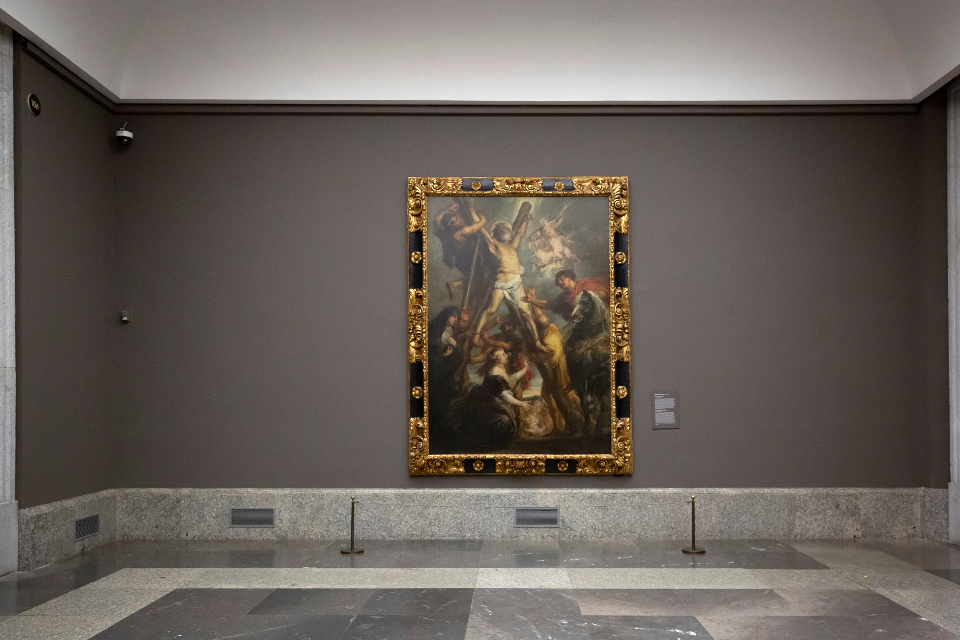
The Museo Nacional del Prado, home to the world’s largest and most important collection of works by Rubens, will, from now until 2026, host The Martyrdom of Saint Andrew, a masterpiece from the artist’s final years, thanks to the generosity of the Fundación Carlos de Amberes.
Displayed in Room 16 B of the Villanueva Building along with its original frame, the piece was painted by Rubens during the same period he was working on the decorative programme of the Torre de la Parada.
From today and until 2026, the the Museo del Prado will include in its permanent collection display The Martyrdom of Saint Andrew by Flemish artist Peter Paul Rubens. The work will be exhibited in Room 16 B of the Villanueva Building while architectural remodelling works are underway at the headquarters of the Fundación Carlos de Amberes, a private non-profit institution whose purpose is to bolster European culture and values.
According to Javier Solana, Head of the Museo del Prado’s Board of Trustees, “The Museo del Prado never tires of pursuing excellence... our institution has more ‘Rubens’ on display in its galleries than any other, but if we’re given the opportunity to enrich them and work with a fellow institution like the Fundación Carlos de Amberes to offer a more complete vision of the artist, we’re delighted to take it.”
For the Fundación Carlos de Amberes, in the words of its chairman, Miguel Ángel Aguilar, “Lending the Saint Andrew to the Prado does justice to the importance of the work, which has now joined the array of other masterpieces by the same artist.”
The Martyrdom of Saint Andrew
Peter Paul Rubens
Oil on canvas, 306 x 216 cm, 1636–1639
Original frame by the cabinetmakers Abraham Lers and Julien Beymar, servants of Philip IV
An agent of the Antwerp-based Plantin Press in Madrid named Jan van Vucht commissioned this canvas from Rubens to hang over the main altar of the church at the Real Hospital de San Andrés de los Flamencos, where it was installed in 1639. It is therefore a product of the Flemish master’s final period of activity, made during the same years he was working on the decorative programme of the Torre de la Parada. The hospital was founded on Calle de San Marcos in 1606, honouring the wish of the deceased Carlos de Amberes to provide shelter for the poor and pilgrims from the Seventeen Provinces in the Low Countries who were visiting Madrid. A new church was built in 1621, when sovereignty over these provinces reverted to Philip IV. It is quite likely that the canvas was commissioned to make this church a candidate for hosting the celebration of the feast of Saint Andrew, which was normally held at the Royal Chapel of the Habsburgs and associated with the Order of the Golden Fleece, as Andrew was the patron saint of the House of Burgundy and the Flemish states.
The hospital was founded on Calle de San Marcos in 1606, honouring the wish of the deceased Carlos de Amberes to provide shelter for the poor and pilgrims from the Seventeen Provinces in the Low Countries who were visiting Madrid. A new church was built in 1621, when sovereignty over these provinces reverted to Philip IV. It is quite likely that the canvas was commissioned to make this church a candidate for hosting the celebration of the feast of Saint Andrew, which was normally held at the Royal Chapel of the Habsburgs and associated with the Order of the Golden Fleece, as Andrew was the patron saint of the House of Burgundy and the Flemish states.In this painting, Rubens portrayed Saint Andrew’s martyrdom as narrated by Jacobus de Voragine in The Golden Legend:
But Andrew, seeing him, said: “Art thou here, Aegeus? If thou art come to seek forgiveness, thou shalt have thy pardon; but if thou art come to take me down from the Cross, know that I am not to come down alive! And already I see my King awaiting me in Heaven!” The soldiers sought to unbind him, but they could not touch him, for instantly their arms fell back powerless. And Andrew, seeing that the crowd wished to take him down from the Cross, uttered this prayer, which Saint Augustine has quoted in his book On Penance: “Lord, suffer not that I come down alive from this cross; for it is time for Thee to give, my body back to the earth.” When he had said these words, a dazzling light came down from Heaven and enveloped him for the space of a half hour, hiding him from sight; and when the light vanished, he breathed forth his soul.
The composition is based on Otto van Veen’s version of the same theme for the church of Saint Andrew in Antwerp, and there is a preparatory drawing at the Museum Boijmans Van Beuningen in Rotterdam.
Fundación Carlos de Amberes
Four hundred years after it was established in 1594 to provide refuge for the poor and pilgrims coming from the former Seventeen Provinces of the Low Countries that belonged to the Spanish monarchy in the sixteenth and seventeenth centuries (present-day Belgium, Luxembourg, the Netherlands, and northern France), Fundación Carlos de Amberes continues to promote the culture of those territories in Spain and maintains close ties with them through activities such as temporary exhibitions, workshops for children, lectures, research and cultural tourism projects, and conferences on the past, present, and future of Europe.