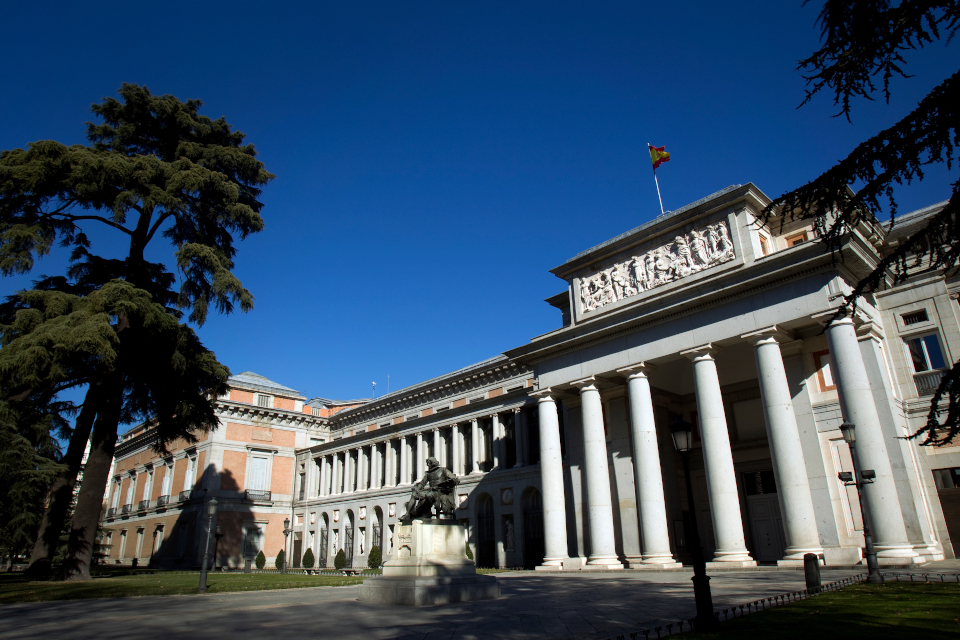
Open to new geographies, nature, themes and eras, while reflecting on the museum’s constant evolution
The Museo del Prado is presenting its 2026 programmeWednesday, January 14, 2026
The Museo del Prado is highlighting the role of Mariana of Austria as a figure emblematic of the queens who promoted art, as well as the Mediterranean Gothic and Central European culture with Hans Baldung Grien and Rilke.
The 2026 programme also includes an exhibition that shows the museum’s profound transformation in the first 25 years of the 21stcentury.
In the Italian Manner.Spain andtheMediterranean Gothic,1320-1420will be the first major exhibition to open at the Museo del Prado in 2026, focusing on the extremely significant influence of Italian art on artistic creation in the Spanish kingdoms during the late Middle Ages. This panorama was enriched by the artistic, technical and iconographic innovations derived from the original Italian models. During thetrecentothe Mediterranean became a two-way crossing between the two peninsulas, with merchants and clerics responsible for artistic exchanges.
The exhibitionMariana of Austriais part of the “Three Queens” year, in which the Museum is highlighting the key role played in its history by Isabella Farnese, Christina of Sweden and Mariana herself, the wife of Philip IV and the first female art patron to be the subject of a major solo exhibition at the Prado. Mariana was the leading artistic patron of her day and the exhibition has a twofold objective: to trace the evolution of her image across the different phases of her rule (from consort to queen mother and including regent; from Velázquez to Carreño Miranda); and secondly, to examine the projection of that image during a time of crisis for the Spanish monarchy.
The centenary of Rainer Maria Rilke (1875-1926), an admirer of El Greco, Velázquez, Murillo and Goya, provides the starting point forRilke and Spanish Artwhich, together with an exhibition devoted to the German Renaissance master Hans Baldung Grien, focuses on the rich cultural tradition of Central Europe.
A quarter of the 21stcentury has now passed, and the Museum will be revealing the way in which it has retained its historical identity while at the same time acquiring a new dimension both in terms of additions to its permanent collection and the number of visitors and followers on social media.
TEMPORARY EXHIBITIONSPROGRAMME2026
JERÓNIMOS BUILDING,ROOMS A-B
In the Italian Manner.Spain andtheMediterranean Gothic,1320-1420
26 May to 20 September 2026
Curator: Joan Molina Figueras, Head of the Collection of European Painting up to 1500
With the exclusive sponsorship of Fundación BBVA
Without Italy it is difficult to understand the artistic landscape of the late Middle Ages in Spain. The arrival of artists and the import of works gave rise to an entire series oftrecentoaesthetic, technical and iconographic innovations which left a profound mark on the visual culture of the Iberian kingdoms. Prominent local masters also contributed to this evolution, employing eclectic and hybrid approaches to create original interpretations of Italian models. Their technical and material sophistication combined with their ability to generate new formal, typological and thematic proposals fascinated the most sophisticated viewers of the time, who were consistently attentive to innovative and exotic solutions. In a world of permeable borders, the two shores of the western Mediterranean became the stage for two-way voyages in which artists’ creations and viewers’ gazes were defined by the artistic cross-fertilisation characteristic of Mediterranean identities.
This exhibition aims to bring a fascinating artistic period closer to a broad public through a series of arguments intended to go beyond the debate between centre and periphery; the use of technique as a means of expression in sumptuary items; artistic exchanges derived from trade routes and diplomatic networks; dialogues between the new Gothic culture and the Islamic world; and finally, the need to replace traditional art-historical categories with more multifaceted and heterogeneous perspectives.
In order to achieve this end, the exhibition will include a remarkable and varied selection of over one hundred works in a range of techniques (painting, sculpture, goldsmiths’ work, illuminated manuscripts, drawings, embroidery, silk textiles, etc.), many of them little known and some never previously exhibited. Alongside works by leading Italian masters such as Ambrogio Lorenzetti, Gherardo Starnina, Lupo di Francesco, Barnaba da Modena, Andrea di Petruccio and Geri Lapi, the exhibition will also include creations by local artists such as Ferrer and Arnau Bassa, the Serra brothers, Pedro de Córdoba and Miquel Alcañiz. The works are loaned from 31 national and 25 international institutions.
Mariana of Austria
1 December 2026 to 28 March 2027
Curator: Noelia García Pérez, Professor of Art History, University of Murcia
Sponsored by Fundación AXA
In recent years the Museo del Prado has demonstrated a firm commitment to highlighting the role of women in the art world, both as creators and as subjects of the male gaze. This commitment has taken the form of monographic exhibitions, thematic routes based on the permanent collection, scholarly encounters, lectures, specialist grants from the Prado’s Study Centre, and more recentlyThe Female Perspectiveproject, which focuses on the study of female art patrons: women who contributed decisively to the genesis of the Museum and to the formation of its collections.
In this context, the Prado is currently preparingMariana of Austria, the first exhibition at the Museum to be devoted to a female art patron. It will be shown in Rooms A-B of the Jerónimos Building, a space reserved for major temporary exhibitions, from 1 December 2026 to 28 March 2027.
With this exhibition, the Museum is undertaking an ambitious project that has two principal objectives: firstly, to trace the creation and evolution of the image of Queen Mariana of Austria across the different stages of her life and her exercise of power; and secondly, to present the promotion and dissemination of that image during one of the most decisive periods in the history of the Spanish monarchy.
Through a carefully chosen and representative selection of around one hundred works - including paintings, sculptures, medals, textiles, illuminated manuscripts and prints - the exhibition allows visitors to explore the principal iconographic strategies employed by Mariana of Austria and her court painters to construct and promote a public image that legitimised her position, strengthened her authority in a complex and adverse political context, and disseminated her power among the European courts that observed with considerable expectation the impending fate of a monarchy whose heir had serious health problems. Far from arising from a void, these representational strategies drew directly on the principal iconographic traditions employed by Habsburg women for more than two centuries to depict female power. As the last queen of this dynasty, Mariana knew how to make full use of and adapt the visual legacy created by the women of the House of Austria who preceded her in the exercise of power, reinterpreting those models to claim her own place in history.
JERÓNIMOS BUILDING,ROOMS C-D
Prado. 21stCentury
Jerónimos Building. Rooms C and D
9 June to 27 September 2026
Curators: Alfonso Palacio, Deputy director of Conservation and Research, and Elena Cenalmor, Curatorial assistant in the department of Conservation and Research
Sponsored by the Fundación Amigos del Museo del Prado.
This exhibition traces the transformation of the Museo del Prado over the last quarter of a century. Through works acquired during this period and a series of statistical, object-based, photographic and documentary comparisons, it presents the history of an active and evolving museum: a vibrant and open institution that has built on the work of previous generations to attain a leading place among the world's great museums over the course of the last twenty-five years, undoubtedly its period of maximum development. This is due not only to the excellence of the Museum’s collections but also to the strength of its scholarly mission, its international reach, its communicative strength, its reception by society as a whole, its unwavering and committed openness to the public, and its increasingly close relationship with its visitors.
The works in the exhibition offer a representative selection of acquisitions made over the last twenty-five years. Arranged chronologically and thematically, they focus attention on the essence of the Museo del Prado, which distinguishes it above all else: its remarkable collection, which has never ceased to expand and which continues to grow year on year. At the same time, these works also bear witness to the efforts of all those who have made this metamorphosis possible and the means by which they have achieved it. In order to visually express this evolution and bring it closer to the visitor, each area of the exhibition features various objects and other elements that reflect different facets of this transformation: museography, conservation, visitor services, accessibility, corporate image and the participation of society in the evolution of the Museum, among others.
The final section of the exhibition presents a survey of a number of the Museum’s departments and their activities, which exemplify this transformation: publishing activity, represented by a display of all the books published since 2000; training and research, through graphic material on the Study Centre; and the work of the departments of Restoration, National and International Promotion, Communication, and Education, presented in the form of four videos.
Rilke and SpanishArt
Jerónimos Building, Room C
17 November 2026 to 7 March 2027
Curators: Javier Arnaldo, Director of the Museo del Prado’s Study Centre, and Javier Barón, Head of the 19th-century Painting Collection
With the collaboration of the City Council of Madrid
To commemorate the centenary of the death of Rainer Maria Rilke (1875-1926), the Museo del Prado is preparing the exhibitionRilke and Spanish Art, to be held from 17 November 2026 to 7 March 2027 in Room C of the Jerónimos Building.
This project will explore the importance of Rilke's experience of Spanish painting. For a writer deeply sensitive to art - which he made a part of his life as the husband of a sculptor and the lover of the painters Lou Albert-Lasard and Baladine Klossowska - who devoted books and numerous reflections in his correspondence to the artists of the Worpswede colony as well as to Cézanne and Rodin among others, this choice is significant. It already appears in his early works devoted to Diego Velázquez (a sonnet of 1895) and to Bartolomé Esteban Murillo, and was subsequently developed in his work, particularly through the profound influence which the art of El Greco had on him and his interest in Francisco de Goya. Rilke was able to see paintings by both artists in the collections in Vienna, Munich and Berlin. He visited the exhibition on El Greco at the Salon d’Automne in Paris in 1908, which included theView of Toledo(Metropolitan Museum of Art). He also saw works by El Greco from the collection of Marczell von Nemes exhibited at the Alte Pinakothek in Munich in 1911, alongsideThe Disrobing of Christfrom the Pinakothek’s permanent collection, theLaocoön(National Gallery of Art, Washington), and paintings by the artist from the collection of the Musée Bonnat in Bayonne.
The exhibition is curated by Javier Barón, Head of the 19th-century painting collection at the Museo del Prado, and Javier Arnaldo, Head of the Museo del Prado’s Study Centre. They are also the authors and editors of the catalogue that will accompany the project.
The central section of the exhibition focuses on Rilke's travels around Spain between November 1912 and February 1913, specifically his time in Toledo, Ronda and Madrid, where he visited the Museo del Prado and the Royal Armoury. It was there that he renewed his enthusiasm for El Greco, his interest in Goya and his esteem for Velázquez.
In addition, between 1902 and 1906 Rilke maintained a close relationship with the Spanish painter Ignacio Zuloaga, as evident in their correspondence and in his admiration for Zuloaga's paintings, which he saw in Berlin, Dresden, Paris, Munich, Venice and Düsseldorf. Zuloaga also admired El Greco, owning several of his paintings, and Goya; both had a decisive influence on his work.
Hans Baldung Grien
Jerónimos Building. Room D
24 November 2026 to 7 March 2027
Curator: Christine Seidel, Associate Curator of Renaissance Painting, National Gallery (London)
Hans Baldung Grien (1484/1485-1545) was one of the key figures of German Renaissance painting. Born into a family of lawyers and humanists, he worked in Dürer's studio in Nuremberg. He was arguably Dürer's most ambitious apprentice and very probably took charge of the studio during the artist’s second trip to Italy.
Baldung retained the nickname he received in the studio (Grien, meaning green in German) and maintained close ties with Dürer after moving to Strasbourg, where he acquired citizenship in 1509 and soon after began working as an independent master with his own studio. He started his career there as a portraitist and printmaker while important ecclesiastical commissions soon followed. Baldung worked for members of the elite social class in Strasbourg, a city with a fiercely independent civic government. After establishing his reputation as a prestigious painter in the city, in the 1520s he began painting large mythological and historical scenes as well as allegorical subjects. The patrons of these private works are virtually unknown today but these visually and intellectually daring creations suggest a humanist context.
The two works in the collection of the Prado,Harmony(The Three Graces?) andThe Ages and Death, are considered to be among Baldung’s last works, dating from around 1541-44. They are thought to have been commissioned by or for Frederick the Great of Solms-Laubach, a German count from Rhineland-Palatinate who was a friend of Melanchthon, Luther's spiritual companion who had embraced the teachings of the Reformation only a few years earlier. The pair of paintings was gifted to Jean de Ligne in 1547, apparently shortly after their completion. Probably via this route, and through one of the close allies of the Spanish Crown in the struggle against the Northern Flemish provinces during the Dutch Revolt, the paintings entered Philip II’s collection, where they are described as a diptych. They transform a theme omnipresent in late medieval iconography - the motif of vanitas and triumphant death - into a unique pictorial discourse that transcends this popular imagery. Interpreted respectively as "The Three Graces" or an Elysian vision of beauty, and "The Ages," advancing through a winter landscape resembling a Bosch-like hell, the two panels juxtapose the fundamental ideas of eternal beauty and earthly life. While one finds its expression in the poetic forms of beauty, the other is linked to the cycle of life and the fleeting nature of time manifested in the Ages of Man. Baldung’s interest in devising an idealised human form and the ages of life, as well as his study of nature, has been revealed thanks to the recent restoration of these two paintings which has made it possible to appreciate the botanical details and the marked tonal difference between the two panels.
The exhibition aims to explore three themes that allow for a better appreciation of the unique nature of the panels in the Prado. It also encourages a consideration of Hans Baldung within the broader context of German Renaissance artistic trends, among which the work of Cranach, whom Baldung must have known, is particularly significant.
Dürer's artistic legacy, his study of nature and his reflections on the ideal human form had a profound impact on Baldung even after he moved to Strasbourg. The artistic dialogue between the two, more specifically Baldung’s constant references to his master and to contemporary trends in German Renaissance painting in his later works, establishes the artistic legacy of the Prado panels in the era of their creation.
This dialogue includes the study of nature and plants, as well as the introduction of classical motifs into a Christian pictorial context that arose from a renewed interest in classical themes in the work of Dürer and his contemporaries.
The exhibition aims to locate the two Prado panels within an artistic panorama, not through strict reconstruction but rather by exploring the artistic landscape in which Baldung, as an established painter, found himself towards the end of his career. A separate section in the exhibition is devoted to the discoveries made during the cleaning of these two works, which provide insights into the creative process.
VILLANUEVA BUILDING
Room 60. Rotating collections
The Prado multiplied. Photography as shared memory
2 February to 5 April 2026
Curator: Beatriz Sánchez Torija, department of Prints and Drawings
The historical photography collection is the most recent addition to the Museo del Prado's holdings. Its importance has grown considerably in recent years, evident in both the increasing number of works and the growing public interest it generates.
In a way comparable to engraving and lithography, photography allows for the creation of multiple copies of the same work. Furthermore, it offers a precise representation of reality, making it the primary medium for disseminating collections and an effective recorder of memory for the institution and its visitors.
Photographs reproducing works of art constitute the largest group in the collection and their study has served as the basis for this exhibition, in which the materiality of the photographic objects themselves and their uses during the second half of the 19thcentury and the first decades of the 20thcentury acquire particular importance. The exhibition will include images in various formats, techniques and supports, produced by national and international photography firms such as Laurent, Moreno, Anderson, and Hanfstaengl.
The exhibition opens with one of the first photographs displayed at the Museum, in 1899. After a visual tour through various rooms of the Villanueva Building, the focus shifts to reproductions of works now in the collection, produced using photographic or photomechanical techniques. The connection between the photographers Juan Laurent (1816-1886) and José Lacoste (1872-?) and the Museum is also recognised in the exhibition, as is their contribution to disseminating the image of the Prado both nationally and abroad.
The artist’sworld through thecamera
13 April to 5 July 2026
Curator: Beatriz Sánchez Torija, department of Prints and Drawings
The advent of photography in the 19thcentury marked the birth of a new artistic discipline and paved the way for an unprecedented and remarkably effective method of representing reality. Artists rapidly grasped the scope of this transformation: they portrayed themselves (alone or with colleagues), documented their work spaces, and made the effort to graphically record both their creative processes and the final materialisation of their works.
Based on the holdings of the Museo del Prado, specifically the archives of Luis and Federico de Madrazo, Dióscoro Puebla, Rafael Rocafull, Cecilio Pla, Agustín Querol, Miguel Blay, Fernanda Francés and Manuel González Santos, the exhibition brings together photographs by renowned professionals alongside other anonymous and possibly amateur creations. Created using a range of techniques and formats, taken as a whole this group of images makes it possible to trace a visual map of the presence of artists in their domestic contexts, studios and various spaces of social interaction and learning, as well as in alternative creative settings, such as the evocative Patio de las Doncellas in the Real Alcázar in Seville.
The exhibition is intended as a tribute to the male and female creators who were active in the 19thand early 20thcenturies, with a particular acknowledgement of those who understood photography as a privileged medium for ensuring the preservation of their image and artistic practice over time.
Valeriano D. Bécquer (1834-1870)
13 July to 11 October 2026
Curator: Pedro J. Martínez Plaza, 19th-century Painting Collection
For the first time at the Museum, this exhibition will bring together the eight paintings painted by Valeriano D. Bécquer between 1866 and 1867 as part of a government commission for the now-defunct Museo de la Trinidad. Although only three provinces - Zaragoza, Soria, and Ávila - were completed, this is an exceptional group. The details of traditional dress and the depiction of local people, together with the quality of these works, make the series one of the finest examples of 19th-century genre painting in Spain.
Ricardo de Madrazo (1852-1917): drawings and watercolours
19 October to 17 January 2027
Curator: Pedro J. Martínez Plaza, 19th-century Painting Collection
The various acquisitions made by the Museum in recent years have allowed for the organisation of the first exhibition entirely devoted to Ricardo de Madrazo, the youngest son of Federico de Madrazo and the least known member of this family of artists. Focusing on his works on paper, the exhibition will reunite a number of his sketchbooks, drawings and watercolours. The result will be to reveal the diversity of Ricardo de Madrazo’s artistic pursuits, ranging from copies of Old Master paintings to Orientalism and genre scenes, the result of his extensive travels in Spain, Europe and North Africa.
Temporary exhibition. Room 66
ThePainting ofHunger
27 April 2026 to 13 September 2027
Curators: Celia Guilarte, museum curator, and Carlos G. Navarro, 19th-century Painting Collection
This exhibition traces and analyses the history of José Aparicio’s paintingTheYear ofHunger in Madrid(1818), which went from being one of the most popular and controversial paintings in 19th-century Spain to languishing in a storage facility where it now passes unnoticed by the public and art historians, considered no more than an anecdotal depiction of local interest.
Acclaimed and loathed, promoted by the official art world, published in the press and made famous in literary, musical and theatrical works and popular sayings, during the reign of Ferdinand VII the painting acquired a “Pop” status before that term was coined. It was, however, gradually excluded from the canonical account of Spanish painting and even from the Prado's own galleries, to the point where it is now seen as no more than a record of local history in Madrid. To a degree matched by few other paintings, Aparicio’s work exemplifies shifts in art-historical judgment and the difficulty with which great cultural icons endure and become enshrined as such.
In the “prehistory” of the Museo del Prado, during the time when the Museum was forming its collections through a repeated process of accumulation and dispersal of works, Aparicio’s painting reigned supreme. However, the story of the rise and fall of both the work and its creator spans the period from 1819 to 1927, when it was finally deposited in the Museo de la Historia de Madrid. In the present day, when the concept of the immutability of museums is used as a political strategy by a sector of society, the painting and its story deserve to be remembered by the public.
This act of temporary exhumation of a fallen glory evokes the complex process of the birth and formation of the earliest public museums and the fluctuating quality criteria they have applied. Contemplating José Aparicio’s painting alongside contemporaneous ones by José de Madrazo and Francisco de Goya allows for a reflection on the polysemy of this concept, given that its history encourages us to revisit the myth of progress in the arts, the ideas of tradition and modernity, and the role of art in nationalist constructs, as well as to reflect on the outdated cultural notion ofartistic geniusat a time when the great painters of the day had not yet achieved that status.
Itineraries
TheMuseo del Pradoand the Council of State
15 June to 20 September 2026
Engineeringinthe Prado. A bridge between art and technology
26 October 2026 to 21 February 2027
Curators: Francisco Javier Fernández and Francisco Javier León
With the collaboration of Fundación FHECOR
In recent years the Museo del Prado has worked on devising thematic routes around the collection as a high-potential strategy for diversifying and expanding its cultural activities while also allowing for new interpretations of the works on display, providing an opportunity for research and dissemination from a multidisciplinary perspective.
In a reflection of this aim, October 2026 will see the presentation of a new perspective on the Prado’s collections. This is a thematic route based on 30 works displayed in different galleries in the Villanueva Building which aims to focus on elements of civil engineering – such as bridges, for example – represented in the Museum's collections.
This new thematic route has been made possible thanks to collaboration with Fundación FHECOR. The Fundación’s activities include promoting, fostering and disseminating complementary and specialised training in the fields of Structural Design and Engineering and their historical and cultural values.
The display of the Permanent Collection: new actions
Comprehensive rehanging of the rooms displaying 18th-century art
Spring 2026
Villanueva Building, Rooms 85-94
Curator in charge: Andrés Úbeda de los Cobos, Head of the Collection of 18th-century Painting and Goya
The Museo del Prado has embarked on an ambitious process to reorganise the rooms displaying its 18th-century and Goya collections, with the aim of offering a better understanding of the historical period in question and the specific characteristics of this collection.
This re-hanging project started in 2025 in the recently renovated 18th-century galleries on the first floor of the Villanueva Building (Rooms 19-23) and will continue in the galleries on the second floor (Rooms 85-94), in which the new installation of the 18th-century collection and Goya's tapestry cartoons will be on display. The final phase will focus on the Goya galleries on the first floor (Rooms 32-38).
Christina of Sweden, passion for sculpture
Summer 2026
Villanueva Building, Room 74
Curator in charge: Manuel Arias, Head of the Collection of Sculpture up to 1700
The celebration in December 2026 of the 400thanniversary of the birth of Queen Christina of Sweden provides a magnificent opportunity to celebrate this exceptional figure at the Museo del Prado. As a scholar, patron and art collector Christina defied all stereotypes, and the fact that her collection of classical sculpture arrived in Spain in 1724 thanks to the interest of another queen, Isabella Farnese, is a cause for celebration today.
The Museo del Prado will be devoting Room 74 of its permanent display to the Swedish queen. This space, which will display some of the most significant examples from Christina’s sculpture collection, will join other areas in the Museum in which her presence is already notable, such as the Hall of the Muses where, in addition to sculptures of the Muses, her equestrian portrait by Sébastien Bourdon (1653-54) is currently on display. All the above corresponds to a series of initiatives scheduled for the second half of 2026 and intended as an expression of appreciative remembrance.
Neoclassical Sculpture in the Cloister
Jerónimos Building. Cloister
The Museo del Prado will continue to work on enhancing the presence of sculpture in the rooms of the Permanent Collection and to renewing and improving the museographic elements that allow for its presentation, an action plan that has already seen significant results in previous years, primarily due to the transfer of the sculptural portraits by Pompeo and Leone Leoni from the Cloister to the Central Gallery, where they are now exhibited. This change of location has allowed them to recover their true symbolic role in the context of Habsburg dynastic portraiture and consequently strengthen the museum's own exhibition discourse.
As a consequence of that earlier change of location of the works by Pompeo and Leone Leoni, various 19th-century sculptures have now been installed in the Cloister, provided with special bases specifically designed for this location.
Over the next few months the Museo del Prado will be reinforcing the presence of sculpture in this space, which currently displays a selection of sculpted nudes by 19th-century Spanish and international artists such as José Ginés, Bertel Thorvaldsen and Antonio Solá: inspired by classical models, these works reveal a range of different approaches to the subject.
TRAVELLING PRADO
Exhibitions outside the Museum
Botany inArt. Plants in the collections of theMuseo del Prado
CaixaForum Girona, 24 March to 23 August 2026
CaixaForum Lleida, 23 September 2026 to 26 January 2027
Curator: Eduardo Barba Gómez, botanical researcher and landscape gardener, with the collaboration of Beatriz Sánchez, department of Prints and Drawings, Museo del Prado
Exhibition organised by the Museo del Prado and Fundación "la Caixa"
Plants have been present in works of art for centuries. They frequently form the backgrounds of landscapes, in which groves of trees and stretches of grass accompany each narrative and contribute to creating a believable and appealing pictorial space. They also frequently add another layer of knowledge, with symbolism and meanings that complement the message that the artist wished to convey.
In this exhibition Eduardo Barba invites us to discover the importance of botany as a narrative element through a selection of 53 paintings and sculptures from the Museo del Prado. These works guide the visitor through four fascinating sections in which plants take centre stage. As a result, the exhibition also becomes a wander through a garden filled with a wide variety of plant species.
To enhance this relationship between botany and art, the presentation of the works in the galleries is accompanied by the scents of certain plants, as well as by a series of photographs created or modified by Paula Codoñer, which allow visitors to identify the plant species depicted in the works from the Museum’s collection. This visual connection has been transferred to the pages of the accompanying book, which also features an essay by curator Beatriz Sánchez Torija that contextualises Codoñer's work within a tradition that closely links photography to the botanical world, a relationship that can be traced back to the 19thcentury and which continues today.
STUDY CENTRE
The Prado Chair
The Museo del Prado Chair is one of the principal action lines of the Prado Study Centre. It is based on the participation of renowned professionals whose important contributions in terms of knowledge and experience are intended to reach both the specialist and general public. Awarded annually thanks to the collaboration of Fundación Notariado, the Chair will be held in 2026 by Maria Stavrinaki, professor of contemporary history at the Université Paris I-Panthéon-Sorbonne, with the titleThe artist as art historian.
Writingthe Prado
This joint initiative with Fundación Loewe, in collaboration withGranta en español, consists of residencies at the Museo del Prado for internationally renowned writers to explore its collections and rich history with the aim of providing inspiration for literary creation. In 2026 the residency will benefit from the participation of journalist and writer Leila Slimani, winner of the prestigious Prix Goncourt forChanson douce, and Vladimir Sorokin, one of the key figures of Russian postmodernism and the recipient of the Andrei Bely Prize.