What have we learned in the last ten years about the Prado’s Mona Lisa?
The Museo Nacional del Prado is presenting the latest research on Leonardo’s closest circleMonday, September 27, 2021
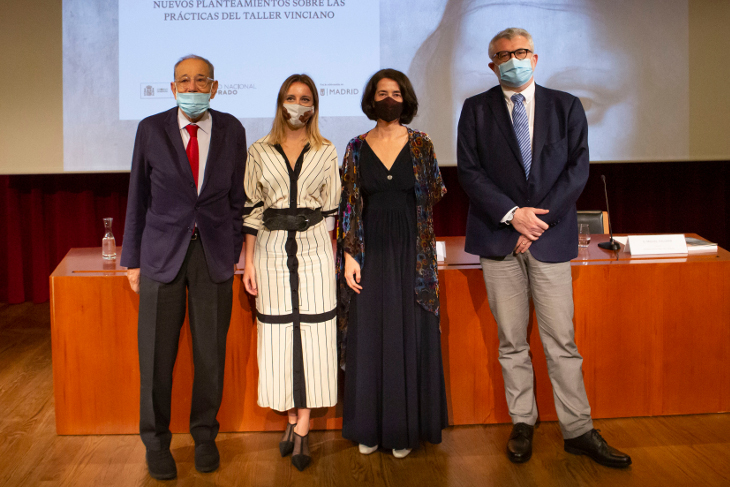
Leonardo and the copy of the Mona Lisa. New approaches to the artist’s studio practices is the first monographic exhibition in Spain to study the copies and versions made in Leonardo’s studio during his lifetime, works that were based on the master’s prototypes and authorised by him. On display at the Museo Nacional del Prado until 23 January in Room D of the Jerónimos Building, this event is benefiting from the collaboration of the City Council of Madrid.
The exhibition includes a significant group of works, most executed in Leonardo’s studio. Together with the graphic material and infrared reflectograms also on display, they help to illustrate the master’s ideas, how his pupils assimilated them and the practices employed by the latter in order to produce paintings.
Since the technical study and restoration of the painting (catalogued with inventory number 504 in the Museo Nacional del Prado) showed that it is the earliest known copy of the Mona Lisa and one of the most revealing testaments to Leonardo’s studio practices, further research has made it possible to attribute the copy of Saint Anne in the Hammer Museum, Los Angeles, and the Ganay version of the Salvator Mundi to the same painter.
Curated by Ana González Mozo, Senior Technician of Museums in the Museum’s Conservation Department, Leonardo and the copy of the Mona Lisa. New approaches to the artist’s studio practices is the result of an ambitious research project which the Prado undertook in parallel and in collaboration with other international institutions, such as the Musée du Louvre, the Molecular Archaeology Laboratory at the Sorbonne and the National Gallery, London.
The presence in the exhibition (which benefits from the collaboration of the City Council of Madrid) of a carefully selected group of works painted by pupils and followers of Leonardo offers a unique opportunity to publicly present the results of the most recent research on the artist’s closest circle and to analyse teaching methods and the production of paintings in the context of Italian studios in the late 15th and early 16th centuries.
Since the presentation of the research on the copy of the Mona Lisa in the Museo Nacional del Prado, the painting has been included in most catalogues and research projects on Leonardo and his collaborators. Stimulated by the studies that accompanied the exhibition La Sainte Anne, l’ultime chef-d’oeuvre de Léonard de Vinci (Musée du Louvre, 2012) and those presented at some of the events organised to mark Leonardo year in 2019, the most recent analyses of the drawings, treatises and pictorial technique of the master and his closest circle have helped to increase understanding of both Leonardo’s pictorial thinking and the works produced in the context of his studio.
Structured around the Prado copy of the Mona Lisa and the information derived from the technical images made possible by new analytical equipment, the Prado is now focusing on the unique and unconventional figure of Leonardo as a teacher and on other characteristically Renaissance themes: the importance of the idea; the concept of the original; and the function and types of copies derived from prototypes created by the great masters. The works on display, which are based on paintings and drawings by Leonardo, also facilitate an understanding of how his theoretical knowledge was assimilated by his pupils while helping to explain many of the ideas and observations expressed in his writings.
The exhibition is based on the new orientation and significance that Leonardo studies have acquired following the exhibitions devoted to the artist at the Louvre in 2012 and 2019; the scientific analyses undertaken at the Prado and the Hammer Museum on their copies and the infrared reflectogram of the Ganay version of the Salvator Mundi; on the increased understanding - deriving from the results of recent studies - of the nature of the copies and works executed in the bottega vinciana during the master’s lifetime and authorised by him, given that not all of them reflect the same intentions or were made with the same aim; and on the scientific study of the painting in the Museo Nacional del Prado carried out with the help of recently updated technology.