
Loading...
Anna Escher von Muralt. Angelica Kauffmann
Accessible visit
/ Easy-to-read content of Museo del Prado
/ Anna Escher von Muralt. Angelica Kauffmann
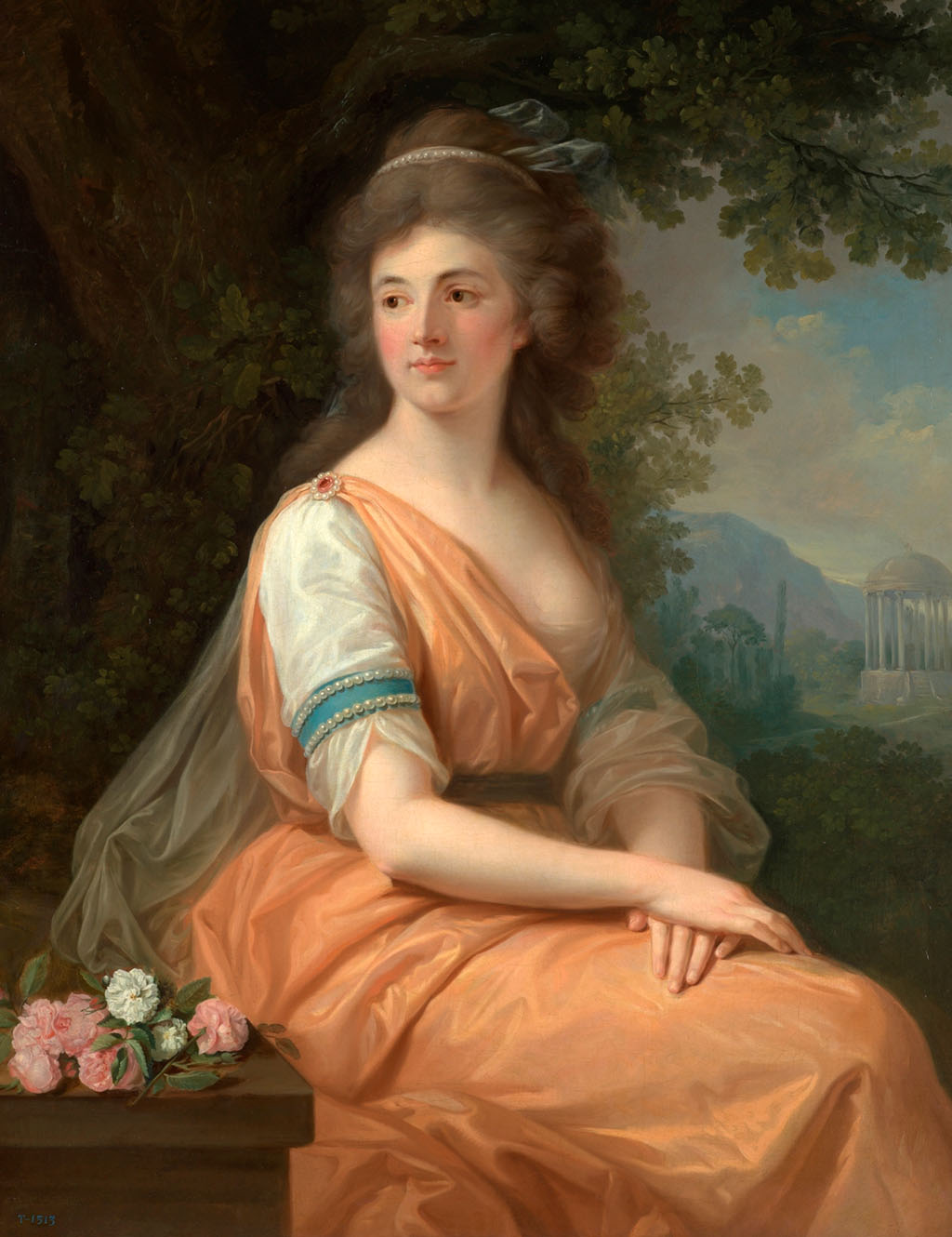
Anna Escher von Muralt is a painting by Angelica Kauffmann, a Swiss painter.
The painting is from 1800.

What is relevant of this portrait?
This painting shows a full-length seated woman.
It is a portrait of Anna Escher von Muralt.
She was part of an important family in Switzerland.
Anna Escher von Muralt wears a dress in the classical style that reminds us of Ancient Greece and Rome.
This type of clothing was popular in the 18 century when Angelica Kauffmann painted this portrait.
She also wears a pearl headband on her hair that matches the blue pearl bracelet on her right arm.
Her arms are crossed over her legs, and her head is turned to her right.
Beside her is a bouquet of pink and white flowers.
In the background is a landscape with a forest and a temple that reminds us of classical times.
How do we know who is person depicted?
For a long time, no one knew who the woman in the painting was.
But an heiress of the Escher family kept a miniature painting that was a copy of this painting.
This miniature was used to identify the woman in the painting.
The painter
The author of the painting is the painter Angelica Kauffmann.
Angelica Kauffmann was born in Switzerland.
Her father was a painter, and she studied painting since childhood.
She travelled around Switzerland, Austria and Italy because she helped her father paint murals in churches.
At the age of 15, Angelica Kauffmann was already painting portraits, which she sold to her clients.
Later, Angelica Kauffmann moved to Italy and London, where she continued to paint and learn the techniques of other artists.
At that time, women painters usually painted portraits and still life.
But Angelica Kauffmann specialised in painting portraits and history scenes.
A still life is a painting that depicts objects and food.
English clients preferred portraits to historical paintings.
Angelica Kauffmann decided to combine her two specialities and started to paint portraits of her clients dressed up as historical figures or gods from classical myths.




Funded with the National Recovery and Resilience Plan (NRPP) , Spain’s Next Generation EU financing and according to the initiatives within the component C.24.I3 Digitization and valorization of major cultural services. The project is part of Campus Prado within Accessibility and Signage: Revitalization of the Urban Environment action line and as a universal accessibility activity.