formularioRDF
The itinerary <em>TITULORECORRIDO</em> has been successfully created. Now you can add in works from the Collection browser
<em>TITULOOBRA</em> added to <em>TITULORECORRIDO</em> itinerary

The Annunciation. El Greco

The Annunciation is a painting by El Greco, a Greek painter who lived in Spain.

The painting is from 1600.

ETR (Easy to Read) icon
© Easy-to-read european logo: Inclusion Europe. More information at: Easy-to-read

What is the subject?

This painting shows the moment when the archangel Gabriel announces to the Virgin Mary that she will be the mother of Jesus Christ.

For this reason, we call this moment The Annunciation.

Saint Gabriel, the archangel, stands on a cloud, his body is in rotation, and his arms are on his chest.

The Virgin Mary looks at the archangel with a calm facial expression, and her arms are open.

The Virgin Mary was reading on her knees.

It seems that she suddenly stopped reading.

She turns around because the archangel appears.

There is the Holy Spirit above the Virgin and the archangel.

The Holy Spirit appears as a white dove that descends towards the Virgin.

There is an orchestra of 8 angels on clouds above the Holy Spirit.

The angel in the centre conducts the orchestra, and the rest of the angels play different instruments.

The angels are all concentrated as if they played in a concert.

Musical angels were typical in the paintings of the Annunciation in the time of El Greco.
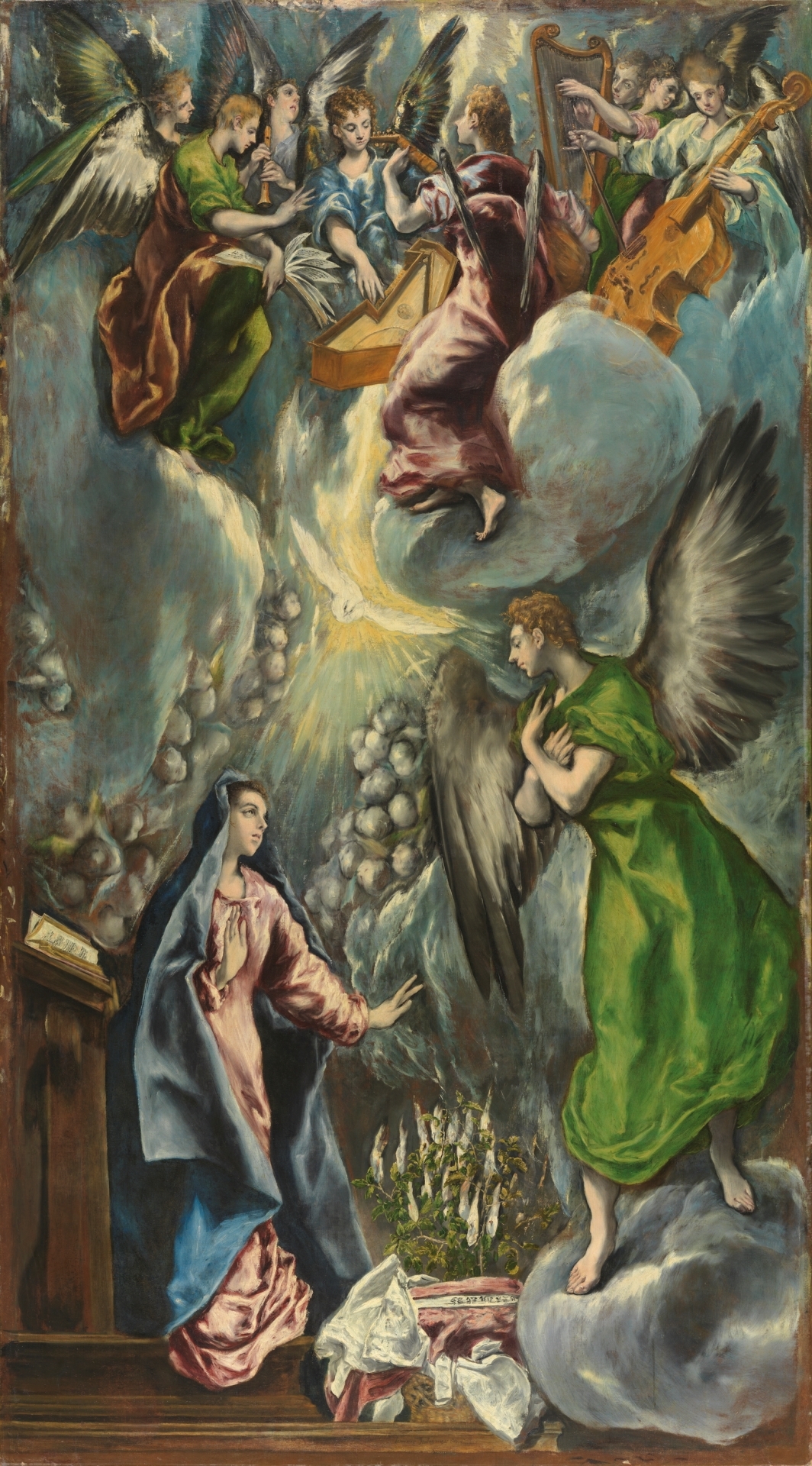
The Annunciation by El Greco.

What are the relevant features?

This painting shows several characteristics typical of the style of El Greco.

For example, this painting shows that light, colours and the elongated shape of the bodies were important to El Greco.

El Greco found inspiration for this painting in a painting of the Annunciation by the Italian painter Titian.

El Greco created this painting for the main altarpiece of the Colegio de la Encarnación in Madrid.

The altarpiece is a wooden structure behind the altar, which shows religious episodes.

The Incarnation and the Annunciation are 2 names that describe the same scene.

In the Annunciation, the Virgin receives the news that she will be the mother of the Son of God.

The Incarnation means that God becomes flesh in the form of Jesus Christ, who will be born of the Virgin.

In this altarpiece, in addition to the Annunciation, there were other episodes from the life of Jesus Christ, such as the Crucifixion and the Resurrection.

During his lifetime, El Greco created around 10 paintings on the theme of The Annunciation.

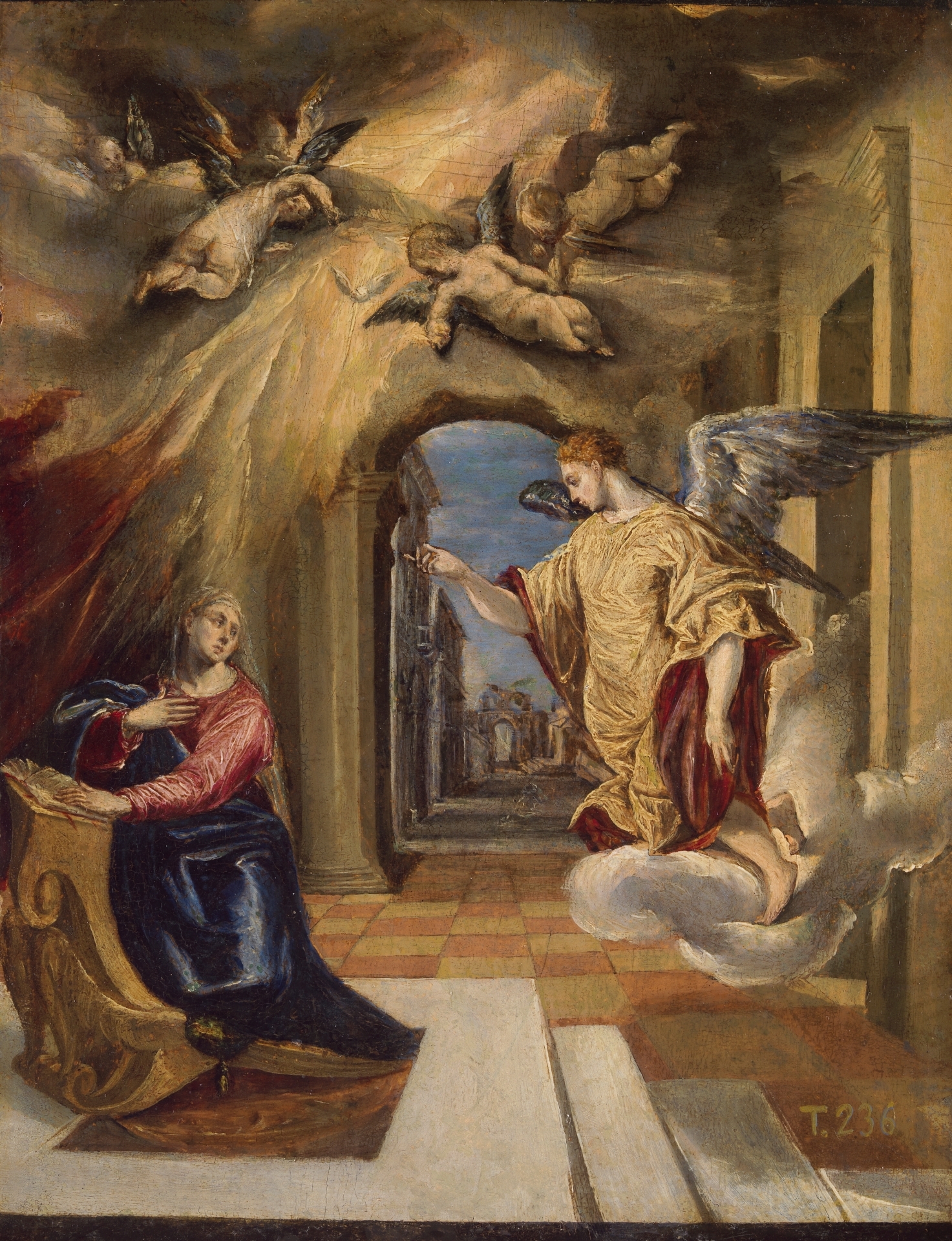
Another version of The Annunciation by El Greco.

This work belongs to the following tours:

Easy-to-read content of Museo del Prado
Funded by the European Union - NextGenerationEU Government of Spain - Ministry of Culture Recovery, Transformation and Resiliency Plan Museo Nacional del Prado

Funded with the National Recovery and Resilience Plan (NRPP) , Spain’s Next Generation EU financing and according to the initiatives within the component C.24.I3 Digitization and valorization of major cultural services. The project is part of Campus Prado within Accessibility and Signage: Revitalization of the Urban Environment action line and as a universal accessibility activity.

Up