formularioRDF
The itinerary <em>TITULORECORRIDO</em> has been successfully created. Now you can add in works from the Collection browser
<em>TITULOOBRA</em> added to <em>TITULORECORRIDO</em> itinerary

The Duke and Duchess of Osuna and their Children. Goya

The Duke and Duchess of Osuna and their Children is a painting by Goya, a Spanish painter.

The painting is from 1788.

ETR (Easy to Read) icon
© Easy-to-read european logo: Inclusion Europe. More information at: Easy-to-read

Who are the people depicted in the painting?

This painting is a portrait of the family of the Duke and Duchess of Osuna.

The Dukes of Osuna were one of the most important noble families in Spain at the time.

A nobleman is a person who has a title granted by the king or inherited from his family.

The Duke of Osuna is Pedro Téllez-Girón.

He dresses in a black military uniform and mourning for the death of his father.

The seated Duchess of Osuna is Josefa Alonso Pimentel.

In this family portrait, the Duke and Duchess have 4 children.

Josefa Manuela is the eldest daughter, and her father holds her hand.

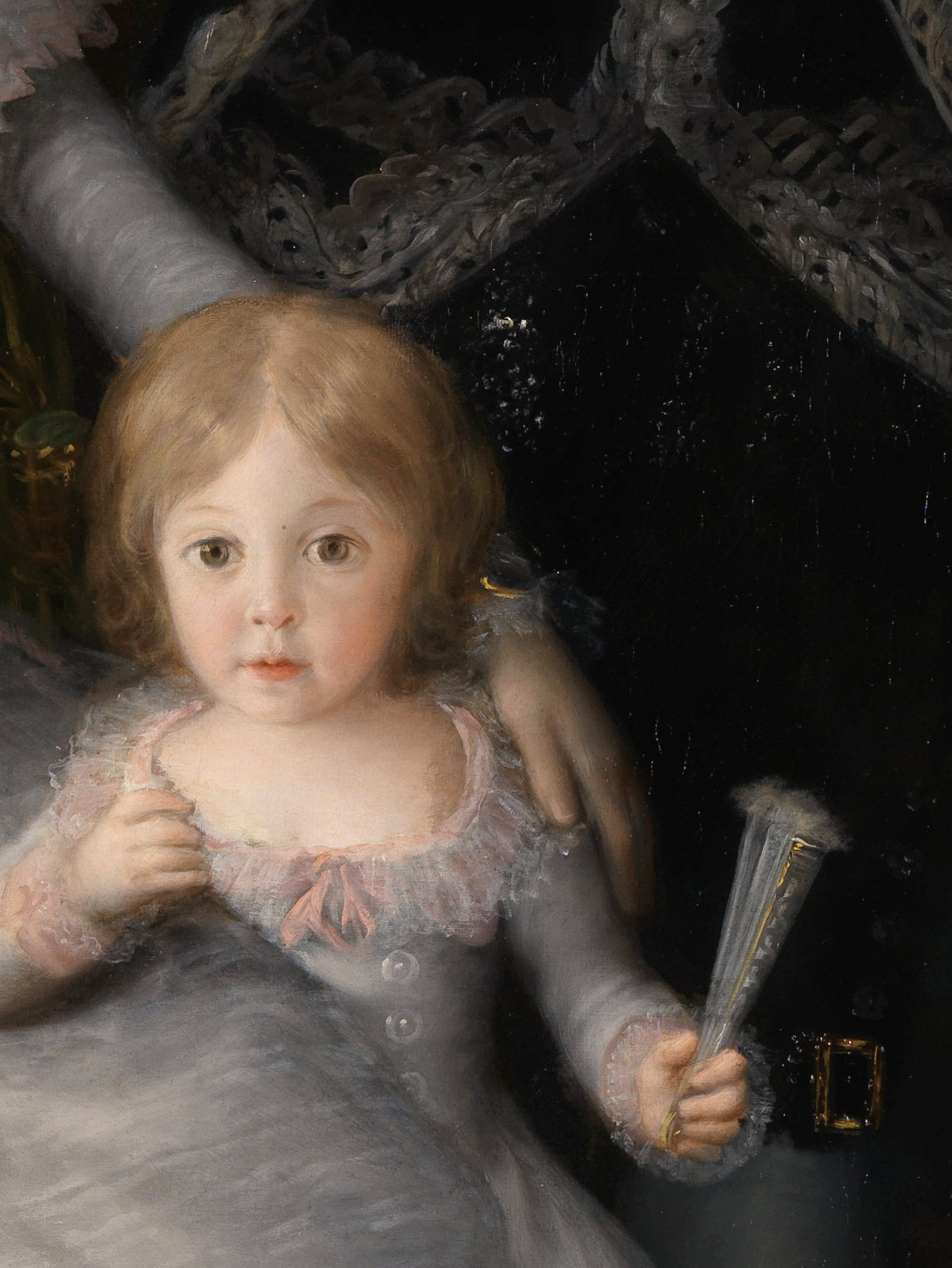
Joaquina leans on the lap of her mother.

Francisco de Borja stands, playing with the swagger stick of his father like a horse.

He will inherit the title of Duke.

Pedro de Alcántara is the youngest of the 4 children.

He sits on a cushion at the feet of his mother and holds the rope of a toy carriage in his hand.

Pedro later became the director of the Prado Museum.

The family has 2 small dogs with them.
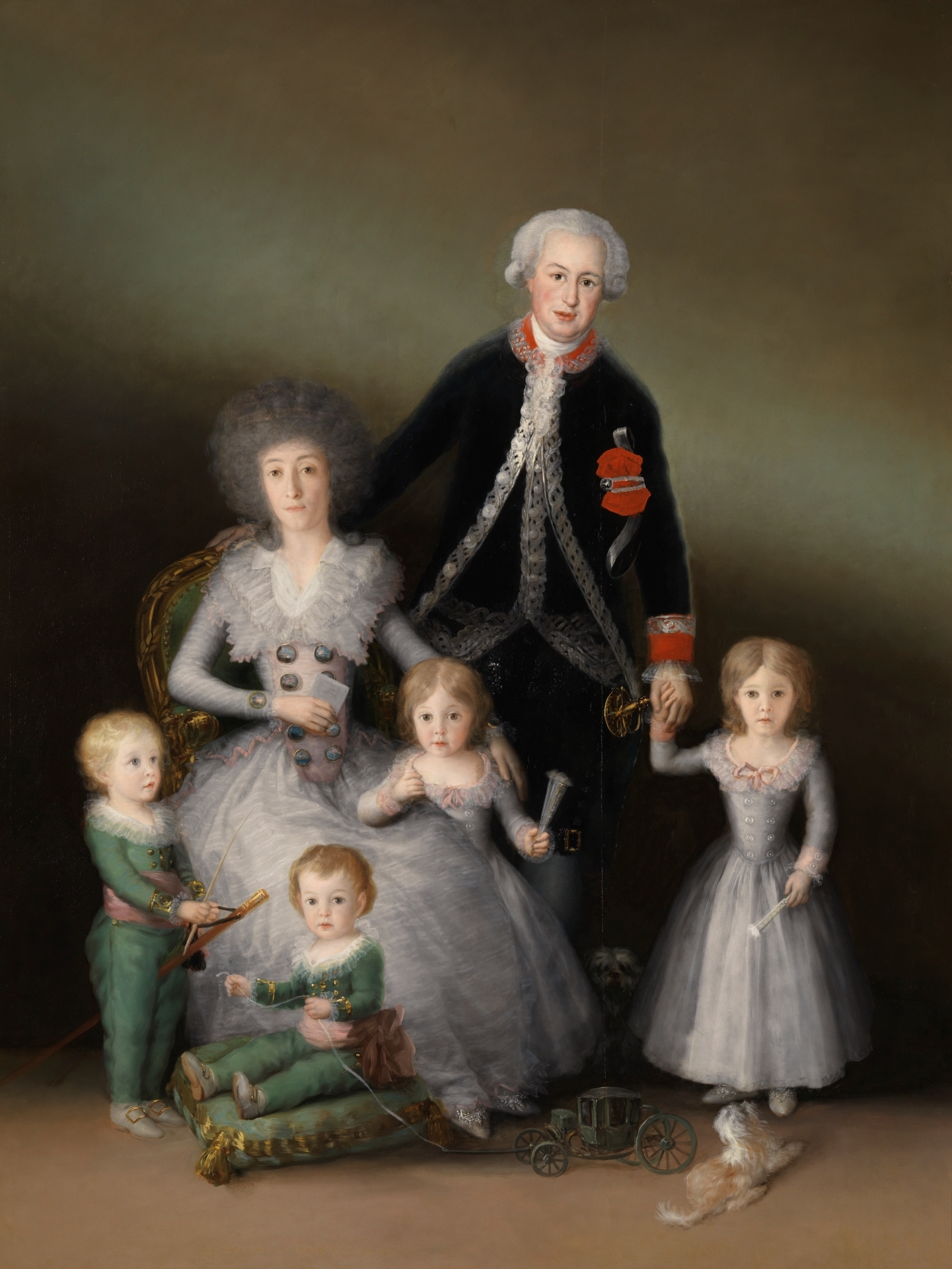
The Duke and Duchess of Osuna and their Children by Goya.

Relevant features of the painting

Goya captures the personalities of the figures in the portraits.

In this painting, Goya depicted children with expressions of astonishment and curiosity, the duke with a kind gesture, and the duchess with a refined beauty.

In addition, Goya shows attention to detail in how he paints the fabrics of uniforms and dresses, including lace and other intricate details.

Goya painted this family portrait when Pedro Téllez-Girón inherited the title of Duke of Osuna.

At the time, this type of family portrait was not common in Spain.

It was more typical in countries like the Netherlands or England.

Goya possibly used examples from these countries as inspiration for this portrait.

Goya had a close relationship with the Duke and Duchess of Osuna.

They were not only one of his main clients but also his friends.

This bond is evident in how Goya painted the entire family in the portrait with great affection.

In addition to this painting, Goya created several other paintings for the family mansion at La Alameda, on the outskirts of Madrid.

Detail of The Duke and Duchess of Osuna and their Children by Goya.
Funded by the European Union - NextGenerationEU Government of Spain - Ministry of Culture Recovery, Transformation and Resiliency Plan Museo Nacional del Prado

Funded with the National Recovery and Resilience Plan (NRPP) , Spain’s Next Generation EU financing and according to the initiatives within the component C.24.I3 Digitization and valorization of major cultural services. The project is part of Campus Prado within Accessibility and Signage: Revitalization of the Urban Environment action line and as a universal accessibility activity.

Up