Saint Hermenegildo was a prince, the son of the Visigothic king Leovigildo.
His family followed the Arianism religion, but Saint Hermenegildo converted to Catholicism.
Arianism is a belief that Jesus Christ was not divine, while Catholics believe in the divinity of Jesus Christ.
The father of Saint Hermenegildo disagreed with the decision to change religion.
As punishment, he imprisoned Hermenegildo and beheaded him.
Before dying, Saint Hermenegildo refused to receive communion from an Arian bishop.
The Catholic Church recognised him as a martyr.
A martyr is a person who suffers and dies for defending their religion or beliefs.
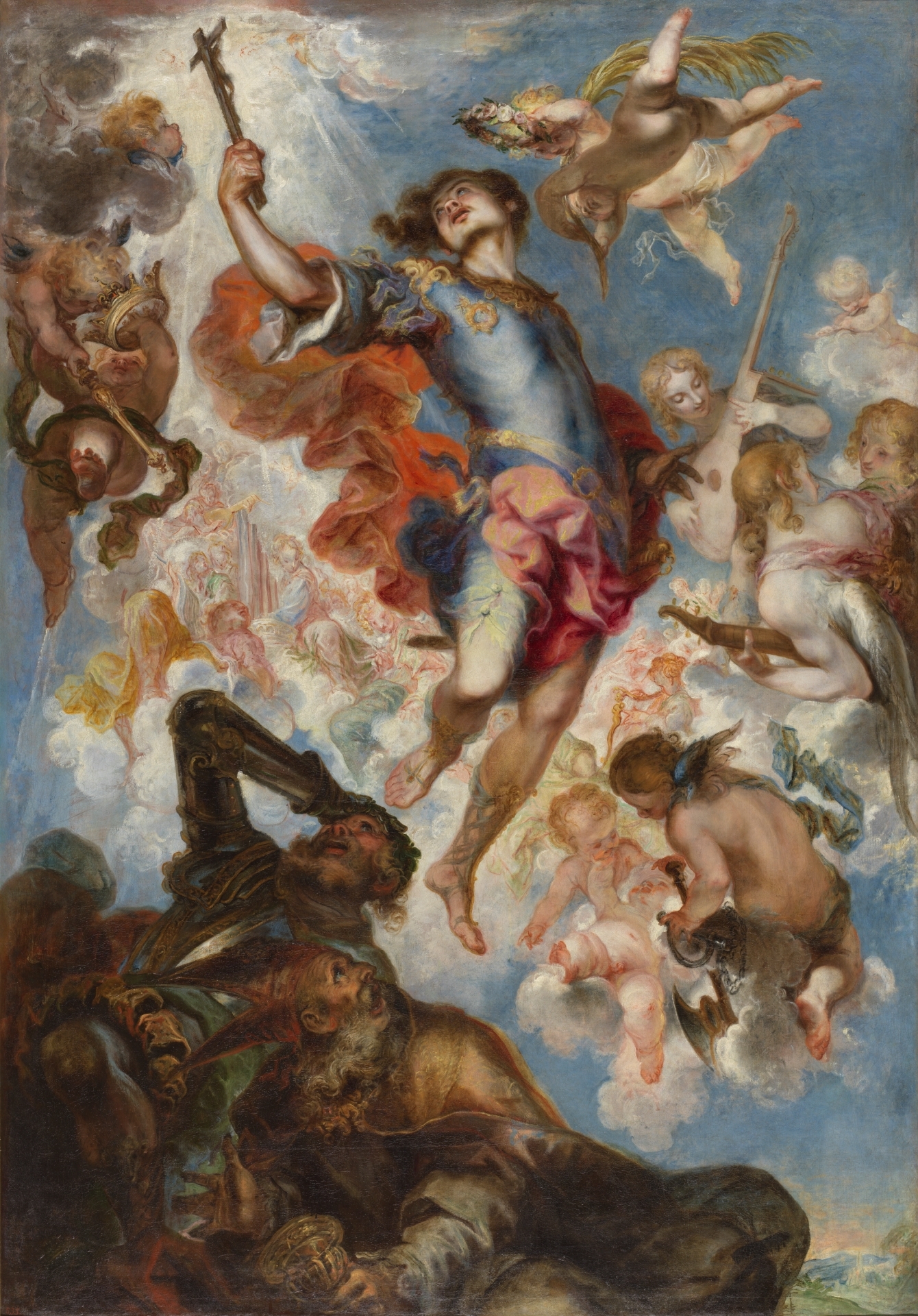
In the painting, some angels surround Saint Hermenegildo.
The angels carry objects that represent his life.
For example, one angel holds the axe that was used to behead him.
There are 2 men at the bottom of this painting.
The man wearing armour is his father.
Beside the father is the Arian bishop.
The painting uses a lighting technique that highlights Saint Hermenegildo while darkening King Leovigild and the bishop.
This use of contrast and the positioning of the figures were intended to make the painting visually striking when displayed on an altar in a church.