Loading...
Boletín del Museo del Prado
Latest boletín
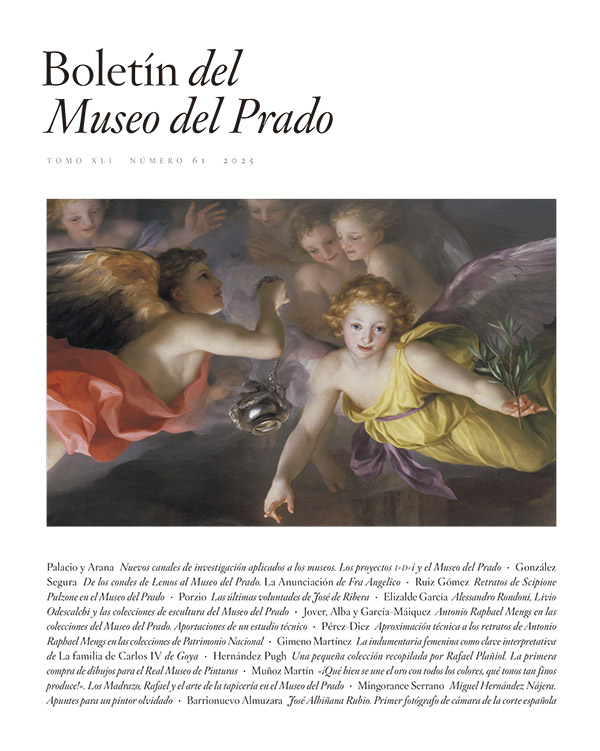
NUMBER 61 | 2025
ISSN: 0210-8143
eISSN: 2952-0630
The Museo del Prado publishes a new issue of the Boletín del Museo del Prado. This is an important publication that serves to present to the academic community and the general public the outcome of new research on works in its collections and on related topics in the field of Art History, as well as on the history of the Museum.
This number of the Boletin 2024 contains the following articles:
Pag. 6-11:
NEW RESEARCH CHANNELS APPLIED TO MUSEUMS. THE MUSEO DEL PRADO’S R&D PROJECTS
Alfonso Palacio and Itziar Arana Cobos
Pag. 12-25:
FROM THE COUNTS OF LEMOS TO THE MUSEO DEL PRADO. THE ANNUNCIATION BY FRA ANGELICO
Jorge González Segura (Universidad Autónoma de Madrid)
https://orcid.org/0000-0003-3902-4467
Summary: The Annunciation by Fra Angelico is one of the most recognisable paintings in the Museo del Prado. The present study addresses the art-historical, documentary and historiographical problems associated with this work. At the same time, it offers a hypothesis as to how the painting passed from the collections of the Lemos family to the Descalzas Reales in Madrid during the first third of the seventeenth century and subsequently to the Museo del Prado.
Keywords: patronaje, historiography, Fra Angelico, Annunciation, counts of Lemos, Catalina de Zúñiga y Sandoval, María de Castro y Gattinara, Descalzas Reales
Pag. 26-36:
PORTRAITS BY SCIPIONE PULZONE IN THE MUSEO DEL PRADO
Leticia Ruiz Gómez (Museo Nacional del Prado)
https://orcid.org/0000-0003-1437-601x
Summary: This article reviews the provenance and attribution history of three portraits in the Museo del Prado that were in the collection housed at the estate of the 1st Duke of El Arco, who assembled a notable group of portraits. Portrait of a Lady and Knight of Santiago are presented here as a possible portrait of a couple, executed in a style that corresponds to that of Scipione Pulzone (il Gaetano): a balanced combination of distinction, compositional simplicity and sumptuous attire which, although characteristic of other painters of the period, became a true hallmark of Pulzone’s work. The same attribution is reinstated for Portrait of a Gentleman (P-295), a carefully executed head that lost its connection with Pulzone in 1919, following the hypothetical identification of the sitter as Diego Hurtado de Mendoza.
Keywords: portraits, Scipione Pulzone, Juan Pantoja de la Cruz, Quinta del Duque del Arco
Pag. 37-49:
JUSEPE DE RIBERA’S WILL
Giuseppe Porzio (Universidad de Nápoles L’Orientale)
https://orcid.org/0000-0001-8321-7501
Summary: Jusepe de Ribera’s unpublished will, drawn up shortly before his death in Naples in 1652, provides valuable insights into his personal, social and financial life. The will, which is accompanied by a later codicil that modifies some of the original provisions, sheds new light on Ribera’s financial situation at the end of his life and highlights his connections with significant Neapolitan churches: Santo Spirito di Palazzo, with which he was associated, like his father-in-law Giovanni Bernardino Azzolino, and Santa Maria del Parto in Mergellina, where he was buried and to which he bequeathed a significant part of his estate. In relation to art, there are notable provisions regarding the sale of an anonymous bronze bust of Philip II, left some time earlier in the painter’s studio by one of his clients, the little-known Milanese Giovanni Battista Novellone, and the payment for The Communion of the Apostles, Ribera’s last great work, painted for the Charterhouse of San Martino in Naples.
Keywords: Jusepe de Ribera, seventeenth-century Spanish Naples, archival research, social history of art
Pag. 50-62:
ALESSANDRO RONDONI (CA. 1644-CA. 1710), LIVIO ODESCALCHI AND THE MUSEO DEL PRADO’S SCULPTURE COLLECTIONS
Alejandro Elizalde García (Universidad La Sapienza de Roma)
https://orcid.org/0009-0009-4729-4302
Summary: Active in Rome in the late seventeenth century, the sculptor Alessandro Rondoni (ca. 1644–after 1710) worked for some of the most influential nobles of the day, such as Livio Odescalchi and the Marquis of El Carpio. Following the acquisition of their collections by Philip V and Isabella Farnese, numerous works by Rondoni arrived in Spain, initially sent to the Palace of La Granja de San Ildefonso and later transferred to the Museo del Prado. Over time, Rondoni’s name as their creator was lost and his works were erroneously attributed to other artists. The present study aims to shed light on his activities, while also highlighting Rondoni’s significance within the collections of the Museo del Prado.
Keywords: Rondoni, Odescalchi, Marquis of El Carpio, Philip V, Augustus, collecting
Pag. 63-90:
ANTON RAPHAEL MENGS IN THE COLLECTIONS OF THE MUSEO DEL PRADO. RESULTS OF A TECHNICAL STUDY
Maite Jover: https://orcid.org/0000-0003-1150-2682
Laura Alba: https://orcid.org/0000-0003-3910-343X
Jaime García-Máiquez: https://orcid.org/0009-0000-2375-2801
Museo Nacional del Prado
Summary: This article presents the results of the technical study of thirty paintings and drawings attributed to Anton Raphael Mengs or closely related to him, housed at the Museo del Prado. Through a range of imaging techniques and material analysis, the supports and the preparatory and paint layers employed by Mengs in the different locations where he was professionally active (Rome, Naples, Madrid, Florence and other Italian cities) have been characterised. The study has revealed some of the artistic procedures followed by the artist and the court studio of Charles III, providing new and unpublished information that connects the painter’s theoretical and academic vision with his pictorial practice, thus making it possible to verify to what extent Mengs followed his own precepts.
Keywords: Mengs, Museo Nacional del Prado, portraits, technical studies, artistic procedures, painting materials
Pag. 91-111:
TECHNICAL STUDY OF THE PORTRAITS BY ANTON RAPHAEL MENGS IN THE COLLECTIONS OF PATRIMONIO NACIONAL
Silvia Pérez-Diez (Patrimonio Nacional)
https://orcid.org/0000-0001-7986-7843
Summary: Patrimonio Nacional houses several portraits executed by Anton Raphael Mengs (1728-1779) as commissions from Charles III and received by the king during his lifetime, in addition to three portraits of the royal family and one of an unknown sitter acquired by his son Charles IV in Rome, and one of an unidentified woman from the collection of Charles III’s brother, the Infante Don Luis. Based on technical analyses, this article presents a survey of the painter’s output, principally that produced in Madrid and during his periods in Tuscany and Naples, with the aim of understanding his working method employed in the portraits in the Royal Collections.
Keywords: portraits, Mengs, technical analyses, Royal Collections
Pag. 112-125:
FEMALE DRESS AS THE INTERPRETATIVE KEY TO THE FAMILY OF CHARLES IV BY FRANCISCO DE GOYA
Javier Gimeno Martínez (Vrije Universiteit Amsterdam)
https://orcid.org/0009-0009-1275-0750
Summary: The Family of Charles IV has been interpreted as a group portrait with a metaphorical content, although clear conclusions about its meaning have not been reached. The identification of the female attire as a dress “à la demi-Psyché”, referencing the character Psyche, suggests that the painting’s subject could be a defense of conjugal love and of queens as both mothers and rulers. The painting would thus allude to Enlightenment reflections on the reconciliation of the public and private roles of women in general and queens in particular.
Keywords: Psyche, Francisco de Goya, Apuleius, Juan de Mal Lara, Journal des Dames et des Modes, fashion prints
Pag. 126-139:
A SMALL COLLECTION ASSEMBLED BY RAFAEL PLAÑIOL. THE FIRST ACQUISITION OF DRAWINGS FOR THE REAL MUSEO DE PINTURAS Y ESCULTURAS (1833)
Ana Hernández Pugh (Independent Researcher)
https://orcid.org/0009-0004-5285-9463
Summary: In 1833 Ferdinand VII approved the purchase of eight drawings for the Real Museo de Pinturas y Esculturas. Newly discovered documentation reveals that the collection belonged to Rafael Plañiol, an intaglio engraver and director of the Royal Mint in Seville. A comparison of various records and inventories has made it possible to identify the eight works, and in doing so to assess and draw attention to the first acquisition of drawings specifically intended to enrich the drawings collection of the Museo del Prado.
Keywords: drawings, inventories, Rafael Plañiol, Real Museo de Pinturas y Esculturas, Museo Nacional del Prado
Pag. 140-156:
“HOW WELL THE GOLD COMBINES WITH ALL THE COLOURS, WHAT DELICATE TONES IT PRODUCES!”. THE MADRAZOS, RAPHAEL AND THE ART OF TAPESTRY IN THE MUSEO DEL PRADO
Roberto Muñoz Martín (Patrimonio Nacional)
https://orcid.org/0000-0003-4684-0809
Summary: This text explores the historical evolution of tapestry in Spain with a particular focus on its presence in the collections of the Museo del Prado. It singles out the role of José and Federico de Madrazo, who promoted the acquisition of celebrated tapestries for the Museum’s collection, such as those from the Acts of the Apostles series, works appreciated both for their artistic merits and their educational potential. Although their efforts were not fully consolidated in the nineteenth century, the idea persisted, resulting in further additions to the collection in the twentieth century, including those from the Durán Bequest. Despite having had limited visibility, the Museum’s tapestries can be seen as works of great potential for enriching the Prado’s artistic and pedagogical discourse due to their quality and uniqueness.
Keywords: Tapestries, Raphael, José de Madrazo, Federico de Madrazo, Royal Collection
Pag. 157-169:
MIGUEL HERNÁNDEZ NÁJERA (1864-1936). NOTES ON A FORGOTTEN PAINTER
Lorena Mingorance Serrano (Universidad Nacional de Educación a Distancia (UNED))
https://orcid.org/0000-0003-0477-6167
Summary: Realism emerged in Spain in the second half of the nineteenth century, becoming one of the maximum expressions of Spanish art. With the arrival of the early twentieth-century avant-garde movements, realist painting fell into oblivion, as did many of the artists who had gained important reputations and whose works had received prizes at the most influential competitions and had been acquired by the State. A good example is the Madrid painter Miguel Hernández Nájera (1864-1936), closely linked to two of the most outstanding Spanish artists of the day: Emilio Sala and Joaquín Sorolla. This article aims to reconstruct the principal biographical and artistic facts relating to Hernández Nájera, four of whose paintings are in the Museo del Prado.
Keywords: realism, Miguel Hernández Nájera, Joaquín Sorolla, Emilio Sala, genre painting, exhibitions, nineteenth century, art criticism
Pag. 170-184:
JOSÉ ALBIÑANA RUBIO (1820-1879). THE FIRST COURT PHOTOGRAPHER IN SPAIN
Isabel Barrionuevo Almuzara (Independent Researcher)
https://orcid.org/0009-0002-8399-3572
Summary: In February 1850 José Albiñana Rubio (1820–1879) was made daguerreotype portrait photographer to the Spanish court, the first appointment to the royal household in this role. In the 1850s he produced the earliest known photographic portraits of Queen Isabel II, as well as the first image (a daguerreotype) of the Museo del Prado. For over two decades José and his brother Salvador were active in their photographic establishment in Madrid, where they hand coloured portraits by renowned miniaturists such as Francisco Reigón, Gabriel Domínguez and Juan Bautista Ugalde. The promoter of various technical advances in collaboration with Eusebio Juliá, Albiñana also worked for the Junta General de Estadística [General Statistical Council], now the Instituto Geográfico Nacional [National Geographical Institute], from 1863 to 1869, the year when he abandoned photography.
Keywords: José Albiñana, Spanish Royal Household, daguerreotype, photography, miniature painting