Air
1675 - 1700. Oil on canvas.On display elsewhere
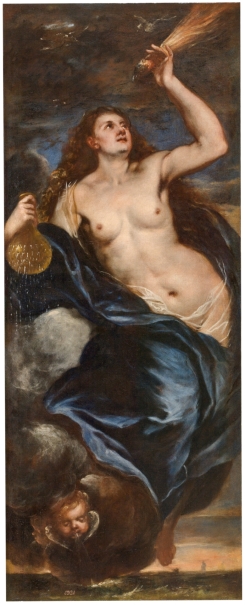
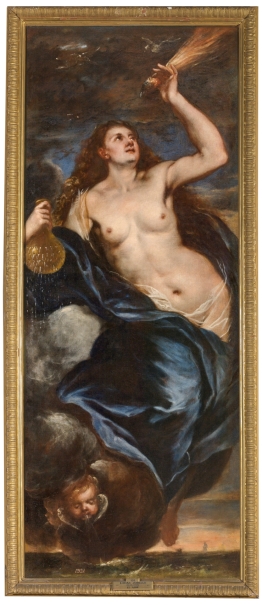
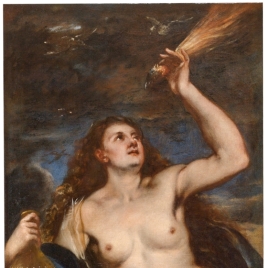
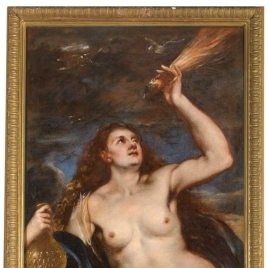
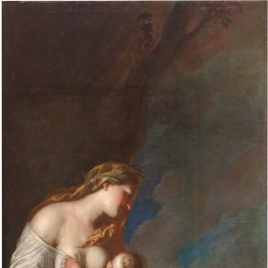
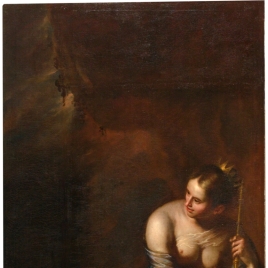
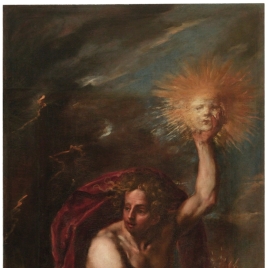
This canvas by a late 17th-century painter is part of a group of four works, all at the Museo del Prado (P191, P3196, P3197 and P3198), that express the idea of the Elements through motives drawn from classical mythology. The female figure that represents Air is accompanied by the Winds. In her right hand, she carries a bag that sprinkles water, representing rain, while the ray of light represents storms and lightning. Her exact identity is unclear, however. Madrazo thought she might represent Dawn, but she is not accompanied by the proper attributes. Another possibility is Juno, who embodied Air on other occasions, but her traditional iconography is not present, either. J. R. Marcaida thought she represent the birds-of-paradise.
This work’s overall color scheme, human models and facial features are very similar to those of Antolínez. It is smaller than the other three, which were expanded with additional canvas on the sides some time before 1794, when numbers from that year’s inventory of the Buen Retiro palace were inscribed on the added canvas.
This important series has never received critical attention, yet it is especially interesting as an example of the artistic situation in circles close to the Madrid court during the final years of the 17th century. They reflect much of Carreño’s approach through Claudio Coello and Ruiz de la Iglesia, with clear but already distant echoes of Venetian and Flemish painting, and even knowledge of Luca Giordano, whose works are known to have been at the Madrid court since at least the late sixteen-fifties. These four works cannot be confidently attributed to any known artist and there are even some differences among them. The present one is attributed to Giordano, while the other three are always listed as anonymous, without mention of their school or possible circle.
Pérez Sánchez, Alfonso E., Carreño, Rizi, Herrera y la pintura madrileña de su tiempo, Madrid, Ministerio de Cultura. Banco Herrero, 1986, p.348-350