Allegory of Justice and Peace
1753 - 1754. Oil on canvas.Room 021
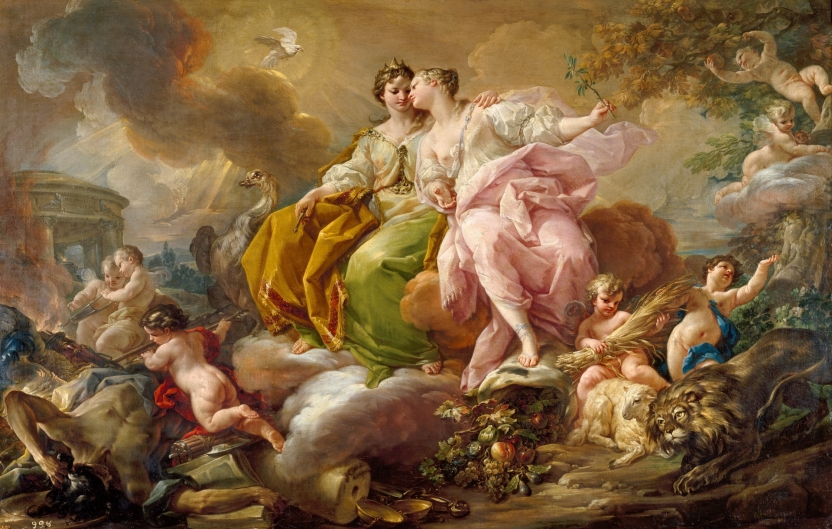
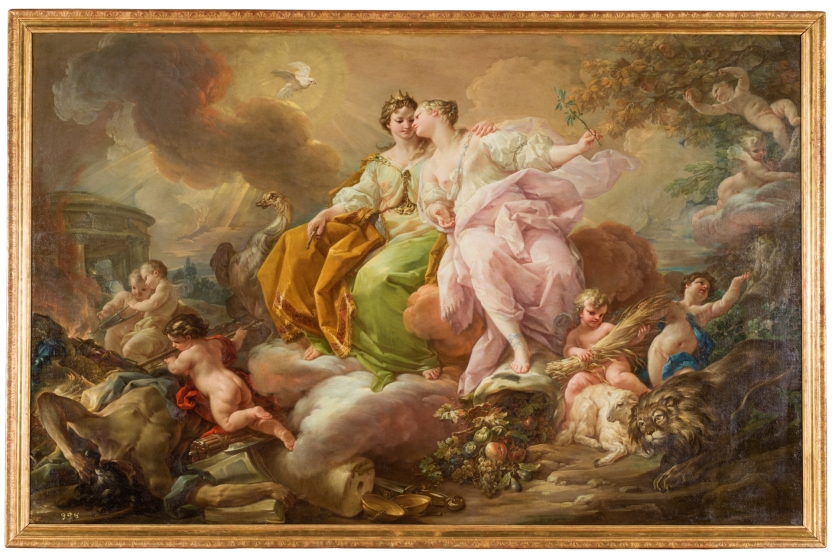
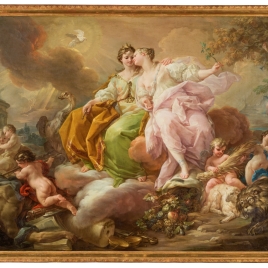
This allegorical work, signed on the column lying on the ground in the centre of the composition, shows two women in Roman garb sitting on clouds. Representing Justice and Peace, they embrace and seem about to kiss each other. This pictorial motif could be used to express political peace or, as is the case here, to allude to the peaceful policies that characterised the reign of Ferdinand VI, for whom this work was painted. It also relates to Psalm 85, which announces eternal peace between God and humankind, or salvation, implying the warning that peace should be consolidated on earth as well: Mercy and truth are met together; righteousness and peace have kissed each other. Truth shall spring out of the earth; and righteousness shall look down from heaven. Yea, the Lord shall give that which is good; and our land shall yield her increase. Righteousness shall go before him; and shall set us in the way of his steps.
Justice manifests her great authority with a crown and sceptre. She is also inspired by Divine Justice, symbolised by the white dove of the Holy Ghost. The customary attributes alluding to Justice’s most essential characteristics are also present, including the ostrich, whose symmetrical feathers signify fairness, and a fasces and a column, which symbolise severity and fortitude, at her feet. Her sword evokes the separation of good from evil, an act also associated with the scales lying on the ground. The prone figure surrounded by pieces of armour represents discord or war, which has been dutifully vanquished by Justice. It is also the target of one of Cupid’s arrows, which is stored in a box and symbolises reconciliation. The god of love is accompanied by two other cherubs who operate a bellows in front of the Temple of Peace, fanning the flames that will be used to burn the armour.
Peace bears an olive branch, transmitting the idea that it is the result of Justice, which leads to the wellbeing symbolised by a horn of plenty at her feet, and by the wheat and fruit on the tree to the right being harvested by cherubs. The lion and the lamb, symbolising meekness and strength, also allude to God’s coming as announced by the Psalm 85. Specifically, these animals refer to the characterisations of Christ as the Lion of Judea and the Lamb of God that appear at the beginning of the Book of the Seven Seals that marks the beginning of the Last Judgement and the establishment of Paradise. With this combination of secular allegory and religious references, Giaquinto sought to ennoble the reign of Ferdinand VI by comparing it to the Kingdom of God.
Corrado Giaquinto was the leading exponent of the Roman Rococo during the first half of the eighteenth century and had a decisive influence on Spanish artists from that time, including Antonio González Velázquez (1723-1794) and Mariano Salvador Maella (1739-1819). In 1740, while based in Rome, Giaquinto began work for the Spanish court, supervising Spanish scholarship students at the Accademia di San Luca. In 1753, three years after he painted the main fresco at the Roman church of Santissima Trinità degli Spagnoli, he was called to Madrid as Ferdinand VI’s first court painter. There, Giaquinto directed and carried out the decoration of the Royal Palace and supervised decorative work on the court’s other palaces. In 1762 he retired to Naples for health reasons and was replaced by Anton Raphael Mengs and Giambattista Tiepolo. When Giaquinto died, Tiepolo took his place as first chamber painter (Maurer, G. en: Italian Masterpieces. From Spain´s Royal Court, Museo del Prado, 2014, p. 240).