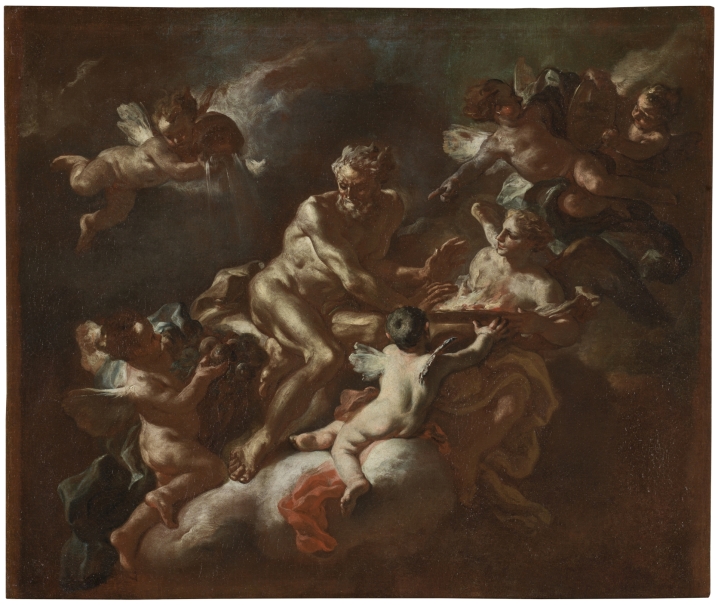
Allegory of Winter
Ca. 1740. Oil on canvas.Room 086
This sketch is a creation by the master Solimena (1657-1747). It is unknown to art history, although it is undoubtedly related to a drawing by his hand in the Società Napoletana di Storia Patria (inv. 11750), whose iconography depicts the Allegory of Winter and describes all the elements in a manner that coincides with the work analysed here.
It is a late work in the artist’s production, from around 1740. According to the author of the latest monograph on the painter, Nicola Spinosa (2018), it would be related to the decoration of the painter’s own bedroom; either in his Neapolitan palace of San Potito or in the recreational villa he owned in Barra. It is Antonio de’ Dominici himself, the father of Neapolitan art history, who recalls those decorations. They were executed on the cupola interior of the artist’s bedroom in one of his two residences and had as its central theme the Allegory of Humanity in its childhood nourished by Divine Providence, a subject flanked on either side by the four allegories of the seasons. As already seen, the present model belongs to that of Winter.
García Cueto, David, 'Francesco Solimena. Alegoria del Invierno'. en: Memoria de actividades 2021 Museo Nacional del Prado, Ministerio de Cultura y Deporte, 2022, p.37-38